#!#3#@# COMISSÃO-DE-ESTUDOS ABNT/CB08/SC010/CE70. System for IBI generation. São José dos Campos: Comissão-de-Estudo ABNT/CB08/SC010/CE70, version: 2021-11-14. 48 p. IBI:
#!#4#@# BANON, G. J. F. Example of robust hypertext and authentic data. #!#S.l.#@# Deposited in the URLib collection, 2023. IBI:
Example of three fully persistent HTML hyperlinks
Work in progress
by Gérald Jean Francis Banon
November 2023
Updated in October 2025
Introduction
The need to preserve digital information in the long term is a primary concern of many initiatives, one of which is the development of the Reference Model for an Open Archival Information System (OAIS) by the Consultative Committee on Spatial Data Systems (CCSDS) and the International Organization for Standardization (ISO) #!#1#@#.
One of the open preservation problem is how to maintain the integrity of hyperlinks in the long-term, which may extend indefinitely.
In a previous note, the existence of a digital service that turns the persistent hyperlinks independent of the URL scheme and the resolver domain name has been shown #!#2#@#.
The purpose of this note is to illustrate the use of that digital service in the case of a Federation of Archives that allows persistent hyperlinks to work with local destination resolvers instead of a global destination resolver. By local destination resolver, it is intended that the Archive which contain the destination resource works as a resolver for all its Archival Information Packages (AIPs) #!#1#@# contain in the Archive.
Inicially, it is suposed that each Archive identifies its AIPs independent of each other. In this way, as commented in #!#1#@#: "when an Archive joins a Federation, there is no assurance that some of its current AIP identifiers are not already used by other members of the Federation. An example of a general solution to this problem is to form the AIP identifiers in the Federation by assigning a Unique ID for each Archive in the Federation and concatenating it to the identifier for each AIP preserved by that Archive".
Here, to assign a unique ID to each Archive we propose a simpler alternative standard to ISO X.500 Directory Services Naming. This standard reuses part of the standard presented in #!#3#@#. Futhermore, to refer to the unique ID of an Archive, we use the general expression "Namespace Prefix" (see definition below), already used in #!#2#@# to identify a naming system.
This HTML page contains three examples of Fully Persistent Hyperlinks (see definition below). The first uses the namespace prefix upn:3Q3U5H8, the second uses upn:GJR3MH and the third upn:35SP775. The UPN URI scheme that we propose to register stands for Uniform Package Name.
In each of these examples, the hyperlink point to a destination resource which is the Data Object (Digital Object) of an AIP hosted by an Archive that is a member of a Federation of Archives. Currently, the Federation is composed, in particular, of the following two members identified here by there namespace prefix: upn:3Q3U5H8 and upn:35SP775.
Each federated member identifies its AIPs and works simultaneously as an Archive containing the destination recourse, and as a local destination resolver. In turn, the Archive hosting the AIP containing this HTML page, the source recourse, works as a source resolver.
Definitions
In the definitions below, the word object is a synonymous with resource or even AIP.
– A Namespace is a set of names.
– A Namespace Prefix is a unique name assigned to an Archive. When an AIP is created in the Archive, this name is preserved in the AIP's Provenance Information and is used to be concatenated to the identifier of the AIP preserved by that Archive to utimately form the URI for the AIP. That URI will never change, even if the AIP migrates to another Archive, hence the importance of preserving the namespace prefix in the AIP's Provenance Information.
– An Identifier (of an object) is a name within a specific namespace that is assigned exclusively and permanently to that object by the Archive at the time of its creation.
– A Hyperlink (from a Source Object - SO to a Destination Object - DO) is a computational command inserted into the SO, whose argument specifies the URL of the DO, and which, when activated, brings the DO on the user's screen.
– A Persistent Hyperlink (from a Source Object - SO to a Destination Object - DO) is a computational command inserted into the SO, whose argument specifies a URL scheme, a resolver domain name and the DO Identifier that is used by the resolver to find the current URL of the DO, and which, when activated, brings the DO on the user's screen.
– A Source Resolver is an extension of an Archive that maps the distinct namespace prefix that appears in all the URIs in fully persistent hyperlinks appearing in the source objects hosted in the Archive to the corresponding destination resolver URL.
– A Local Destination Resolver is an extension of an Archive that maps the identifier of all the objects hosted in the Archive to the corresponding object URL.
– An Almost Fully Persistent Hyperlink (from a Source Object - SO to a Destination Object - DO) is a relative Persistent Hyperlink (from the SO to the DO). In other words, the computational command argument specifies neither the URL scheme nor the resolver domain name, but it does specify the namespace prefix (e.g., urn:doi). In the background, the DO Identifier may need be resolved by a global resolver.
– A Fully Persistent Hyperlink (from a Source Object - SO to a Destination Object - DO) is a relative Persistent Hyperlink (from the SO to the DO) whose DO Identifier is resolved by the DO Archive (i.e. the Archive that contains the DO) itself working as a local destination resolver, at the request of the SO Archive (i.e. the Archive that contains the SO) working as a source resolver.
Examples of three Almost Fully Persistent Hyperlinks are given in #!#2#@#. In the next section, examples of three Fully Persistent Hyperlinks are now given.Examples
The three hyperlinks below are relative Persistent Hyperlinks†. This can be verified by looking at the value of the respective href attribute in the source code of this HTML page.
They are Fully Persistent because the SO Archive works as a source resolver that triggers the local destination resolver which is an extention of the DO Archive.
-
Fully persistent HTML hyperlink using an IBI identifier
Title of the Destination Object (DO): The Internet Based Identifier (IBI) and the IBI Network.
Available from: upn:3Q3U5H8:8JMKD3MGP3W34R/44C25PS
Hyperlink source code: <a href="./upn:3Q3U5H8:8JMKD3MGP3W34R/44C25PS" target="_blank">upn:3Q3U5H8:8JMKD3MGP3W34R/44C25PS</a> -
Fully persistent HTML hyperlink using an IBI identifier
Title of the Destination Object (DO): Conceitos e Ferramentas para Análise de Imagens de Radar de Abertura Sintética (SAR).
Available from: upn:GJR3MH:5PFmX3pFwXQZ55QH/xUCHa
Hyperlink source code: <a href="./upn:GJR3MH:5PFmX3pFwXQZ55QH/xUCHa" target="_blank">upn:GJR3MH:5PFmX3pFwXQZ55QH/xUCHa</a> -
Fully persistent HTML hyperlink using an IBI identifier
Title of the Destination Object (DO): Research and development in a small Spherical Tokamak.
Available from: upn:35SP775:8JMKD3MGP7W/36U89RH
Hyperlink source code: <a href="./upn:35SP775:8JMKD3MGP7W/36U89RH" target="_blank">upn:35SP775:8JMKD3MGP7W/36U89RH</a>
Observation 1: The above examples work because the SO (containing this page) and the DOs of the hyperlinks have been deposited in federated Archives (Digital Repositories - Data Providers), all hosted in an experimental computational platform called URLib and thereby, parts of what is called the IBI network of Archives. Each of these Archives uses Uniform Resource Identifiers (name type URI) to identify their AIPs and operates as both a data provider and a local resolver for all the AIPs in the Federation. Since both DOs are part of the Federation, they can accessed without the held of a global resolver. These examples demonstrate that it would be advantageous for the AIPs of any Archive to be identified by name type URIs, should the Archive ever need to join a Federation.
Observation 2: It is sufficient for an Almost Fully Persistent Hyperlink (from a SO to a DO) to become a fully persistent hyperlink (from a SO to a DO) to ensure that the resolution doesn't depend on a global resolver, that is, it only depends on the resolution ability of the SO data provider itself.
Observation 3: The upn URI scheme still needs to be registered with IANA. The acronym upn stands for Uniform Package Name. Inicially, this scheme was designed to identify any pecified naming system used to identify Archival Information Package hosted on the URLib platform, nevertheless it can be used to identify any type of naming sistem to turn a local namespace into o global one. To create and register a new UPN namespace ID point to ibi-:QABCDSTQQW/4DMTTQE and send an e-mail to urlibservice@gmail.com stating the resolver's domain name for the created UPN namespace ID.
Table 1 - Source resolver operation
| Source resolver | http://$localSite/upn:3Q3U5H8:8JMKD3MGP3W34R/44C25PS |
| Mapping value for upn:3Q3U5H8 | upn:3Q3U5H8 ↦ ${upn:3Q3U5H8ResolverURL} |
| upn:3Q3U5H8 resolver | ${upn:3Q3U5H8ResolverURL}/upn:3Q3U5H8:8JMKD3MGP3W34R/44C25PS |
| Source resolver | http://$localSite/upn:GJR3MH:5PFmX3pFwXQZ55QH/xUCHa |
| Mapping value for upn:GJR3MH | upn:GJR3MH ↦ ${upn:GJR3MHResolverURL} |
| upn:GJR3MH resolver | ${upn:GJR3MHResolverURL}/upn:GJR3MH:5PFmX3pFwXQZ55QH/xUCHa |
| Source resolver | http://$localSite/upn:35SP775:8JMKD3MGP7W/36U89RH |
| Mapping value for upn:35SP775 | upn:35SP775 ↦ ${upn:35SP775ResolverURL} |
| upn:35SP775 resolver | ${upn:35SP775ResolverURL}/upn:35SP775:8JMKD3MGP7W/36U89RH |
A next note introduces yet another definition of hyperlink, the so-called robust hyperlink, which is the last stage of the proposed advanced hyperlink types and contributes to solving the problem of the continued existence of Web resources #!#4#@#.
References
#!#1#@# THE CONSULTATIVE COMMITTEE FOR SPACE DATA SYSTEMS (CCSDS). Reference Model for an Open Archival Information System (OAIS) - CCSDS 650.0-M-3. Reston: CCSDS, 2024. 150 p. (CCSDS 650.0-M-3). Available from: https://ccsds.org/wp-content/uploads/gravity_forms/5-448e85c647331d9cbaf66c096458bdd5/2025/01//650x0m3.pdf.#!#2#@# BANON, G. J. F. Example of three almost fully persistent HTML hyperlinks. #!#S.l.#@# Deposited in the URLib collection, 2023. IBI:
#!#3#@# COMISSÃO-DE-ESTUDOS ABNT/CB08/SC010/CE70. System for IBI generation. São José dos Campos: Comissão-de-Estudo ABNT/CB08/SC010/CE70, version: 2021-11-14. 48 p. IBI:
#!#4#@# BANON, G. J. F. Example of robust hypertext and authentic data. #!#S.l.#@# Deposited in the URLib collection, 2023. IBI:
Example of three fully persistent HTML hyperlinks
Work in progress
by Gérald Jean Francis Banon
November 2023
Updated in October 2025
Introduction
The need to preserve digital information in the long term is a primary concern of many initiatives, one of which is the development of the Reference Model for an Open Archival Information System (OAIS) by the Consultative Committee on Spatial Data Systems (CCSDS) and the International Organization for Standardization (ISO) #!#1#@#.
One of the open preservation problem is how to maintain the integrity of hyperlinks in the long-term, which may extend indefinitely.
In a previous note, the existence of a digital service that turns the persistent hyperlinks independent of the URL scheme and the resolver domain name has been shown #!#2#@#.
The purpose of this note is to illustrate the use of that digital service in the case of a Federation of Archives that allows persistent hyperlinks to work with local destination resolvers instead of a global destination resolver. By local destination resolver, it is intended that the Archive which contain the destination resource works as a resolver for all its Archival Information Packages (AIPs) #!#1#@# contain in the Archive.
Inicially, it is suposed that each Archive identifies its AIPs independent of each other. In this way, as commented in #!#1#@#: "when an Archive joins a Federation, there is no assurance that some of its current AIP identifiers are not already used by other members of the Federation. An example of a general solution to this problem is to form the AIP identifiers in the Federation by assigning a Unique ID for each Archive in the Federation and concatenating it to the identifier for each AIP preserved by that Archive".
Here, to assign a unique ID to each Archive we propose a simpler alternative standard to ISO X.500 Directory Services Naming. This standard reuses part of the standard presented in #!#3#@#. Futhermore, to refer to the unique ID of an Archive, we use the general expression "Namespace Prefix" (see definition below), already used in #!#2#@# to identify a naming system.
This HTML page contains three examples of Fully Persistent Hyperlinks (see definition below). The first uses the namespace prefix upn:3Q3U5H8, the second uses upn:GJR3MH and the third upn:35SP775. The UPN URI scheme that we propose to register stands for Uniform Package Name.
In each of these examples, the hyperlink point to a destination resource which is the Data Object (Digital Object) of an AIP hosted by an Archive that is a member of a Federation of Archives. Currently, the Federation is composed, in particular, of the following two members identified here by there namespace prefix: upn:3Q3U5H8 and upn:35SP775.
Each federated member identifies its AIPs and works simultaneously as an Archive containing the destination recourse, and as a local destination resolver. In turn, the Archive hosting the AIP containing this HTML page, the source recourse, works as a source resolver.
Definitions
In the definitions below, the word object is a synonymous with resource or even AIP.
– A Namespace is a set of names.
– A Namespace Prefix is a unique name assigned to an Archive. When an AIP is created in the Archive, this name is preserved in the AIP's Provenance Information and is used to be concatenated to the identifier of the AIP preserved by that Archive to utimately form the URI for the AIP. That URI will never change, even if the AIP migrates to another Archive, hence the importance of preserving the namespace prefix in the AIP's Provenance Information.
– An Identifier (of an object) is a name within a specific namespace that is assigned exclusively and permanently to that object by the Archive at the time of its creation.
– A Hyperlink (from a Source Object - SO to a Destination Object - DO) is a computational command inserted into the SO, whose argument specifies the URL of the DO, and which, when activated, brings the DO on the user's screen.
– A Persistent Hyperlink (from a Source Object - SO to a Destination Object - DO) is a computational command inserted into the SO, whose argument specifies a URL scheme, a resolver domain name and the DO Identifier that is used by the resolver to find the current URL of the DO, and which, when activated, brings the DO on the user's screen.
– A Source Resolver is an extension of an Archive that maps the distinct namespace prefix that appears in all the URIs in fully persistent hyperlinks appearing in the source objects hosted in the Archive to the corresponding destination resolver URL.
– A Local Destination Resolver is an extension of an Archive that maps the identifier of all the objects hosted in the Archive to the corresponding object URL.
– An Almost Fully Persistent Hyperlink (from a Source Object - SO to a Destination Object - DO) is a relative Persistent Hyperlink (from the SO to the DO). In other words, the computational command argument specifies neither the URL scheme nor the resolver domain name, but it does specify the namespace prefix (e.g., urn:doi). In the background, the DO Identifier may need be resolved by a global resolver.
– A Fully Persistent Hyperlink (from a Source Object - SO to a Destination Object - DO) is a relative Persistent Hyperlink (from the SO to the DO) whose DO Identifier is resolved by the DO Archive (i.e. the Archive that contains the DO) itself working as a local destination resolver, at the request of the SO Archive (i.e. the Archive that contains the SO) working as a source resolver.
Examples of three Almost Fully Persistent Hyperlinks are given in #!#2#@#. In the next section, examples of three Fully Persistent Hyperlinks are now given.Examples
The three hyperlinks below are relative Persistent Hyperlinks†. This can be verified by looking at the value of the respective href attribute in the source code of this HTML page.
They are Fully Persistent because the SO Archive works as a source resolver that triggers the local destination resolver which is an extention of the DO Archive.
-
Fully persistent HTML hyperlink using an IBI identifier
Title of the Destination Object (DO): The Internet Based Identifier (IBI) and the IBI Network.
Available from: upn:3Q3U5H8:8JMKD3MGP3W34R/44C25PS
Hyperlink source code: <a href="./upn:3Q3U5H8:8JMKD3MGP3W34R/44C25PS" target="_blank">upn:3Q3U5H8:8JMKD3MGP3W34R/44C25PS</a> -
Fully persistent HTML hyperlink using an IBI identifier
Title of the Destination Object (DO): Conceitos e Ferramentas para Análise de Imagens de Radar de Abertura Sintética (SAR).
Available from: upn:GJR3MH:5PFmX3pFwXQZ55QH/xUCHa
Hyperlink source code: <a href="./upn:GJR3MH:5PFmX3pFwXQZ55QH/xUCHa" target="_blank">upn:GJR3MH:5PFmX3pFwXQZ55QH/xUCHa</a> -
Fully persistent HTML hyperlink using an IBI identifier
Title of the Destination Object (DO): Research and development in a small Spherical Tokamak.
Available from: upn:35SP775:8JMKD3MGP7W/36U89RH
Hyperlink source code: <a href="./upn:35SP775:8JMKD3MGP7W/36U89RH" target="_blank">upn:35SP775:8JMKD3MGP7W/36U89RH</a>
Observation 1: The above examples work because the SO (containing this page) and the DOs of the hyperlinks have been deposited in federated Archives (Digital Repositories - Data Providers), all hosted in an experimental computational platform called URLib and thereby, parts of what is called the IBI network of Archives. Each of these Archives uses Uniform Resource Identifiers (name type URI) to identify their AIPs and operates as both a data provider and a local resolver for all the AIPs in the Federation. Since both DOs are part of the Federation, they can accessed without the held of a global resolver. These examples demonstrate that it would be advantageous for the AIPs of any Archive to be identified by name type URIs, should the Archive ever need to join a Federation.
Observation 2: It is sufficient for an Almost Fully Persistent Hyperlink (from a SO to a DO) to become a fully persistent hyperlink (from a SO to a DO) to ensure that the resolution doesn't depend on a global resolver, that is, it only depends on the resolution ability of the SO data provider itself.
Observation 3: The upn URI scheme still needs to be registered with IANA. The acronym upn stands for Uniform Package Name. Inicially, this scheme was designed to identify any pecified naming system used to identify Archival Information Package hosted on the URLib platform, nevertheless it can be used to identify any type of naming sistem to turn a local namespace into o global one. To create and register a new UPN namespace ID point to ibi-:QABCDSTQQW/4DMTTQE and send an e-mail to urlibservice@gmail.com stating the resolver's domain name for the created UPN namespace ID.
Table 1 - Source resolver operation
| Source resolver | http://$localSite/upn:3Q3U5H8:8JMKD3MGP3W34R/44C25PS |
| Mapping value for upn:3Q3U5H8 | upn:3Q3U5H8 ↦ ${upn:3Q3U5H8ResolverURL} |
| upn:3Q3U5H8 resolver | ${upn:3Q3U5H8ResolverURL}/upn:3Q3U5H8:8JMKD3MGP3W34R/44C25PS |
| Source resolver | http://$localSite/upn:GJR3MH:5PFmX3pFwXQZ55QH/xUCHa |
| Mapping value for upn:GJR3MH | upn:GJR3MH ↦ ${upn:GJR3MHResolverURL} |
| upn:GJR3MH resolver | ${upn:GJR3MHResolverURL}/upn:GJR3MH:5PFmX3pFwXQZ55QH/xUCHa |
| Source resolver | http://$localSite/upn:35SP775:8JMKD3MGP7W/36U89RH |
| Mapping value for upn:35SP775 | upn:35SP775 ↦ ${upn:35SP775ResolverURL} |
| upn:35SP775 resolver | ${upn:35SP775ResolverURL}/upn:35SP775:8JMKD3MGP7W/36U89RH |
A next note introduces yet another definition of hyperlink, the so-called robust hyperlink, which is the last stage of the proposed advanced hyperlink types and contributes to solving the problem of the continued existence of Web resources #!#4#@#.
References
#!#1#@# THE CONSULTATIVE COMMITTEE FOR SPACE DATA SYSTEMS (CCSDS). Reference Model for an Open Archival Information System (OAIS) - CCSDS 650.0-M-3. Reston: CCSDS, 2024. 150 p. (CCSDS 650.0-M-3). Available from: https://ccsds.org/wp-content/uploads/gravity_forms/5-448e85c647331d9cbaf66c096458bdd5/2025/01//650x0m3.pdf.#!#2#@# BANON, G. J. F. Example of three almost fully persistent HTML hyperlinks. #!#S.l.#@# Deposited in the URLib collection, 2023. IBI:
#!#3#@# COMISSÃO-DE-ESTUDOS ABNT/CB08/SC010/CE70. System for IBI generation. São José dos Campos: Comissão-de-Estudo ABNT/CB08/SC010/CE70, version: 2021-11-14. 48 p. IBI:
#!#4#@# BANON, G. J. F. Example of robust hypertext and authentic data. #!#S.l.#@# Deposited in the URLib collection, 2023. IBI:
Example of three fully persistent HTML hyperlinks
Work in progress
by Gérald Jean Francis Banon
November 2023
Updated in October 2025
Introduction
The need to preserve digital information in the long term is a primary concern of many initiatives, one of which is the development of the Reference Model for an Open Archival Information System (OAIS) by the Consultative Committee on Spatial Data Systems (CCSDS) and the International Organization for Standardization (ISO) #!#1#@#.
One of the open preservation problem is how to maintain the integrity of hyperlinks in the long-term, which may extend indefinitely.
In a previous note, the existence of a digital service that turns the persistent hyperlinks independent of the URL scheme and the resolver domain name has been shown #!#2#@#.
The purpose of this note is to illustrate the use of that digital service in the case of a Federation of Archives that allows persistent hyperlinks to work with local destination resolvers instead of a global destination resolver. By local destination resolver, it is intended that the Archive which contain the destination resource works as a resolver for all its Archival Information Packages (AIPs) #!#1#@# contain in the Archive.
Inicially, it is suposed that each Archive identifies its AIPs independent of each other. In this way, as commented in #!#1#@#: "when an Archive joins a Federation, there is no assurance that some of its current AIP identifiers are not already used by other members of the Federation. An example of a general solution to this problem is to form the AIP identifiers in the Federation by assigning a Unique ID for each Archive in the Federation and concatenating it to the identifier for each AIP preserved by that Archive".
Here, to assign a unique ID to each Archive we propose a simpler alternative standard to ISO X.500 Directory Services Naming. This standard reuses part of the standard presented in #!#3#@#. Futhermore, to refer to the unique ID of an Archive, we use the general expression "Namespace Prefix" (see definition below), already used in #!#2#@# to identify a naming system.
This HTML page contains three examples of Fully Persistent Hyperlinks (see definition below). The first uses the namespace prefix upn:3Q3U5H8, the second uses upn:GJR3MH and the third upn:35SP775. The UPN URI scheme that we propose to register stands for Uniform Package Name.
In each of these examples, the hyperlink point to a destination resource which is the Data Object (Digital Object) of an AIP hosted by an Archive that is a member of a Federation of Archives. Currently, the Federation is composed, in particular, of the following two members identified here by there namespace prefix: upn:3Q3U5H8 and upn:35SP775.
Each federated member identifies its AIPs and works simultaneously as an Archive containing the destination recourse, and as a local destination resolver. In turn, the Archive hosting the AIP containing this HTML page, the source recourse, works as a source resolver.
Definitions
In the definitions below, the word object is a synonymous with resource or even AIP.
– A Namespace is a set of names.
– A Namespace Prefix is a unique name assigned to an Archive. When an AIP is created in the Archive, this name is preserved in the AIP's Provenance Information and is used to be concatenated to the identifier of the AIP preserved by that Archive to utimately form the URI for the AIP. That URI will never change, even if the AIP migrates to another Archive, hence the importance of preserving the namespace prefix in the AIP's Provenance Information.
– An Identifier (of an object) is a name within a specific namespace that is assigned exclusively and permanently to that object by the Archive at the time of its creation.
– A Hyperlink (from a Source Object - SO to a Destination Object - DO) is a computational command inserted into the SO, whose argument specifies the URL of the DO, and which, when activated, brings the DO on the user's screen.
– A Persistent Hyperlink (from a Source Object - SO to a Destination Object - DO) is a computational command inserted into the SO, whose argument specifies a URL scheme, a resolver domain name and the DO Identifier that is used by the resolver to find the current URL of the DO, and which, when activated, brings the DO on the user's screen.
– A Source Resolver is an extension of an Archive that maps the distinct namespace prefix that appears in all the URIs in fully persistent hyperlinks appearing in the source objects hosted in the Archive to the corresponding destination resolver URL.
– A Local Destination Resolver is an extension of an Archive that maps the identifier of all the objects hosted in the Archive to the corresponding object URL.
– An Almost Fully Persistent Hyperlink (from a Source Object - SO to a Destination Object - DO) is a relative Persistent Hyperlink (from the SO to the DO). In other words, the computational command argument specifies neither the URL scheme nor the resolver domain name, but it does specify the namespace prefix (e.g., urn:doi). In the background, the DO Identifier may need be resolved by a global resolver.
– A Fully Persistent Hyperlink (from a Source Object - SO to a Destination Object - DO) is a relative Persistent Hyperlink (from the SO to the DO) whose DO Identifier is resolved by the DO Archive (i.e. the Archive that contains the DO) itself working as a local destination resolver, at the request of the SO Archive (i.e. the Archive that contains the SO) working as a source resolver.
Examples of three Almost Fully Persistent Hyperlinks are given in #!#2#@#. In the next section, examples of three Fully Persistent Hyperlinks are now given.Examples
The three hyperlinks below are relative Persistent Hyperlinks†. This can be verified by looking at the value of the respective href attribute in the source code of this HTML page.
They are Fully Persistent because the SO Archive works as a source resolver that triggers the local destination resolver which is an extention of the DO Archive.
-
Fully persistent HTML hyperlink using an IBI identifier
Title of the Destination Object (DO): The Internet Based Identifier (IBI) and the IBI Network.
Available from: upn:3Q3U5H8:8JMKD3MGP3W34R/44C25PS
Hyperlink source code: <a href="./upn:3Q3U5H8:8JMKD3MGP3W34R/44C25PS" target="_blank">upn:3Q3U5H8:8JMKD3MGP3W34R/44C25PS</a> -
Fully persistent HTML hyperlink using an IBI identifier
Title of the Destination Object (DO): Conceitos e Ferramentas para Análise de Imagens de Radar de Abertura Sintética (SAR).
Available from: upn:GJR3MH:5PFmX3pFwXQZ55QH/xUCHa
Hyperlink source code: <a href="./upn:GJR3MH:5PFmX3pFwXQZ55QH/xUCHa" target="_blank">upn:GJR3MH:5PFmX3pFwXQZ55QH/xUCHa</a> -
Fully persistent HTML hyperlink using an IBI identifier
Title of the Destination Object (DO): Research and development in a small Spherical Tokamak.
Available from: upn:35SP775:8JMKD3MGP7W/36U89RH
Hyperlink source code: <a href="./upn:35SP775:8JMKD3MGP7W/36U89RH" target="_blank">upn:35SP775:8JMKD3MGP7W/36U89RH</a>
Observation 1: The above examples work because the SO (containing this page) and the DOs of the hyperlinks have been deposited in federated Archives (Digital Repositories - Data Providers), all hosted in an experimental computational platform called URLib and thereby, parts of what is called the IBI network of Archives. Each of these Archives uses Uniform Resource Identifiers (name type URI) to identify their AIPs and operates as both a data provider and a local resolver for all the AIPs in the Federation. Since both DOs are part of the Federation, they can accessed without the held of a global resolver. These examples demonstrate that it would be advantageous for the AIPs of any Archive to be identified by name type URIs, should the Archive ever need to join a Federation.
Observation 2: It is sufficient for an Almost Fully Persistent Hyperlink (from a SO to a DO) to become a fully persistent hyperlink (from a SO to a DO) to ensure that the resolution doesn't depend on a global resolver, that is, it only depends on the resolution ability of the SO data provider itself.
Observation 3: The upn URI scheme still needs to be registered with IANA. The acronym upn stands for Uniform Package Name. Inicially, this scheme was designed to identify any pecified naming system used to identify Archival Information Package hosted on the URLib platform, nevertheless it can be used to identify any type of naming sistem to turn a local namespace into o global one. To create and register a new UPN namespace ID point to ibi-:QABCDSTQQW/4DMTTQE and send an e-mail to urlibservice@gmail.com stating the resolver's domain name for the created UPN namespace ID.
Table 1 - Source resolver operation
| Source resolver | http://$localSite/upn:3Q3U5H8:8JMKD3MGP3W34R/44C25PS |
| Mapping value for upn:3Q3U5H8 | upn:3Q3U5H8 ↦ ${upn:3Q3U5H8ResolverURL} |
| upn:3Q3U5H8 resolver | ${upn:3Q3U5H8ResolverURL}/upn:3Q3U5H8:8JMKD3MGP3W34R/44C25PS |
| Source resolver | http://$localSite/upn:GJR3MH:5PFmX3pFwXQZ55QH/xUCHa |
| Mapping value for upn:GJR3MH | upn:GJR3MH ↦ ${upn:GJR3MHResolverURL} |
| upn:GJR3MH resolver | ${upn:GJR3MHResolverURL}/upn:GJR3MH:5PFmX3pFwXQZ55QH/xUCHa |
| Source resolver | http://$localSite/upn:35SP775:8JMKD3MGP7W/36U89RH |
| Mapping value for upn:35SP775 | upn:35SP775 ↦ {${upn:35SP775ResolverURL}} |
| upn:35SP775 resolver | $url2 |
A next note introduces yet another definition of hyperlink, the so-called robust hyperlink, which is the last stage of the proposed advanced hyperlink types and contributes to solving the problem of the continued existence of Web resources #!#4#@#.
References
#!#1#@# THE CONSULTATIVE COMMITTEE FOR SPACE DATA SYSTEMS (CCSDS). Reference Model for an Open Archival Information System (OAIS) - CCSDS 650.0-M-3. Reston: CCSDS, 2024. 150 p. (CCSDS 650.0-M-3). Available from: https://ccsds.org/wp-content/uploads/gravity_forms/5-448e85c647331d9cbaf66c096458bdd5/2025/01//650x0m3.pdf.#!#2#@# BANON, G. J. F. Example of three almost fully persistent HTML hyperlinks. #!#S.l.#@# Deposited in the URLib collection, 2023. IBI: <QABCDSTQQW/49884CP>. Available from: upn:EFDBHS:QABCDSTQQW/49884CP.
#!#3#@# COMISSÃO-DE-ESTUDOS ABNT/CB08/SC010/CE70. System for IBI generation. São José dos Campos: Comissão-de-Estudo ABNT/CB08/SC010/CE70, version: 2021-11-14. 48 p. IBI: <J8LNKB5R7W/3NSP3DL>. Available from: upn:32NSFRP:J8LNKB5R7W/3NSP3DL.
#!#4#@# BANON, G. J. F. Example of robust hypertext and authentic data. #!#S.l.#@# Deposited in the URLib collection, 2023. IBI: <QABCDSTQQW/4AEFPDB>. Available from: <upn:E8KGRE:QABCDSTQQW/4AEFPDB>.
Example of three fully persistent HTML hyperlinks
Work in progress
by Gérald Jean Francis Banon
November 2023
Updated in October 2025
Introduction
The need to preserve digital information in the long term is a primary concern of many initiatives, one of which is the development of the Reference Model for an Open Archival Information System (OAIS) by the Consultative Committee on Spatial Data Systems (CCSDS) and the International Organization for Standardization (ISO) #!#1#@#.
One of the open preservation problem is how to maintain the integrity of hyperlinks in the long-term, which may extend indefinitely.
In a previous note, the existence of a digital service that turns the persistent hyperlinks independent of the URL scheme and the resolver domain name has been shown #!#2#@#.
The purpose of this note is to illustrate the use of that digital service in the case of a Federation of Archives that allows persistent hyperlinks to work with local destination resolvers instead of a global destination resolver. By local destination resolver, it is intended that the Archive which contain the destination resource works as a resolver for all its Archival Information Packages (AIPs) #!#1#@# contain in the Archive.
Inicially, it is suposed that each Archive identifies its AIPs independent of each other. In this way, as commented in #!#1#@#: "when an Archive joins a Federation, there is no assurance that some of its current AIP identifiers are not already used by other members of the Federation. An example of a general solution to this problem is to form the AIP identifiers in the Federation by assigning a Unique ID for each Archive in the Federation and concatenating it to the identifier for each AIP preserved by that Archive".
Here, to assign a unique ID to each Archive we propose a simpler alternative standard to ISO X.500 Directory Services Naming. This standard reuses part of the standard presented in #!#3#@#. Futhermore, to refer to the unique ID of an Archive, we use the general expression "Namespace Prefix" (see definition below), already used in #!#2#@# to identify a naming system.
This HTML page contains three examples of Fully Persistent Hyperlinks (see definition below). The first uses the namespace prefix upn:3Q3U5H8, the second uses upn:GJR3MH and the third upn:35SP775. The UPN URI scheme that we propose to register stands for Uniform Package Name.
In each of these examples, the hyperlink point to a destination resource which is the Data Object (Digital Object) of an AIP hosted by an Archive that is a member of a Federation of Archives. Currently, the Federation is composed, in particular, of the following two members identified here by there namespace prefix: upn:3Q3U5H8 and upn:35SP775.
Each federated member identifies its AIPs and works simultaneously as an Archive containing the destination recourse, and as a local destination resolver. In turn, the Archive hosting the AIP containing this HTML page, the source recourse, works as a source resolver.
Definitions
In the definitions below, the word object is a synonymous with resource or even AIP.
– A Namespace is a set of names.
– A Namespace Prefix is a unique name assigned to an Archive. When an AIP is created in the Archive, this name is preserved in the AIP's Provenance Information and is used to be concatenated to the identifier of the AIP preserved by that Archive to utimately form the URI for the AIP. That URI will never change, even if the AIP migrates to another Archive, hence the importance of preserving the namespace prefix in the AIP's Provenance Information.
– An Identifier (of an object) is a name within a specific namespace that is assigned exclusively and permanently to that object by the Archive at the time of its creation.
– A Hyperlink (from a Source Object - SO to a Destination Object - DO) is a computational command inserted into the SO, whose argument specifies the URL of the DO, and which, when activated, brings the DO on the user's screen.
– A Persistent Hyperlink (from a Source Object - SO to a Destination Object - DO) is a computational command inserted into the SO, whose argument specifies a URL scheme, a resolver domain name and the DO Identifier that is used by the resolver to find the current URL of the DO, and which, when activated, brings the DO on the user's screen.
– A Source Resolver is an extension of an Archive that maps the distinct namespace prefix that appears in all the URIs in fully persistent hyperlinks appearing in the source objects hosted in the Archive to the corresponding destination resolver URL.
– A Local Destination Resolver is an extension of an Archive that maps the identifier of all the objects hosted in the Archive to the corresponding object URL.
– An Almost Fully Persistent Hyperlink (from a Source Object - SO to a Destination Object - DO) is a relative Persistent Hyperlink (from the SO to the DO). In other words, the computational command argument specifies neither the URL scheme nor the resolver domain name, but it does specify the namespace prefix (e.g., urn:doi). In the background, the DO Identifier may need be resolved by a global resolver.
– A Fully Persistent Hyperlink (from a Source Object - SO to a Destination Object - DO) is a relative Persistent Hyperlink (from the SO to the DO) whose DO Identifier is resolved by the DO Archive (i.e. the Archive that contains the DO) itself working as a local destination resolver, at the request of the SO Archive (i.e. the Archive that contains the SO) working as a source resolver.
Examples of three Almost Fully Persistent Hyperlinks are given in #!#2#@#. In the next section, examples of three Fully Persistent Hyperlinks are now given.Examples
The three hyperlinks below are relative Persistent Hyperlinks†. This can be verified by looking at the value of the respective href attribute in the source code of this HTML page.
They are Fully Persistent because the SO Archive works as a source resolver that triggers the local destination resolver which is an extention of the DO Archive.
-
Fully persistent HTML hyperlink using an IBI identifier
Title of the Destination Object (DO): The Internet Based Identifier (IBI) and the IBI Network.
Available from: upn:3Q3U5H8:8JMKD3MGP3W34R/44C25PS
Hyperlink source code: <a href="./upn:3Q3U5H8:8JMKD3MGP3W34R/44C25PS" target="_blank">upn:3Q3U5H8:8JMKD3MGP3W34R/44C25PS</a> -
Fully persistent HTML hyperlink using an IBI identifier
Title of the Destination Object (DO): Conceitos e Ferramentas para Análise de Imagens de Radar de Abertura Sintética (SAR).
Available from: upn:GJR3MH:5PFmX3pFwXQZ55QH/xUCHa
Hyperlink source code: <a href="./upn:GJR3MH:5PFmX3pFwXQZ55QH/xUCHa" target="_blank">upn:GJR3MH:5PFmX3pFwXQZ55QH/xUCHa</a> -
Fully persistent HTML hyperlink using an IBI identifier
Title of the Destination Object (DO): Research and development in a small Spherical Tokamak.
Available from: upn:35SP775:8JMKD3MGP7W/36U89RH
Hyperlink source code: <a href="./upn:35SP775:8JMKD3MGP7W/36U89RH" target="_blank">upn:35SP775:8JMKD3MGP7W/36U89RH</a>
Observation 1: The above examples work because the SO (containing this page) and the DOs of the hyperlinks have been deposited in federated Archives (Digital Repositories - Data Providers), all hosted in an experimental computational platform called URLib and thereby, parts of what is called the IBI network of Archives. Each of these Archives uses Uniform Resource Identifiers (name type URI) to identify their AIPs and operates as both a data provider and a local resolver for all the AIPs in the Federation. Since both DOs are part of the Federation, they can accessed without the held of a global resolver. These examples demonstrate that it would be advantageous for the AIPs of any Archive to be identified by name type URIs, should the Archive ever need to join a Federation.
Observation 2: It is sufficient for an Almost Fully Persistent Hyperlink (from a SO to a DO) to become a fully persistent hyperlink (from a SO to a DO) to ensure that the resolution doesn't depend on a global resolver, that is, it only depends on the resolution ability of the SO data provider itself.
Observation 3: The upn URI scheme still needs to be registered with IANA. The acronym upn stands for Uniform Package Name. Inicially, this scheme was designed to identify any pecified naming system used to identify Archival Information Package hosted on the URLib platform, nevertheless it can be used to identify any type of naming sistem to turn a local namespace into o global one. To create and register a new UPN namespace ID point to ibi-:QABCDSTQQW/4DMTTQE and send an e-mail to urlibservice@gmail.com stating the resolver's domain name for the created UPN namespace ID.
Table 1 - Source resolver operation
| Source resolver | http://$localSite/upn:3Q3U5H8:8JMKD3MGP3W34R/44C25PS |
| Mapping value for upn:3Q3U5H8 | upn:3Q3U5H8 ↦ ${upn:3Q3U5H8ResolverURL} |
| upn:3Q3U5H8 resolver | ${upn:3Q3U5H8ResolverURL}/upn:3Q3U5H8:8JMKD3MGP3W34R/44C25PS |
| Source resolver | http://$localSite/upn:GJR3MH:5PFmX3pFwXQZ55QH/xUCHa |
| Mapping value for upn:GJR3MH | upn:GJR3MH ↦ ${upn:GJR3MHResolverURL} |
| upn:GJR3MH resolver | ${upn:GJR3MHResolverURL}/upn:GJR3MH:5PFmX3pFwXQZ55QH/xUCHa |
| Source resolver | http://$localSite/upn:35SP775:8JMKD3MGP7W/36U89RH |
| Mapping value for upn:35SP775 | upn:35SP775 ↦ {${upn:35SP775ResolverURL}} |
| upn:35SP775 resolver | $url2 |
A next note introduces yet another definition of hyperlink, the so-called robust hyperlink, which is the last stage of the proposed advanced hyperlink types and contributes to solving the problem of the continued existence of Web resources #!#4#@#.
References
#!#1#@# THE CONSULTATIVE COMMITTEE FOR SPACE DATA SYSTEMS (CCSDS). Reference Model for an Open Archival Information System (OAIS) - CCSDS 650.0-M-3. Reston: CCSDS, 2024. 150 p. (CCSDS 650.0-M-3). Available from: https://ccsds.org/wp-content/uploads/gravity_forms/5-448e85c647331d9cbaf66c096458bdd5/2025/01//650x0m3.pdf.#!#2#@# BANON, G. J. F. Example of three almost fully persistent HTML hyperlinks. #!#S.l.#@# Deposited in the URLib collection, 2023. IBI: <QABCDSTQQW/49884CP>. Available from: upn:EFDBHS:QABCDSTQQW/49884CP.
#!#3#@# COMISSÃO-DE-ESTUDOS ABNT/CB08/SC010/CE70. System for IBI generation. São José dos Campos: Comissão-de-Estudo ABNT/CB08/SC010/CE70, version: 2021-11-14. 48 p. IBI: <J8LNKB5R7W/3NSP3DL>. Available from: upn:32NSFRP:J8LNKB5R7W/3NSP3DL.
#!#4#@# BANON, G. J. F. Example of robust hypertext and authentic data. #!#S.l.#@# Deposited in the URLib collection, 2023. IBI: <QABCDSTQQW/4AEFPDB>. Available from: <upn:E8KGRE:QABCDSTQQW/4AEFPDB>.
Example of three fully persistent HTML hyperlinks
Work in progress
by Gérald Jean Francis Banon
November 2023
Updated in October 2025
Introduction
The need to preserve digital information in the long term is a primary concern of many initiatives, one of which is the development of the Reference Model for an Open Archival Information System (OAIS) by the Consultative Committee on Spatial Data Systems (CCSDS) and the International Organization for Standardization (ISO) #!#1#@#.
One of the open preservation problem is how to maintain the integrity of hyperlinks in the long-term, which may extend indefinitely.
In a previous note, the existence of a digital service that turns the persistent hyperlinks independent of the URL scheme and the resolver domain name has been shown #!#2#@#.
The purpose of this note is to illustrate the use of that digital service in the case of a Federation of Archives that allows persistent hyperlinks to work with local destination resolvers instead of a global destination resolver. By local destination resolver, it is intended that the Archive which contain the destination resource works as a resolver for all its Archival Information Packages (AIPs) #!#1#@# contain in the Archive.
Inicially, it is suposed that each Archive identifies its AIPs independent of each other. In this way, as commented in #!#1#@#: "when an Archive joins a Federation, there is no assurance that some of its current AIP identifiers are not already used by other members of the Federation. An example of a general solution to this problem is to form the AIP identifiers in the Federation by assigning a Unique ID for each Archive in the Federation and concatenating it to the identifier for each AIP preserved by that Archive".
Here, to assign a unique ID to each Archive we propose a simpler alternative standard to ISO X.500 Directory Services Naming. This standard reuses part of the standard presented in #!#3#@#. Futhermore, to refer to the unique ID of an Archive, we use the general expression "Namespace Prefix" (see definition below), already used in #!#2#@# to identify a naming system.
This HTML page contains three examples of Fully Persistent Hyperlinks (see definition below). The first uses the namespace prefix upn:3Q3U5H8, the second uses upn:GJR3MH and the third upn:35SP775. The UPN URI scheme that we propose to register stands for Uniform Package Name.
In each of these examples, the hyperlink point to a destination resource which is the Data Object (Digital Object) of an AIP hosted by an Archive that is a member of a Federation of Archives. Currently, the Federation is composed, in particular, of the following two members identified here by there namespace prefix: upn:3Q3U5H8 and upn:35SP775.
Each federated member identifies its AIPs and works simultaneously as an Archive containing the destination recourse, and as a local destination resolver. In turn, the Archive hosting the AIP containing this HTML page, the source recourse, works as a source resolver.
Definitions
In the definitions below, the word object is a synonymous with resource or even AIP.
– A Namespace is a set of names.
– A Namespace Prefix is a unique name assigned to an Archive. When an AIP is created in the Archive, this name is preserved in the AIP's Provenance Information and is used to be concatenated to the identifier of the AIP preserved by that Archive to utimately form the URI for the AIP. That URI will never change, even if the AIP migrates to another Archive, hence the importance of preserving the namespace prefix in the AIP's Provenance Information.
– An Identifier (of an object) is a name within a specific namespace that is assigned exclusively and permanently to that object by the Archive at the time of its creation.
– A Hyperlink (from a Source Object - SO to a Destination Object - DO) is a computational command inserted into the SO, whose argument specifies the URL of the DO, and which, when activated, brings the DO on the user's screen.
– A Persistent Hyperlink (from a Source Object - SO to a Destination Object - DO) is a computational command inserted into the SO, whose argument specifies a URL scheme, a resolver domain name and the DO Identifier that is used by the resolver to find the current URL of the DO, and which, when activated, brings the DO on the user's screen.
– A Source Resolver is an extension of an Archive that maps the distinct namespace prefix that appears in all the URIs in fully persistent hyperlinks appearing in the source objects hosted in the Archive to the corresponding destination resolver URL.
– A Local Destination Resolver is an extension of an Archive that maps the identifier of all the objects hosted in the Archive to the corresponding object URL.
– An Almost Fully Persistent Hyperlink (from a Source Object - SO to a Destination Object - DO) is a relative Persistent Hyperlink (from the SO to the DO). In other words, the computational command argument specifies neither the URL scheme nor the resolver domain name, but it does specify the namespace prefix (e.g., urn:doi). In the background, the DO Identifier may need be resolved by a global resolver.
– A Fully Persistent Hyperlink (from a Source Object - SO to a Destination Object - DO) is a relative Persistent Hyperlink (from the SO to the DO) whose DO Identifier is resolved by the DO Archive (i.e. the Archive that contains the DO) itself working as a local destination resolver, at the request of the SO Archive (i.e. the Archive that contains the SO) working as a source resolver.
Examples of three Almost Fully Persistent Hyperlinks are given in #!#2#@#. In the next section, examples of three Fully Persistent Hyperlinks are now given.Examples
The three hyperlinks below are relative Persistent Hyperlinks†. This can be verified by looking at the value of the respective href attribute in the source code of this HTML page.
They are Fully Persistent because the SO Archive works as a source resolver that triggers the local destination resolver which is an extention of the DO Archive.
-
Fully persistent HTML hyperlink using an IBI identifier
Title of the Destination Object (DO): The Internet Based Identifier (IBI) and the IBI Network.
Available from: upn:3Q3U5H8:8JMKD3MGP3W34R/44C25PS
Hyperlink source code: <a href="./upn:3Q3U5H8:8JMKD3MGP3W34R/44C25PS" target="_blank">upn:3Q3U5H8:8JMKD3MGP3W34R/44C25PS</a> -
Fully persistent HTML hyperlink using an IBI identifier
Title of the Destination Object (DO): Conceitos e Ferramentas para Análise de Imagens de Radar de Abertura Sintética (SAR).
Available from: upn:GJR3MH:5PFmX3pFwXQZ55QH/xUCHa
Hyperlink source code: <a href="./upn:GJR3MH:5PFmX3pFwXQZ55QH/xUCHa" target="_blank">upn:GJR3MH:5PFmX3pFwXQZ55QH/xUCHa</a> -
Fully persistent HTML hyperlink using an IBI identifier
Title of the Destination Object (DO): Research and development in a small Spherical Tokamak.
Available from: upn:35SP775:8JMKD3MGP7W/36U89RH
Hyperlink source code: <a href="./upn:35SP775:8JMKD3MGP7W/36U89RH" target="_blank">upn:35SP775:8JMKD3MGP7W/36U89RH</a>
Observation 1: The above examples work because the SO (containing this page) and the DOs of the hyperlinks have been deposited in federated Archives (Digital Repositories - Data Providers), all hosted in an experimental computational platform called URLib and thereby, parts of what is called the IBI network of Archives. Each of these Archives uses Uniform Resource Identifiers (name type URI) to identify their AIPs and operates as both a data provider and a local resolver for all the AIPs in the Federation. Since both DOs are part of the Federation, they can accessed without the held of a global resolver. These examples demonstrate that it would be advantageous for the AIPs of any Archive to be identified by name type URIs, should the Archive ever need to join a Federation.
Observation 2: It is sufficient for an Almost Fully Persistent Hyperlink (from a SO to a DO) to become a fully persistent hyperlink (from a SO to a DO) to ensure that the resolution doesn't depend on a global resolver, that is, it only depends on the resolution ability of the SO data provider itself.
Observation 3: The upn URI scheme still needs to be registered with IANA. The acronym upn stands for Uniform Package Name. Inicially, this scheme was designed to identify any pecified naming system used to identify Archival Information Package hosted on the URLib platform, nevertheless it can be used to identify any type of naming sistem to turn a local namespace into o global one. To create and register a new UPN namespace ID point to ibi-:QABCDSTQQW/4DMTTQE and send an e-mail to urlibservice@gmail.com stating the resolver's domain name for the created UPN namespace ID.
Table 1 - Source resolver operation
| Source resolver | http://$localSite/upn:3Q3U5H8:8JMKD3MGP3W34R/44C25PS |
| Mapping value for upn:3Q3U5H8 | upn:3Q3U5H8 ↦ ${upn:3Q3U5H8ResolverURL} |
| upn:3Q3U5H8 resolver | ${upn:3Q3U5H8ResolverURL}/upn:3Q3U5H8:8JMKD3MGP3W34R/44C25PS |
| Source resolver | http://$localSite/upn:GJR3MH:5PFmX3pFwXQZ55QH/xUCHa |
| Mapping value for upn:GJR3MH | upn:GJR3MH ↦ ${upn:GJR3MHResolverURL} |
| upn:GJR3MH resolver | ${upn:GJR3MHResolverURL}/upn:GJR3MH:5PFmX3pFwXQZ55QH/xUCHa |
| Source resolver | http://$localSite/upn:35SP775:8JMKD3MGP7W/36U89RH |
| Mapping value for upn:35SP775 | upn:35SP775 ↦ {${upn:35SP775ResolverURL}} |
| upn:35SP775 resolver | $url2 |
A next note introduces yet another definition of hyperlink, the so-called robust hyperlink, which is the last stage of the proposed advanced hyperlink types and contributes to solving the problem of the continued existence of Web resources #!#4#@#.
References
#!#1#@# THE CONSULTATIVE COMMITTEE FOR SPACE DATA SYSTEMS (CCSDS). Reference Model for an Open Archival Information System (OAIS) - CCSDS 650.0-M-3. Reston: CCSDS, 2024. 150 p. (CCSDS 650.0-M-3). Available from: https://ccsds.org/wp-content/uploads/gravity_forms/5-448e85c647331d9cbaf66c096458bdd5/2025/01//650x0m3.pdf.#!#2#@# BANON, G. J. F. Example of three almost fully persistent HTML hyperlinks. #!#S.l.#@# Deposited in the URLib collection, 2023. IBI: <QABCDSTQQW/49884CP>. Available from: upn:EFDBHS:QABCDSTQQW/49884CP.
#!#3#@# COMISSÃO-DE-ESTUDOS ABNT/CB08/SC010/CE70. System for IBI generation. São José dos Campos: Comissão-de-Estudo ABNT/CB08/SC010/CE70, version: 2021-11-14. 48 p. IBI: <J8LNKB5R7W/3NSP3DL>. Available from: upn:32NSFRP:J8LNKB5R7W/3NSP3DL.
#!#4#@# BANON, G. J. F. Example of robust hypertext and authentic data. #!#S.l.#@# Deposited in the URLib collection, 2023. IBI: <QABCDSTQQW/4AEFPDB>. Available from: <upn:E8KGRE:QABCDSTQQW/4AEFPDB>.
Example of three fully persistent HTML hyperlinks
Work in progress
by Gérald Jean Francis Banon
November 2023
Updated in October 2025
Introduction
The need to preserve digital information in the long term is a primary concern of many initiatives, one of which is the development of the Reference Model for an Open Archival Information System (OAIS) by the Consultative Committee on Spatial Data Systems (CCSDS) and the International Organization for Standardization (ISO) #!#1#@#.
One of the open preservation problem is how to maintain the integrity of hyperlinks in the long-term, which may extend indefinitely.
In a previous note, the existence of a digital service that turns the persistent hyperlinks independent of the URL scheme and the resolver domain name has been shown #!#2#@#.
The purpose of this note is to illustrate the use of that digital service in the case of a Federation of Archives that allows persistent hyperlinks to work with local destination resolvers instead of a global destination resolver. By local destination resolver, it is intended that the Archive which contain the destination resource works as a resolver for all its Archival Information Packages (AIPs) #!#1#@# contain in the Archive.
Inicially, it is suposed that each Archive identifies its AIPs independent of each other. In this way, as commented in #!#1#@#: "when an Archive joins a Federation, there is no assurance that some of its current AIP identifiers are not already used by other members of the Federation. An example of a general solution to this problem is to form the AIP identifiers in the Federation by assigning a Unique ID for each Archive in the Federation and concatenating it to the identifier for each AIP preserved by that Archive".
Here, to assign a unique ID to each Archive we propose a simpler alternative standard to ISO X.500 Directory Services Naming. This standard reuses part of the standard presented in #!#3#@#. Futhermore, to refer to the unique ID of an Archive, we use the general expression "Namespace Prefix" (see definition below), already used in #!#2#@# to identify a naming system.
This HTML page contains three examples of Fully Persistent Hyperlinks (see definition below). The first uses the namespace prefix upn:3Q3U5H8, the second uses upn:GJR3MH and the third upn:35SP775. The UPN URI scheme that we propose to register stands for Uniform Package Name.
In each of these examples, the hyperlink point to a destination resource which is the Data Object (Digital Object) of an AIP hosted by an Archive that is a member of a Federation of Archives. Currently, the Federation is composed, in particular, of the following two members identified here by there namespace prefix: upn:3Q3U5H8 and upn:35SP775.
Each federated member identifies its AIPs and works simultaneously as an Archive containing the destination recourse, and as a local destination resolver. In turn, the Archive hosting the AIP containing this HTML page, the source recourse, works as a source resolver.
Definitions
In the definitions below, the word object is a synonymous with resource or even AIP.
– A Namespace is a set of names.
– A Namespace Prefix is a unique name assigned to an Archive. When an AIP is created in the Archive, this name is preserved in the AIP's Provenance Information and is used to be concatenated to the identifier of the AIP preserved by that Archive to utimately form the URI for the AIP. That URI will never change, even if the AIP migrates to another Archive, hence the importance of preserving the namespace prefix in the AIP's Provenance Information.
– An Identifier (of an object) is a name within a specific namespace that is assigned exclusively and permanently to that object by the Archive at the time of its creation.
– A Hyperlink (from a Source Object - SO to a Destination Object - DO) is a computational command inserted into the SO, whose argument specifies the URL of the DO, and which, when activated, brings the DO on the user's screen.
– A Persistent Hyperlink (from a Source Object - SO to a Destination Object - DO) is a computational command inserted into the SO, whose argument specifies a URL scheme, a resolver domain name and the DO Identifier that is used by the resolver to find the current URL of the DO, and which, when activated, brings the DO on the user's screen.
– A Source Resolver is an extension of an Archive that maps the distinct namespace prefix that appears in all the URIs in fully persistent hyperlinks appearing in the source objects hosted in the Archive to the corresponding destination resolver URL.
– A Local Destination Resolver is an extension of an Archive that maps the identifier of all the objects hosted in the Archive to the corresponding object URL.
– An Almost Fully Persistent Hyperlink (from a Source Object - SO to a Destination Object - DO) is a relative Persistent Hyperlink (from the SO to the DO). In other words, the computational command argument specifies neither the URL scheme nor the resolver domain name, but it does specify the namespace prefix (e.g., urn:doi). In the background, the DO Identifier may need be resolved by a global resolver.
– A Fully Persistent Hyperlink (from a Source Object - SO to a Destination Object - DO) is a relative Persistent Hyperlink (from the SO to the DO) whose DO Identifier is resolved by the DO Archive (i.e. the Archive that contains the DO) itself working as a local destination resolver, at the request of the SO Archive (i.e. the Archive that contains the SO) working as a source resolver.
Examples of three Almost Fully Persistent Hyperlinks are given in #!#2#@#. In the next section, examples of three Fully Persistent Hyperlinks are now given.Examples
The three hyperlinks below are relative Persistent Hyperlinks†. This can be verified by looking at the value of the respective href attribute in the source code of this HTML page.
They are Fully Persistent because the SO Archive works as a source resolver that triggers the local destination resolver which is an extention of the DO Archive.
-
Fully persistent HTML hyperlink using an IBI identifier
Title of the Destination Object (DO): The Internet Based Identifier (IBI) and the IBI Network.
Available from: upn:3Q3U5H8:8JMKD3MGP3W34R/44C25PS
Hyperlink source code: <a href="./upn:3Q3U5H8:8JMKD3MGP3W34R/44C25PS" target="_blank">upn:3Q3U5H8:8JMKD3MGP3W34R/44C25PS</a> -
Fully persistent HTML hyperlink using an IBI identifier
Title of the Destination Object (DO): Conceitos e Ferramentas para Análise de Imagens de Radar de Abertura Sintética (SAR).
Available from: upn:GJR3MH:5PFmX3pFwXQZ55QH/xUCHa
Hyperlink source code: <a href="./upn:GJR3MH:5PFmX3pFwXQZ55QH/xUCHa" target="_blank">upn:GJR3MH:5PFmX3pFwXQZ55QH/xUCHa</a> -
Fully persistent HTML hyperlink using an IBI identifier
Title of the Destination Object (DO): Research and development in a small Spherical Tokamak.
Available from: upn:35SP775:8JMKD3MGP7W/36U89RH
Hyperlink source code: <a href="./upn:35SP775:8JMKD3MGP7W/36U89RH" target="_blank">upn:35SP775:8JMKD3MGP7W/36U89RH</a>
Observation 1: The above examples work because the SO (containing this page) and the DOs of the hyperlinks have been deposited in federated Archives (Digital Repositories - Data Providers), all hosted in an experimental computational platform called URLib and thereby, parts of what is called the IBI network of Archives. Each of these Archives uses Uniform Resource Identifiers (name type URI) to identify their AIPs and operates as both a data provider and a local resolver for all the AIPs in the Federation. Since both DOs are part of the Federation, they can accessed without the held of a global resolver. These examples demonstrate that it would be advantageous for the AIPs of any Archive to be identified by name type URIs, should the Archive ever need to join a Federation.
Observation 2: It is sufficient for an Almost Fully Persistent Hyperlink (from a SO to a DO) to become a fully persistent hyperlink (from a SO to a DO) to ensure that the resolution doesn't depend on a global resolver, that is, it only depends on the resolution ability of the SO data provider itself.
Observation 3: The upn URI scheme still needs to be registered with IANA. The acronym upn stands for Uniform Package Name. Inicially, this scheme was designed to identify any pecified naming system used to identify Archival Information Package hosted on the URLib platform, nevertheless it can be used to identify any type of naming sistem to turn a local namespace into o global one. To create and register a new UPN namespace ID point to ibi-:QABCDSTQQW/4DMTTQE and send an e-mail to urlibservice@gmail.com stating the resolver's domain name for the created UPN namespace ID.
Table 1 - Source resolver operation
| Source resolver | http://$localSite/upn:3Q3U5H8:8JMKD3MGP3W34R/44C25PS |
| Mapping value for upn:3Q3U5H8 | upn:3Q3U5H8 ↦ ${upn:3Q3U5H8ResolverURL} |
| upn:3Q3U5H8 resolver | ${upn:3Q3U5H8ResolverURL}/upn:3Q3U5H8:8JMKD3MGP3W34R/44C25PS |
| Source resolver | http://$localSite/upn:GJR3MH:5PFmX3pFwXQZ55QH/xUCHa |
| Mapping value for upn:GJR3MH | upn:GJR3MH ↦ ${upn:GJR3MHResolverURL} |
| upn:GJR3MH resolver | ${upn:GJR3MHResolverURL}/upn:GJR3MH:5PFmX3pFwXQZ55QH/xUCHa |
| Source resolver | http://$localSite/upn:35SP775:8JMKD3MGP7W/36U89RH |
| Mapping value for upn:35SP775 | upn:35SP775 ↦ {${upn:35SP775ResolverURL}} |
| upn:35SP775 resolver | $url2 |
A next note introduces yet another definition of hyperlink, the so-called robust hyperlink, which is the last stage of the proposed advanced hyperlink types and contributes to solving the problem of the continued existence of Web resources #!#4#@#.
References
#!#1#@# THE CONSULTATIVE COMMITTEE FOR SPACE DATA SYSTEMS (CCSDS). Reference Model for an Open Archival Information System (OAIS) - CCSDS 650.0-M-3. Reston: CCSDS, 2024. 150 p. (CCSDS 650.0-M-3). Available from: https://ccsds.org/wp-content/uploads/gravity_forms/5-448e85c647331d9cbaf66c096458bdd5/2025/01//650x0m3.pdf.#!#2#@# BANON, G. J. F. Example of three almost fully persistent HTML hyperlinks. #!#S.l.#@# Deposited in the URLib collection, 2023. IBI: <QABCDSTQQW/49884CP>. Available from: upn:EFDBHS:QABCDSTQQW/49884CP.
#!#3#@# COMISSÃO-DE-ESTUDOS ABNT/CB08/SC010/CE70. System for IBI generation. São José dos Campos: Comissão-de-Estudo ABNT/CB08/SC010/CE70, version: 2021-11-14. 48 p. IBI: <J8LNKB5R7W/3NSP3DL>. Available from: upn:32NSFRP:J8LNKB5R7W/3NSP3DL.
#!#4#@# BANON, G. J. F. Example of robust hypertext and authentic data. #!#S.l.#@# Deposited in the URLib collection, 2023. IBI: <QABCDSTQQW/4AEFPDB>. Available from: <upn:E8KGRE:QABCDSTQQW/4AEFPDB>.
Example of three fully persistent HTML hyperlinks
Work in progress
by Gérald Jean Francis Banon
November 2023
Updated in October 2025
Introduction
The need to preserve digital information in the long term is a primary concern of many initiatives, one of which is the development of the Reference Model for an Open Archival Information System (OAIS) by the Consultative Committee on Spatial Data Systems (CCSDS) and the International Organization for Standardization (ISO) #!#1#@#.
One of the open preservation problem is how to maintain the integrity of hyperlinks in the long-term, which may extend indefinitely.
In a previous note, the existence of a digital service that turns the persistent hyperlinks independent of the URL scheme and the resolver domain name has been shown #!#2#@#.
The purpose of this note is to illustrate the use of that digital service in the case of a Federation of Archives that allows persistent hyperlinks to work with local destination resolvers instead of a global destination resolver. By local destination resolver, it is intended that the Archive which contain the destination resource works as a resolver for all its Archival Information Packages (AIPs) #!#1#@# contain in the Archive.
Inicially, it is suposed that each Archive identifies its AIPs independent of each other. In this way, as commented in #!#1#@#: "when an Archive joins a Federation, there is no assurance that some of its current AIP identifiers are not already used by other members of the Federation. An example of a general solution to this problem is to form the AIP identifiers in the Federation by assigning a Unique ID for each Archive in the Federation and concatenating it to the identifier for each AIP preserved by that Archive".
Here, to assign a unique ID to each Archive we propose a simpler alternative standard to ISO X.500 Directory Services Naming. This standard reuses part of the standard presented in #!#3#@#. Futhermore, to refer to the unique ID of an Archive, we use the general expression "Namespace Prefix" (see definition below), already used in #!#2#@# to identify a naming system.
This HTML page contains three examples of Fully Persistent Hyperlinks (see definition below). The first uses the namespace prefix upn:3Q3U5H8, the second uses upn:GJR3MH and the third upn:35SP775. The UPN URI scheme that we propose to register stands for Uniform Package Name.
In each of these examples, the hyperlink point to a destination resource which is the Data Object (Digital Object) of an AIP hosted by an Archive that is a member of a Federation of Archives. Currently, the Federation is composed, in particular, of the following two members identified here by there namespace prefix: upn:3Q3U5H8 and upn:35SP775.
Each federated member identifies its AIPs and works simultaneously as an Archive containing the destination recourse, and as a local destination resolver. In turn, the Archive hosting the AIP containing this HTML page, the source recourse, works as a source resolver.
Definitions
In the definitions below, the word object is a synonymous with resource or even AIP.
– A Namespace is a set of names.
– A Namespace Prefix is a unique name assigned to an Archive. When an AIP is created in the Archive, this name is preserved in the AIP's Provenance Information and is used to be concatenated to the identifier of the AIP preserved by that Archive to utimately form the URI for the AIP. That URI will never change, even if the AIP migrates to another Archive, hence the importance of preserving the namespace prefix in the AIP's Provenance Information.
– An Identifier (of an object) is a name within a specific namespace that is assigned exclusively and permanently to that object by the Archive at the time of its creation.
– A Hyperlink (from a Source Object - SO to a Destination Object - DO) is a computational command inserted into the SO, whose argument specifies the URL of the DO, and which, when activated, brings the DO on the user's screen.
– A Persistent Hyperlink (from a Source Object - SO to a Destination Object - DO) is a computational command inserted into the SO, whose argument specifies a URL scheme, a resolver domain name and the DO Identifier that is used by the resolver to find the current URL of the DO, and which, when activated, brings the DO on the user's screen.
– A Source Resolver is an extension of an Archive that maps the distinct namespace prefix that appears in all the URIs in fully persistent hyperlinks appearing in the source objects hosted in the Archive to the corresponding destination resolver URL.
– A Local Destination Resolver is an extension of an Archive that maps the identifier of all the objects hosted in the Archive to the corresponding object URL.
– An Almost Fully Persistent Hyperlink (from a Source Object - SO to a Destination Object - DO) is a relative Persistent Hyperlink (from the SO to the DO). In other words, the computational command argument specifies neither the URL scheme nor the resolver domain name, but it does specify the namespace prefix (e.g., urn:doi). In the background, the DO Identifier may need be resolved by a global resolver.
– A Fully Persistent Hyperlink (from a Source Object - SO to a Destination Object - DO) is a relative Persistent Hyperlink (from the SO to the DO) whose DO Identifier is resolved by the DO Archive (i.e. the Archive that contains the DO) itself working as a local destination resolver, at the request of the SO Archive (i.e. the Archive that contains the SO) working as a source resolver.
Examples of three Almost Fully Persistent Hyperlinks are given in #!#2#@#. In the next section, examples of three Fully Persistent Hyperlinks are now given.Examples
The three hyperlinks below are relative Persistent Hyperlinks†. This can be verified by looking at the value of the respective href attribute in the source code of this HTML page.
They are Fully Persistent because the SO Archive works as a source resolver that triggers the local destination resolver which is an extention of the DO Archive.
-
Fully persistent HTML hyperlink using an IBI identifier
Title of the Destination Object (DO): The Internet Based Identifier (IBI) and the IBI Network.
Available from: upn:3Q3U5H8:8JMKD3MGP3W34R/44C25PS
Hyperlink source code: <a href="./upn:3Q3U5H8:8JMKD3MGP3W34R/44C25PS" target="_blank">upn:3Q3U5H8:8JMKD3MGP3W34R/44C25PS</a> -
Fully persistent HTML hyperlink using an IBI identifier
Title of the Destination Object (DO): Conceitos e Ferramentas para Análise de Imagens de Radar de Abertura Sintética (SAR).
Available from: upn:GJR3MH:5PFmX3pFwXQZ55QH/xUCHa
Hyperlink source code: <a href="./upn:GJR3MH:5PFmX3pFwXQZ55QH/xUCHa" target="_blank">upn:GJR3MH:5PFmX3pFwXQZ55QH/xUCHa</a> -
Fully persistent HTML hyperlink using an IBI identifier
Title of the Destination Object (DO): Research and development in a small Spherical Tokamak.
Available from: upn:35SP775:8JMKD3MGP7W/36U89RH
Hyperlink source code: <a href="./upn:35SP775:8JMKD3MGP7W/36U89RH" target="_blank">upn:35SP775:8JMKD3MGP7W/36U89RH</a>
Observation 1: The above examples work because the SO (containing this page) and the DOs of the hyperlinks have been deposited in federated Archives (Digital Repositories - Data Providers), all hosted in an experimental computational platform called URLib and thereby, parts of what is called the IBI network of Archives. Each of these Archives uses Uniform Resource Identifiers (name type URI) to identify their AIPs and operates as both a data provider and a local resolver for all the AIPs in the Federation. Since both DOs are part of the Federation, they can accessed without the held of a global resolver. These examples demonstrate that it would be advantageous for the AIPs of any Archive to be identified by name type URIs, should the Archive ever need to join a Federation.
Observation 2: It is sufficient for an Almost Fully Persistent Hyperlink (from a SO to a DO) to become a fully persistent hyperlink (from a SO to a DO) to ensure that the resolution doesn't depend on a global resolver, that is, it only depends on the resolution ability of the SO data provider itself.
Observation 3: The upn URI scheme still needs to be registered with IANA. The acronym upn stands for Uniform Package Name. Inicially, this scheme was designed to identify any pecified naming system used to identify Archival Information Package hosted on the URLib platform, nevertheless it can be used to identify any type of naming sistem to turn a local namespace into o global one. To create and register a new UPN namespace ID point to ibi-:QABCDSTQQW/4DMTTQE and send an e-mail to urlibservice@gmail.com stating the resolver's domain name for the created UPN namespace ID.
Table 1 - Source resolver operation
| Source resolver | http://$localSite/upn:3Q3U5H8:8JMKD3MGP3W34R/44C25PS |
| Mapping value for upn:3Q3U5H8 | upn:3Q3U5H8 ↦ ${upn:3Q3U5H8ResolverURL} |
| upn:3Q3U5H8 resolver | ${upn:3Q3U5H8ResolverURL}/upn:3Q3U5H8:8JMKD3MGP3W34R/44C25PS |
| Source resolver | http://$localSite/upn:GJR3MH:5PFmX3pFwXQZ55QH/xUCHa |
| Mapping value for upn:GJR3MH | upn:GJR3MH ↦ ${upn:GJR3MHResolverURL} |
| upn:GJR3MH resolver | ${upn:GJR3MHResolverURL}/upn:GJR3MH:5PFmX3pFwXQZ55QH/xUCHa |
| Source resolver | http://$localSite/upn:35SP775:8JMKD3MGP7W/36U89RH |
| Mapping value for upn:35SP775 | upn:35SP775 ↦ {${upn:35SP775ResolverURL}} |
| upn:35SP775 resolver | $url2 |
A next note introduces yet another definition of hyperlink, the so-called robust hyperlink, which is the last stage of the proposed advanced hyperlink types and contributes to solving the problem of the continued existence of Web resources #!#4#@#.
References
#!#1#@# THE CONSULTATIVE COMMITTEE FOR SPACE DATA SYSTEMS (CCSDS). Reference Model for an Open Archival Information System (OAIS) - CCSDS 650.0-M-3. Reston: CCSDS, 2024. 150 p. (CCSDS 650.0-M-3). Available from: https://ccsds.org/wp-content/uploads/gravity_forms/5-448e85c647331d9cbaf66c096458bdd5/2025/01//650x0m3.pdf.#!#2#@# BANON, G. J. F. Example of three almost fully persistent HTML hyperlinks. #!#S.l.#@# Deposited in the URLib collection, 2023. IBI: <QABCDSTQQW/49884CP>. Available from: upn:EFDBHS:QABCDSTQQW/49884CP.
#!#3#@# COMISSÃO-DE-ESTUDOS ABNT/CB08/SC010/CE70. System for IBI generation. São José dos Campos: Comissão-de-Estudo ABNT/CB08/SC010/CE70, version: 2021-11-14. 48 p. IBI: <J8LNKB5R7W/3NSP3DL>. Available from: upn:32NSFRP:J8LNKB5R7W/3NSP3DL.
#!#4#@# BANON, G. J. F. Example of robust hypertext and authentic data. #!#S.l.#@# Deposited in the URLib collection, 2023. IBI: <QABCDSTQQW/4AEFPDB>. Available from: <upn:E8KGRE:QABCDSTQQW/4AEFPDB>.
Example of three fully persistent HTML hyperlinks
Work in progress
by Gérald Jean Francis Banon
November 2023
Updated in October 2025
Introduction
The need to preserve digital information in the long term is a primary concern of many initiatives, one of which is the development of the Reference Model for an Open Archival Information System (OAIS) by the Consultative Committee on Spatial Data Systems (CCSDS) and the International Organization for Standardization (ISO) #!#1#@#.
One of the open preservation problem is how to maintain the integrity of hyperlinks in the long-term, which may extend indefinitely.
In a previous note, the existence of a digital service that turns the persistent hyperlinks independent of the URL scheme and the resolver domain name has been shown #!#2#@#.
The purpose of this note is to illustrate the use of that digital service in the case of a Federation of Archives that allows persistent hyperlinks to work with local destination resolvers instead of a global destination resolver. By local destination resolver, it is intended that the Archive which contain the destination resource works as a resolver for all its Archival Information Packages (AIPs) #!#1#@# contain in the Archive.
Inicially, it is suposed that each Archive identifies its AIPs independent of each other. In this way, as commented in #!#1#@#: "when an Archive joins a Federation, there is no assurance that some of its current AIP identifiers are not already used by other members of the Federation. An example of a general solution to this problem is to form the AIP identifiers in the Federation by assigning a Unique ID for each Archive in the Federation and concatenating it to the identifier for each AIP preserved by that Archive".
Here, to assign a unique ID to each Archive we propose a simpler alternative standard to ISO X.500 Directory Services Naming. This standard reuses part of the standard presented in #!#3#@#. Futhermore, to refer to the unique ID of an Archive, we use the general expression "Namespace Prefix" (see definition below), already used in #!#2#@# to identify a naming system.
This HTML page contains three examples of Fully Persistent Hyperlinks (see definition below). The first uses the namespace prefix upn:3Q3U5H8, the second uses upn:GJR3MH and the third upn:35SP775. The UPN URI scheme that we propose to register stands for Uniform Package Name.
In each of these examples, the hyperlink point to a destination resource which is the Data Object (Digital Object) of an AIP hosted by an Archive that is a member of a Federation of Archives. Currently, the Federation is composed, in particular, of the following two members identified here by there namespace prefix: upn:3Q3U5H8 and upn:35SP775.
Each federated member identifies its AIPs and works simultaneously as an Archive containing the destination recourse, and as a local destination resolver. In turn, the Archive hosting the AIP containing this HTML page, the source recourse, works as a source resolver.
Definitions
In the definitions below, the word object is a synonymous with resource or even AIP.
– A Namespace is a set of names.
– A Namespace Prefix is a unique name assigned to an Archive. When an AIP is created in the Archive, this name is preserved in the AIP's Provenance Information and is used to be concatenated to the identifier of the AIP preserved by that Archive to utimately form the URI for the AIP. That URI will never change, even if the AIP migrates to another Archive, hence the importance of preserving the namespace prefix in the AIP's Provenance Information.
– An Identifier (of an object) is a name within a specific namespace that is assigned exclusively and permanently to that object by the Archive at the time of its creation.
– A Hyperlink (from a Source Object - SO to a Destination Object - DO) is a computational command inserted into the SO, whose argument specifies the URL of the DO, and which, when activated, brings the DO on the user's screen.
– A Persistent Hyperlink (from a Source Object - SO to a Destination Object - DO) is a computational command inserted into the SO, whose argument specifies a URL scheme, a resolver domain name and the DO Identifier that is used by the resolver to find the current URL of the DO, and which, when activated, brings the DO on the user's screen.
– A Source Resolver is an extension of an Archive that maps the distinct namespace prefix that appears in all the URIs in fully persistent hyperlinks appearing in the source objects hosted in the Archive to the corresponding destination resolver URL.
– A Local Destination Resolver is an extension of an Archive that maps the identifier of all the objects hosted in the Archive to the corresponding object URL.
– An Almost Fully Persistent Hyperlink (from a Source Object - SO to a Destination Object - DO) is a relative Persistent Hyperlink (from the SO to the DO). In other words, the computational command argument specifies neither the URL scheme nor the resolver domain name, but it does specify the namespace prefix (e.g., urn:doi). In the background, the DO Identifier may need be resolved by a global resolver.
– A Fully Persistent Hyperlink (from a Source Object - SO to a Destination Object - DO) is a relative Persistent Hyperlink (from the SO to the DO) whose DO Identifier is resolved by the DO Archive (i.e. the Archive that contains the DO) itself working as a local destination resolver, at the request of the SO Archive (i.e. the Archive that contains the SO) working as a source resolver.
Examples of three Almost Fully Persistent Hyperlinks are given in #!#2#@#. In the next section, examples of three Fully Persistent Hyperlinks are now given.Examples
The three hyperlinks below are relative Persistent Hyperlinks†. This can be verified by looking at the value of the respective href attribute in the source code of this HTML page.
They are Fully Persistent because the SO Archive works as a source resolver that triggers the local destination resolver which is an extention of the DO Archive.
-
Fully persistent HTML hyperlink using an IBI identifier
Title of the Destination Object (DO): The Internet Based Identifier (IBI) and the IBI Network.
Available from: upn:3Q3U5H8:8JMKD3MGP3W34R/44C25PS
Hyperlink source code: <a href="./upn:3Q3U5H8:8JMKD3MGP3W34R/44C25PS" target="_blank">upn:3Q3U5H8:8JMKD3MGP3W34R/44C25PS</a> -
Fully persistent HTML hyperlink using an IBI identifier
Title of the Destination Object (DO): Conceitos e Ferramentas para Análise de Imagens de Radar de Abertura Sintética (SAR).
Available from: upn:GJR3MH:5PFmX3pFwXQZ55QH/xUCHa
Hyperlink source code: <a href="./upn:GJR3MH:5PFmX3pFwXQZ55QH/xUCHa" target="_blank">upn:GJR3MH:5PFmX3pFwXQZ55QH/xUCHa</a> -
Fully persistent HTML hyperlink using an IBI identifier
Title of the Destination Object (DO): Research and development in a small Spherical Tokamak.
Available from: upn:35SP775:8JMKD3MGP7W/36U89RH
Hyperlink source code: <a href="./upn:35SP775:8JMKD3MGP7W/36U89RH" target="_blank">upn:35SP775:8JMKD3MGP7W/36U89RH</a>
Observation 1: The above examples work because the SO (containing this page) and the DOs of the hyperlinks have been deposited in federated Archives (Digital Repositories - Data Providers), all hosted in an experimental computational platform called URLib and thereby, parts of what is called the IBI network of Archives. Each of these Archives uses Uniform Resource Identifiers (name type URI) to identify their AIPs and operates as both a data provider and a local resolver for all the AIPs in the Federation. Since both DOs are part of the Federation, they can accessed without the held of a global resolver. These examples demonstrate that it would be advantageous for the AIPs of any Archive to be identified by name type URIs, should the Archive ever need to join a Federation.
Observation 2: It is sufficient for an Almost Fully Persistent Hyperlink (from a SO to a DO) to become a fully persistent hyperlink (from a SO to a DO) to ensure that the resolution doesn't depend on a global resolver, that is, it only depends on the resolution ability of the SO data provider itself.
Observation 3: The upn URI scheme still needs to be registered with IANA. The acronym upn stands for Uniform Package Name. Inicially, this scheme was designed to identify any pecified naming system used to identify Archival Information Package hosted on the URLib platform, nevertheless it can be used to identify any type of naming sistem to turn a local namespace into o global one. To create and register a new UPN namespace ID point to ibi-:QABCDSTQQW/4DMTTQE and send an e-mail to urlibservice@gmail.com stating the resolver's domain name for the created UPN namespace ID.
Table 1 - Source resolver operation
| Source resolver | http://$localSite/upn:3Q3U5H8:8JMKD3MGP3W34R/44C25PS |
| Mapping value for upn:3Q3U5H8 | upn:3Q3U5H8 ↦ ${upn:3Q3U5H8ResolverURL} |
| upn:3Q3U5H8 resolver | ${upn:3Q3U5H8ResolverURL}/upn:3Q3U5H8:8JMKD3MGP3W34R/44C25PS |
| Source resolver | http://$localSite/upn:GJR3MH:5PFmX3pFwXQZ55QH/xUCHa |
| Mapping value for upn:GJR3MH | upn:GJR3MH ↦ ${upn:GJR3MHResolverURL} |
| upn:GJR3MH resolver | ${upn:GJR3MHResolverURL}/upn:GJR3MH:5PFmX3pFwXQZ55QH/xUCHa |
| Source resolver | http://$localSite/upn:35SP775:8JMKD3MGP7W/36U89RH |
| Mapping value for upn:35SP775 | upn:35SP775 ↦ {${upn:35SP775ResolverURL}} |
| upn:35SP775 resolver | $url2 |
A next note introduces yet another definition of hyperlink, the so-called robust hyperlink, which is the last stage of the proposed advanced hyperlink types and contributes to solving the problem of the continued existence of Web resources #!#4#@#.
References
#!#1#@# THE CONSULTATIVE COMMITTEE FOR SPACE DATA SYSTEMS (CCSDS). Reference Model for an Open Archival Information System (OAIS) - CCSDS 650.0-M-3. Reston: CCSDS, 2024. 150 p. (CCSDS 650.0-M-3). Available from: https://ccsds.org/wp-content/uploads/gravity_forms/5-448e85c647331d9cbaf66c096458bdd5/2025/01//650x0m3.pdf.#!#2#@# BANON, G. J. F. Example of three almost fully persistent HTML hyperlinks. #!#S.l.#@# Deposited in the URLib collection, 2023. IBI: <QABCDSTQQW/49884CP>. Available from: upn:EFDBHS:QABCDSTQQW/49884CP.
#!#3#@# COMISSÃO-DE-ESTUDOS ABNT/CB08/SC010/CE70. System for IBI generation. São José dos Campos: Comissão-de-Estudo ABNT/CB08/SC010/CE70, version: 2021-11-14. 48 p. IBI: <J8LNKB5R7W/3NSP3DL>. Available from: upn:32NSFRP:J8LNKB5R7W/3NSP3DL.
#!#4#@# BANON, G. J. F. Example of robust hypertext and authentic data. #!#S.l.#@# Deposited in the URLib collection, 2023. IBI: <QABCDSTQQW/4AEFPDB>. Available from: <upn:E8KGRE:QABCDSTQQW/4AEFPDB>.
Example of three fully persistent HTML hyperlinks
Work in progress
by Gérald Jean Francis Banon
November 2023
Updated in October 2025
Introduction
The need to preserve digital information in the long term is a primary concern of many initiatives, one of which is the development of the Reference Model for an Open Archival Information System (OAIS) by the Consultative Committee on Spatial Data Systems (CCSDS) and the International Organization for Standardization (ISO) #!#1#@#.
One of the open preservation problem is how to maintain the integrity of hyperlinks in the long-term, which may extend indefinitely.
In a previous note, the existence of a digital service that turns the persistent hyperlinks independent of the URL scheme and the resolver domain name has been shown #!#2#@#.
The purpose of this note is to illustrate the use of that digital service in the case of a Federation of Archives that allows persistent hyperlinks to work with local destination resolvers instead of a global destination resolver. By local destination resolver, it is intended that the Archive which contain the destination resource works as a resolver for all its Archival Information Packages (AIPs) #!#1#@# contain in the Archive.
Inicially, it is suposed that each Archive identifies its AIPs independent of each other. In this way, as commented in #!#1#@#: "when an Archive joins a Federation, there is no assurance that some of its current AIP identifiers are not already used by other members of the Federation. An example of a general solution to this problem is to form the AIP identifiers in the Federation by assigning a Unique ID for each Archive in the Federation and concatenating it to the identifier for each AIP preserved by that Archive".
Here, to assign a unique ID to each Archive we propose a simpler alternative standard to ISO X.500 Directory Services Naming. This standard reuses part of the standard presented in #!#3#@#. Futhermore, to refer to the unique ID of an Archive, we use the general expression "Namespace Prefix" (see definition below), already used in #!#2#@# to identify a naming system.
This HTML page contains three examples of Fully Persistent Hyperlinks (see definition below). The first uses the namespace prefix upn:3Q3U5H8, the second uses upn:GJR3MH and the third upn:35SP775. The UPN URI scheme that we propose to register stands for Uniform Package Name.
In each of these examples, the hyperlink point to a destination resource which is the Data Object (Digital Object) of an AIP hosted by an Archive that is a member of a Federation of Archives. Currently, the Federation is composed, in particular, of the following two members identified here by there namespace prefix: upn:3Q3U5H8 and upn:35SP775.
Each federated member identifies its AIPs and works simultaneously as an Archive containing the destination recourse, and as a local destination resolver. In turn, the Archive hosting the AIP containing this HTML page, the source recourse, works as a source resolver.
Definitions
In the definitions below, the word object is a synonymous with resource or even AIP.
– A Namespace is a set of names.
– A Namespace Prefix is a unique name assigned to an Archive. When an AIP is created in the Archive, this name is preserved in the AIP's Provenance Information and is used to be concatenated to the identifier of the AIP preserved by that Archive to utimately form the URI for the AIP. That URI will never change, even if the AIP migrates to another Archive, hence the importance of preserving the namespace prefix in the AIP's Provenance Information.
– An Identifier (of an object) is a name within a specific namespace that is assigned exclusively and permanently to that object by the Archive at the time of its creation.
– A Hyperlink (from a Source Object - SO to a Destination Object - DO) is a computational command inserted into the SO, whose argument specifies the URL of the DO, and which, when activated, brings the DO on the user's screen.
– A Persistent Hyperlink (from a Source Object - SO to a Destination Object - DO) is a computational command inserted into the SO, whose argument specifies a URL scheme, a resolver domain name and the DO Identifier that is used by the resolver to find the current URL of the DO, and which, when activated, brings the DO on the user's screen.
– A Source Resolver is an extension of an Archive that maps the distinct namespace prefix that appears in all the URIs in fully persistent hyperlinks appearing in the source objects hosted in the Archive to the corresponding destination resolver URL.
– A Local Destination Resolver is an extension of an Archive that maps the identifier of all the objects hosted in the Archive to the corresponding object URL.
– An Almost Fully Persistent Hyperlink (from a Source Object - SO to a Destination Object - DO) is a relative Persistent Hyperlink (from the SO to the DO). In other words, the computational command argument specifies neither the URL scheme nor the resolver domain name, but it does specify the namespace prefix (e.g., urn:doi). In the background, the DO Identifier may need be resolved by a global resolver.
– A Fully Persistent Hyperlink (from a Source Object - SO to a Destination Object - DO) is a relative Persistent Hyperlink (from the SO to the DO) whose DO Identifier is resolved by the DO Archive (i.e. the Archive that contains the DO) itself working as a local destination resolver, at the request of the SO Archive (i.e. the Archive that contains the SO) working as a source resolver.
Examples of three Almost Fully Persistent Hyperlinks are given in #!#2#@#. In the next section, examples of three Fully Persistent Hyperlinks are now given.Examples
The three hyperlinks below are relative Persistent Hyperlinks†. This can be verified by looking at the value of the respective href attribute in the source code of this HTML page.
They are Fully Persistent because the SO Archive works as a source resolver that triggers the local destination resolver which is an extention of the DO Archive.
-
Fully persistent HTML hyperlink using an IBI identifier
Title of the Destination Object (DO): The Internet Based Identifier (IBI) and the IBI Network.
Available from: upn:3Q3U5H8:8JMKD3MGP3W34R/44C25PS
Hyperlink source code: <a href="./upn:3Q3U5H8:8JMKD3MGP3W34R/44C25PS" target="_blank">upn:3Q3U5H8:8JMKD3MGP3W34R/44C25PS</a> -
Fully persistent HTML hyperlink using an IBI identifier
Title of the Destination Object (DO): Conceitos e Ferramentas para Análise de Imagens de Radar de Abertura Sintética (SAR).
Available from: upn:GJR3MH:5PFmX3pFwXQZ55QH/xUCHa
Hyperlink source code: <a href="./upn:GJR3MH:5PFmX3pFwXQZ55QH/xUCHa" target="_blank">upn:GJR3MH:5PFmX3pFwXQZ55QH/xUCHa</a> -
Fully persistent HTML hyperlink using an IBI identifier
Title of the Destination Object (DO): Research and development in a small Spherical Tokamak.
Available from: upn:35SP775:8JMKD3MGP7W/36U89RH
Hyperlink source code: <a href="./upn:35SP775:8JMKD3MGP7W/36U89RH" target="_blank">upn:35SP775:8JMKD3MGP7W/36U89RH</a>
Observation 1: The above examples work because the SO (containing this page) and the DOs of the hyperlinks have been deposited in federated Archives (Digital Repositories - Data Providers), all hosted in an experimental computational platform called URLib and thereby, parts of what is called the IBI network of Archives. Each of these Archives uses Uniform Resource Identifiers (name type URI) to identify their AIPs and operates as both a data provider and a local resolver for all the AIPs in the Federation. Since both DOs are part of the Federation, they can accessed without the held of a global resolver. These examples demonstrate that it would be advantageous for the AIPs of any Archive to be identified by name type URIs, should the Archive ever need to join a Federation.
Observation 2: It is sufficient for an Almost Fully Persistent Hyperlink (from a SO to a DO) to become a fully persistent hyperlink (from a SO to a DO) to ensure that the resolution doesn't depend on a global resolver, that is, it only depends on the resolution ability of the SO data provider itself.
Observation 3: The upn URI scheme still needs to be registered with IANA. The acronym upn stands for Uniform Package Name. Inicially, this scheme was designed to identify any pecified naming system used to identify Archival Information Package hosted on the URLib platform, nevertheless it can be used to identify any type of naming sistem to turn a local namespace into o global one. To create and register a new UPN namespace ID point to ibi-:QABCDSTQQW/4DMTTQE and send an e-mail to urlibservice@gmail.com stating the resolver's domain name for the created UPN namespace ID.
Table 1 - Source resolver operation
| Source resolver | http://$localSite/upn:3Q3U5H8:8JMKD3MGP3W34R/44C25PS |
| Mapping value for upn:3Q3U5H8 | upn:3Q3U5H8 ↦ ${upn:3Q3U5H8ResolverURL} |
| upn:3Q3U5H8 resolver | ${upn:3Q3U5H8ResolverURL}/upn:3Q3U5H8:8JMKD3MGP3W34R/44C25PS |
| Source resolver | http://$localSite/upn:GJR3MH:5PFmX3pFwXQZ55QH/xUCHa |
| Mapping value for upn:GJR3MH | upn:GJR3MH ↦ ${upn:GJR3MHResolverURL} |
| upn:GJR3MH resolver | ${upn:GJR3MHResolverURL}/upn:GJR3MH:5PFmX3pFwXQZ55QH/xUCHa |
| Source resolver | http://$localSite/upn:35SP775:8JMKD3MGP7W/36U89RH |
| Mapping value for upn:35SP775 | upn:35SP775 ↦ {${upn:35SP775ResolverURL}} |
| upn:35SP775 resolver | url2 |
A next note introduces yet another definition of hyperlink, the so-called robust hyperlink, which is the last stage of the proposed advanced hyperlink types and contributes to solving the problem of the continued existence of Web resources #!#4#@#.
References
#!#1#@# THE CONSULTATIVE COMMITTEE FOR SPACE DATA SYSTEMS (CCSDS). Reference Model for an Open Archival Information System (OAIS) - CCSDS 650.0-M-3. Reston: CCSDS, 2024. 150 p. (CCSDS 650.0-M-3). Available from: https://ccsds.org/wp-content/uploads/gravity_forms/5-448e85c647331d9cbaf66c096458bdd5/2025/01//650x0m3.pdf.#!#2#@# BANON, G. J. F. Example of three almost fully persistent HTML hyperlinks. #!#S.l.#@# Deposited in the URLib collection, 2023. IBI: <QABCDSTQQW/49884CP>. Available from: upn:EFDBHS:QABCDSTQQW/49884CP.
#!#3#@# COMISSÃO-DE-ESTUDOS ABNT/CB08/SC010/CE70. System for IBI generation. São José dos Campos: Comissão-de-Estudo ABNT/CB08/SC010/CE70, version: 2021-11-14. 48 p. IBI: <J8LNKB5R7W/3NSP3DL>. Available from: upn:32NSFRP:J8LNKB5R7W/3NSP3DL.
#!#4#@# BANON, G. J. F. Example of robust hypertext and authentic data. #!#S.l.#@# Deposited in the URLib collection, 2023. IBI: <QABCDSTQQW/4AEFPDB>. Available from: <upn:E8KGRE:QABCDSTQQW/4AEFPDB>.
Example of three fully persistent HTML hyperlinks
Work in progress
by Gérald Jean Francis Banon
November 2023
Updated in October 2025
Introduction
The need to preserve digital information in the long term is a primary concern of many initiatives, one of which is the development of the Reference Model for an Open Archival Information System (OAIS) by the Consultative Committee on Spatial Data Systems (CCSDS) and the International Organization for Standardization (ISO) #!#1#@#.
One of the open preservation problem is how to maintain the integrity of hyperlinks in the long-term, which may extend indefinitely.
In a previous note, the existence of a digital service that turns the persistent hyperlinks independent of the URL scheme and the resolver domain name has been shown #!#2#@#.
The purpose of this note is to illustrate the use of that digital service in the case of a Federation of Archives that allows persistent hyperlinks to work with local destination resolvers instead of a global destination resolver. By local destination resolver, it is intended that the Archive which contain the destination resource works as a resolver for all its Archival Information Packages (AIPs) #!#1#@# contain in the Archive.
Inicially, it is suposed that each Archive identifies its AIPs independent of each other. In this way, as commented in #!#1#@#: "when an Archive joins a Federation, there is no assurance that some of its current AIP identifiers are not already used by other members of the Federation. An example of a general solution to this problem is to form the AIP identifiers in the Federation by assigning a Unique ID for each Archive in the Federation and concatenating it to the identifier for each AIP preserved by that Archive".
Here, to assign a unique ID to each Archive we propose a simpler alternative standard to ISO X.500 Directory Services Naming. This standard reuses part of the standard presented in #!#3#@#. Futhermore, to refer to the unique ID of an Archive, we use the general expression "Namespace Prefix" (see definition below), already used in #!#2#@# to identify a naming system.
This HTML page contains three examples of Fully Persistent Hyperlinks (see definition below). The first uses the namespace prefix upn:3Q3U5H8, the second uses upn:GJR3MH and the third upn:35SP775. The UPN URI scheme that we propose to register stands for Uniform Package Name.
In each of these examples, the hyperlink point to a destination resource which is the Data Object (Digital Object) of an AIP hosted by an Archive that is a member of a Federation of Archives. Currently, the Federation is composed, in particular, of the following two members identified here by there namespace prefix: upn:3Q3U5H8 and upn:35SP775.
Each federated member identifies its AIPs and works simultaneously as an Archive containing the destination recourse, and as a local destination resolver. In turn, the Archive hosting the AIP containing this HTML page, the source recourse, works as a source resolver.
Definitions
In the definitions below, the word object is a synonymous with resource or even AIP.
– A Namespace is a set of names.
– A Namespace Prefix is a unique name assigned to an Archive. When an AIP is created in the Archive, this name is preserved in the AIP's Provenance Information and is used to be concatenated to the identifier of the AIP preserved by that Archive to utimately form the URI for the AIP. That URI will never change, even if the AIP migrates to another Archive, hence the importance of preserving the namespace prefix in the AIP's Provenance Information.
– An Identifier (of an object) is a name within a specific namespace that is assigned exclusively and permanently to that object by the Archive at the time of its creation.
– A Hyperlink (from a Source Object - SO to a Destination Object - DO) is a computational command inserted into the SO, whose argument specifies the URL of the DO, and which, when activated, brings the DO on the user's screen.
– A Persistent Hyperlink (from a Source Object - SO to a Destination Object - DO) is a computational command inserted into the SO, whose argument specifies a URL scheme, a resolver domain name and the DO Identifier that is used by the resolver to find the current URL of the DO, and which, when activated, brings the DO on the user's screen.
– A Source Resolver is an extension of an Archive that maps the distinct namespace prefix that appears in all the URIs in fully persistent hyperlinks appearing in the source objects hosted in the Archive to the corresponding destination resolver URL.
– A Local Destination Resolver is an extension of an Archive that maps the identifier of all the objects hosted in the Archive to the corresponding object URL.
– An Almost Fully Persistent Hyperlink (from a Source Object - SO to a Destination Object - DO) is a relative Persistent Hyperlink (from the SO to the DO). In other words, the computational command argument specifies neither the URL scheme nor the resolver domain name, but it does specify the namespace prefix (e.g., urn:doi). In the background, the DO Identifier may need be resolved by a global resolver.
– A Fully Persistent Hyperlink (from a Source Object - SO to a Destination Object - DO) is a relative Persistent Hyperlink (from the SO to the DO) whose DO Identifier is resolved by the DO Archive (i.e. the Archive that contains the DO) itself working as a local destination resolver, at the request of the SO Archive (i.e. the Archive that contains the SO) working as a source resolver.
Examples of three Almost Fully Persistent Hyperlinks are given in #!#2#@#. In the next section, examples of three Fully Persistent Hyperlinks are now given.Examples
The three hyperlinks below are relative Persistent Hyperlinks†. This can be verified by looking at the value of the respective href attribute in the source code of this HTML page.
They are Fully Persistent because the SO Archive works as a source resolver that triggers the local destination resolver which is an extention of the DO Archive.
-
Fully persistent HTML hyperlink using an IBI identifier
Title of the Destination Object (DO): The Internet Based Identifier (IBI) and the IBI Network.
Available from: upn:3Q3U5H8:8JMKD3MGP3W34R/44C25PS
Hyperlink source code: <a href="./upn:3Q3U5H8:8JMKD3MGP3W34R/44C25PS" target="_blank">upn:3Q3U5H8:8JMKD3MGP3W34R/44C25PS</a> -
Fully persistent HTML hyperlink using an IBI identifier
Title of the Destination Object (DO): Conceitos e Ferramentas para Análise de Imagens de Radar de Abertura Sintética (SAR).
Available from: upn:GJR3MH:5PFmX3pFwXQZ55QH/xUCHa
Hyperlink source code: <a href="./upn:GJR3MH:5PFmX3pFwXQZ55QH/xUCHa" target="_blank">upn:GJR3MH:5PFmX3pFwXQZ55QH/xUCHa</a> -
Fully persistent HTML hyperlink using an IBI identifier
Title of the Destination Object (DO): Research and development in a small Spherical Tokamak.
Available from: upn:35SP775:8JMKD3MGP7W/36U89RH
Hyperlink source code: <a href="./upn:35SP775:8JMKD3MGP7W/36U89RH" target="_blank">upn:35SP775:8JMKD3MGP7W/36U89RH</a>
Observation 1: The above examples work because the SO (containing this page) and the DOs of the hyperlinks have been deposited in federated Archives (Digital Repositories - Data Providers), all hosted in an experimental computational platform called URLib and thereby, parts of what is called the IBI network of Archives. Each of these Archives uses Uniform Resource Identifiers (name type URI) to identify their AIPs and operates as both a data provider and a local resolver for all the AIPs in the Federation. Since both DOs are part of the Federation, they can accessed without the held of a global resolver. These examples demonstrate that it would be advantageous for the AIPs of any Archive to be identified by name type URIs, should the Archive ever need to join a Federation.
Observation 2: It is sufficient for an Almost Fully Persistent Hyperlink (from a SO to a DO) to become a fully persistent hyperlink (from a SO to a DO) to ensure that the resolution doesn't depend on a global resolver, that is, it only depends on the resolution ability of the SO data provider itself.
Observation 3: The upn URI scheme still needs to be registered with IANA. The acronym upn stands for Uniform Package Name. Inicially, this scheme was designed to identify any pecified naming system used to identify Archival Information Package hosted on the URLib platform, nevertheless it can be used to identify any type of naming sistem to turn a local namespace into o global one. To create and register a new UPN namespace ID point to ibi-:QABCDSTQQW/4DMTTQE and send an e-mail to urlibservice@gmail.com stating the resolver's domain name for the created UPN namespace ID.
Table 1 - Source resolver operation
| Source resolver | http://$localSite/upn:3Q3U5H8:8JMKD3MGP3W34R/44C25PS |
| Mapping value for upn:3Q3U5H8 | upn:3Q3U5H8 ↦ ${upn:3Q3U5H8ResolverURL} |
| upn:3Q3U5H8 resolver | ${upn:3Q3U5H8ResolverURL}/upn:3Q3U5H8:8JMKD3MGP3W34R/44C25PS |
| Source resolver | http://$localSite/upn:GJR3MH:5PFmX3pFwXQZ55QH/xUCHa |
| Mapping value for upn:GJR3MH | upn:GJR3MH ↦ ${upn:GJR3MHResolverURL} |
| upn:GJR3MH resolver | ${upn:GJR3MHResolverURL}/upn:GJR3MH:5PFmX3pFwXQZ55QH/xUCHa |
| Source resolver | http://$localSite/upn:35SP775:8JMKD3MGP7W/36U89RH |
| Mapping value for upn:35SP775 | upn:35SP775 ↦ {${upn:35SP775ResolverURL}} |
| upn:35SP775 resolver | url2 |
A next note introduces yet another definition of hyperlink, the so-called robust hyperlink, which is the last stage of the proposed advanced hyperlink types and contributes to solving the problem of the continued existence of Web resources #!#4#@#.
References
#!#1#@# THE CONSULTATIVE COMMITTEE FOR SPACE DATA SYSTEMS (CCSDS). Reference Model for an Open Archival Information System (OAIS) - CCSDS 650.0-M-3. Reston: CCSDS, 2024. 150 p. (CCSDS 650.0-M-3). Available from: https://ccsds.org/wp-content/uploads/gravity_forms/5-448e85c647331d9cbaf66c096458bdd5/2025/01//650x0m3.pdf.#!#2#@# BANON, G. J. F. Example of three almost fully persistent HTML hyperlinks. #!#S.l.#@# Deposited in the URLib collection, 2023. IBI: <QABCDSTQQW/49884CP>. Available from: upn:EFDBHS:QABCDSTQQW/49884CP.
#!#3#@# COMISSÃO-DE-ESTUDOS ABNT/CB08/SC010/CE70. System for IBI generation. São José dos Campos: Comissão-de-Estudo ABNT/CB08/SC010/CE70, version: 2021-11-14. 48 p. IBI: <J8LNKB5R7W/3NSP3DL>. Available from: upn:32NSFRP:J8LNKB5R7W/3NSP3DL.
#!#4#@# BANON, G. J. F. Example of robust hypertext and authentic data. #!#S.l.#@# Deposited in the URLib collection, 2023. IBI: <QABCDSTQQW/4AEFPDB>. Available from: <upn:E8KGRE:QABCDSTQQW/4AEFPDB>.
Example of three fully persistent HTML hyperlinks
Work in progress
by Gérald Jean Francis Banon
November 2023
Updated in October 2025
Introduction
The need to preserve digital information in the long term is a primary concern of many initiatives, one of which is the development of the Reference Model for an Open Archival Information System (OAIS) by the Consultative Committee on Spatial Data Systems (CCSDS) and the International Organization for Standardization (ISO) #!#1#@#.
One of the open preservation problem is how to maintain the integrity of hyperlinks in the long-term, which may extend indefinitely.
In a previous note, the existence of a digital service that turns the persistent hyperlinks independent of the URL scheme and the resolver domain name has been shown #!#2#@#.
The purpose of this note is to illustrate the use of that digital service in the case of a Federation of Archives that allows persistent hyperlinks to work with local destination resolvers instead of a global destination resolver. By local destination resolver, it is intended that the Archive which contain the destination resource works as a resolver for all its Archival Information Packages (AIPs) #!#1#@# contain in the Archive.
Inicially, it is suposed that each Archive identifies its AIPs independent of each other. In this way, as commented in #!#1#@#: "when an Archive joins a Federation, there is no assurance that some of its current AIP identifiers are not already used by other members of the Federation. An example of a general solution to this problem is to form the AIP identifiers in the Federation by assigning a Unique ID for each Archive in the Federation and concatenating it to the identifier for each AIP preserved by that Archive".
Here, to assign a unique ID to each Archive we propose a simpler alternative standard to ISO X.500 Directory Services Naming. This standard reuses part of the standard presented in #!#3#@#. Futhermore, to refer to the unique ID of an Archive, we use the general expression "Namespace Prefix" (see definition below), already used in #!#2#@# to identify a naming system.
This HTML page contains three examples of Fully Persistent Hyperlinks (see definition below). The first uses the namespace prefix upn:3Q3U5H8, the second uses upn:GJR3MH and the third upn:35SP775. The UPN URI scheme that we propose to register stands for Uniform Package Name.
In each of these examples, the hyperlink point to a destination resource which is the Data Object (Digital Object) of an AIP hosted by an Archive that is a member of a Federation of Archives. Currently, the Federation is composed, in particular, of the following two members identified here by there namespace prefix: upn:3Q3U5H8 and upn:35SP775.
Each federated member identifies its AIPs and works simultaneously as an Archive containing the destination recourse, and as a local destination resolver. In turn, the Archive hosting the AIP containing this HTML page, the source recourse, works as a source resolver.
Definitions
In the definitions below, the word object is a synonymous with resource or even AIP.
– A Namespace is a set of names.
– A Namespace Prefix is a unique name assigned to an Archive. When an AIP is created in the Archive, this name is preserved in the AIP's Provenance Information and is used to be concatenated to the identifier of the AIP preserved by that Archive to utimately form the URI for the AIP. That URI will never change, even if the AIP migrates to another Archive, hence the importance of preserving the namespace prefix in the AIP's Provenance Information.
– An Identifier (of an object) is a name within a specific namespace that is assigned exclusively and permanently to that object by the Archive at the time of its creation.
– A Hyperlink (from a Source Object - SO to a Destination Object - DO) is a computational command inserted into the SO, whose argument specifies the URL of the DO, and which, when activated, brings the DO on the user's screen.
– A Persistent Hyperlink (from a Source Object - SO to a Destination Object - DO) is a computational command inserted into the SO, whose argument specifies a URL scheme, a resolver domain name and the DO Identifier that is used by the resolver to find the current URL of the DO, and which, when activated, brings the DO on the user's screen.
– A Source Resolver is an extension of an Archive that maps the distinct namespace prefix that appears in all the URIs in fully persistent hyperlinks appearing in the source objects hosted in the Archive to the corresponding destination resolver URL.
– A Local Destination Resolver is an extension of an Archive that maps the identifier of all the objects hosted in the Archive to the corresponding object URL.
– An Almost Fully Persistent Hyperlink (from a Source Object - SO to a Destination Object - DO) is a relative Persistent Hyperlink (from the SO to the DO). In other words, the computational command argument specifies neither the URL scheme nor the resolver domain name, but it does specify the namespace prefix (e.g., urn:doi). In the background, the DO Identifier may need be resolved by a global resolver.
– A Fully Persistent Hyperlink (from a Source Object - SO to a Destination Object - DO) is a relative Persistent Hyperlink (from the SO to the DO) whose DO Identifier is resolved by the DO Archive (i.e. the Archive that contains the DO) itself working as a local destination resolver, at the request of the SO Archive (i.e. the Archive that contains the SO) working as a source resolver.
Examples of three Almost Fully Persistent Hyperlinks are given in #!#2#@#. In the next section, examples of three Fully Persistent Hyperlinks are now given.Examples
The three hyperlinks below are relative Persistent Hyperlinks†. This can be verified by looking at the value of the respective href attribute in the source code of this HTML page.
They are Fully Persistent because the SO Archive works as a source resolver that triggers the local destination resolver which is an extention of the DO Archive.
-
Fully persistent HTML hyperlink using an IBI identifier
Title of the Destination Object (DO): The Internet Based Identifier (IBI) and the IBI Network.
Available from: upn:3Q3U5H8:8JMKD3MGP3W34R/44C25PS
Hyperlink source code: <a href="./upn:3Q3U5H8:8JMKD3MGP3W34R/44C25PS" target="_blank">upn:3Q3U5H8:8JMKD3MGP3W34R/44C25PS</a> -
Fully persistent HTML hyperlink using an IBI identifier
Title of the Destination Object (DO): Conceitos e Ferramentas para Análise de Imagens de Radar de Abertura Sintética (SAR).
Available from: upn:GJR3MH:5PFmX3pFwXQZ55QH/xUCHa
Hyperlink source code: <a href="./upn:GJR3MH:5PFmX3pFwXQZ55QH/xUCHa" target="_blank">upn:GJR3MH:5PFmX3pFwXQZ55QH/xUCHa</a> -
Fully persistent HTML hyperlink using an IBI identifier
Title of the Destination Object (DO): Research and development in a small Spherical Tokamak.
Available from: upn:35SP775:8JMKD3MGP7W/36U89RH
Hyperlink source code: <a href="./upn:35SP775:8JMKD3MGP7W/36U89RH" target="_blank">upn:35SP775:8JMKD3MGP7W/36U89RH</a>
Observation 1: The above examples work because the SO (containing this page) and the DOs of the hyperlinks have been deposited in federated Archives (Digital Repositories - Data Providers), all hosted in an experimental computational platform called URLib and thereby, parts of what is called the IBI network of Archives. Each of these Archives uses Uniform Resource Identifiers (name type URI) to identify their AIPs and operates as both a data provider and a local resolver for all the AIPs in the Federation. Since both DOs are part of the Federation, they can accessed without the held of a global resolver. These examples demonstrate that it would be advantageous for the AIPs of any Archive to be identified by name type URIs, should the Archive ever need to join a Federation.
Observation 2: It is sufficient for an Almost Fully Persistent Hyperlink (from a SO to a DO) to become a fully persistent hyperlink (from a SO to a DO) to ensure that the resolution doesn't depend on a global resolver, that is, it only depends on the resolution ability of the SO data provider itself.
Observation 3: The upn URI scheme still needs to be registered with IANA. The acronym upn stands for Uniform Package Name. Inicially, this scheme was designed to identify any pecified naming system used to identify Archival Information Package hosted on the URLib platform, nevertheless it can be used to identify any type of naming sistem to turn a local namespace into o global one. To create and register a new UPN namespace ID point to ibi-:QABCDSTQQW/4DMTTQE and send an e-mail to urlibservice@gmail.com stating the resolver's domain name for the created UPN namespace ID.
Table 1 - Source resolver operation
| Source resolver | http://$localSite/upn:3Q3U5H8:8JMKD3MGP3W34R/44C25PS |
| Mapping value for upn:3Q3U5H8 | upn:3Q3U5H8 ↦ ${upn:3Q3U5H8ResolverURL} |
| upn:3Q3U5H8 resolver | ${upn:3Q3U5H8ResolverURL}/upn:3Q3U5H8:8JMKD3MGP3W34R/44C25PS |
| Source resolver | http://$localSite/upn:GJR3MH:5PFmX3pFwXQZ55QH/xUCHa |
| Mapping value for upn:GJR3MH | upn:GJR3MH ↦ ${upn:GJR3MHResolverURL} |
| upn:GJR3MH resolver | ${upn:GJR3MHResolverURL}/upn:GJR3MH:5PFmX3pFwXQZ55QH/xUCHa |
| Source resolver | http://$localSite/upn:35SP775:8JMKD3MGP7W/36U89RH |
| Mapping value for upn:35SP775 | upn:35SP775 ↦ {${upn:35SP775ResolverURL}} |
| upn:35SP775 resolver | url2 |
A next note introduces yet another definition of hyperlink, the so-called robust hyperlink, which is the last stage of the proposed advanced hyperlink types and contributes to solving the problem of the continued existence of Web resources #!#4#@#.
References
#!#1#@# THE CONSULTATIVE COMMITTEE FOR SPACE DATA SYSTEMS (CCSDS). Reference Model for an Open Archival Information System (OAIS) - CCSDS 650.0-M-3. Reston: CCSDS, 2024. 150 p. (CCSDS 650.0-M-3). Available from: https://ccsds.org/wp-content/uploads/gravity_forms/5-448e85c647331d9cbaf66c096458bdd5/2025/01//650x0m3.pdf.#!#2#@# BANON, G. J. F. Example of three almost fully persistent HTML hyperlinks. #!#S.l.#@# Deposited in the URLib collection, 2023. IBI: <QABCDSTQQW/49884CP>. Available from: upn:EFDBHS:QABCDSTQQW/49884CP.
#!#3#@# COMISSÃO-DE-ESTUDOS ABNT/CB08/SC010/CE70. System for IBI generation. São José dos Campos: Comissão-de-Estudo ABNT/CB08/SC010/CE70, version: 2021-11-14. 48 p. IBI: <J8LNKB5R7W/3NSP3DL>. Available from: upn:32NSFRP:J8LNKB5R7W/3NSP3DL.
#!#4#@# BANON, G. J. F. Example of robust hypertext and authentic data. #!#S.l.#@# Deposited in the URLib collection, 2023. IBI: <QABCDSTQQW/4AEFPDB>. Available from: <upn:E8KGRE:QABCDSTQQW/4AEFPDB>.
Example of three fully persistent HTML hyperlinks
Work in progress
by Gérald Jean Francis Banon
November 2023
Updated in October 2025
Introduction
The need to preserve digital information in the long term is a primary concern of many initiatives, one of which is the development of the Reference Model for an Open Archival Information System (OAIS) by the Consultative Committee on Spatial Data Systems (CCSDS) and the International Organization for Standardization (ISO) #!#1#@#.
One of the open preservation problem is how to maintain the integrity of hyperlinks in the long-term, which may extend indefinitely.
In a previous note, the existence of a digital service that turns the persistent hyperlinks independent of the URL scheme and the resolver domain name has been shown #!#2#@#.
The purpose of this note is to illustrate the use of that digital service in the case of a Federation of Archives that allows persistent hyperlinks to work with local destination resolvers instead of a global destination resolver. By local destination resolver, it is intended that the Archive which contain the destination resource works as a resolver for all its Archival Information Packages (AIPs) #!#1#@# contain in the Archive.
Inicially, it is suposed that each Archive identifies its AIPs independent of each other. In this way, as commented in #!#1#@#: "when an Archive joins a Federation, there is no assurance that some of its current AIP identifiers are not already used by other members of the Federation. An example of a general solution to this problem is to form the AIP identifiers in the Federation by assigning a Unique ID for each Archive in the Federation and concatenating it to the identifier for each AIP preserved by that Archive".
Here, to assign a unique ID to each Archive we propose a simpler alternative standard to ISO X.500 Directory Services Naming. This standard reuses part of the standard presented in #!#3#@#. Futhermore, to refer to the unique ID of an Archive, we use the general expression "Namespace Prefix" (see definition below), already used in #!#2#@# to identify a naming system.
This HTML page contains three examples of Fully Persistent Hyperlinks (see definition below). The first uses the namespace prefix upn:3Q3U5H8, the second uses upn:GJR3MH and the third upn:35SP775. The UPN URI scheme that we propose to register stands for Uniform Package Name.
In each of these examples, the hyperlink point to a destination resource which is the Data Object (Digital Object) of an AIP hosted by an Archive that is a member of a Federation of Archives. Currently, the Federation is composed, in particular, of the following two members identified here by there namespace prefix: upn:3Q3U5H8 and upn:35SP775.
Each federated member identifies its AIPs and works simultaneously as an Archive containing the destination recourse, and as a local destination resolver. In turn, the Archive hosting the AIP containing this HTML page, the source recourse, works as a source resolver.
Definitions
In the definitions below, the word object is a synonymous with resource or even AIP.
– A Namespace is a set of names.
– A Namespace Prefix is a unique name assigned to an Archive. When an AIP is created in the Archive, this name is preserved in the AIP's Provenance Information and is used to be concatenated to the identifier of the AIP preserved by that Archive to utimately form the URI for the AIP. That URI will never change, even if the AIP migrates to another Archive, hence the importance of preserving the namespace prefix in the AIP's Provenance Information.
– An Identifier (of an object) is a name within a specific namespace that is assigned exclusively and permanently to that object by the Archive at the time of its creation.
– A Hyperlink (from a Source Object - SO to a Destination Object - DO) is a computational command inserted into the SO, whose argument specifies the URL of the DO, and which, when activated, brings the DO on the user's screen.
– A Persistent Hyperlink (from a Source Object - SO to a Destination Object - DO) is a computational command inserted into the SO, whose argument specifies a URL scheme, a resolver domain name and the DO Identifier that is used by the resolver to find the current URL of the DO, and which, when activated, brings the DO on the user's screen.
– A Source Resolver is an extension of an Archive that maps the distinct namespace prefix that appears in all the URIs in fully persistent hyperlinks appearing in the source objects hosted in the Archive to the corresponding destination resolver URL.
– A Local Destination Resolver is an extension of an Archive that maps the identifier of all the objects hosted in the Archive to the corresponding object URL.
– An Almost Fully Persistent Hyperlink (from a Source Object - SO to a Destination Object - DO) is a relative Persistent Hyperlink (from the SO to the DO). In other words, the computational command argument specifies neither the URL scheme nor the resolver domain name, but it does specify the namespace prefix (e.g., urn:doi). In the background, the DO Identifier may need be resolved by a global resolver.
– A Fully Persistent Hyperlink (from a Source Object - SO to a Destination Object - DO) is a relative Persistent Hyperlink (from the SO to the DO) whose DO Identifier is resolved by the DO Archive (i.e. the Archive that contains the DO) itself working as a local destination resolver, at the request of the SO Archive (i.e. the Archive that contains the SO) working as a source resolver.
Examples of three Almost Fully Persistent Hyperlinks are given in #!#2#@#. In the next section, examples of three Fully Persistent Hyperlinks are now given.Examples
The three hyperlinks below are relative Persistent Hyperlinks†. This can be verified by looking at the value of the respective href attribute in the source code of this HTML page.
They are Fully Persistent because the SO Archive works as a source resolver that triggers the local destination resolver which is an extention of the DO Archive.
-
Fully persistent HTML hyperlink using an IBI identifier
Title of the Destination Object (DO): The Internet Based Identifier (IBI) and the IBI Network.
Available from: upn:3Q3U5H8:8JMKD3MGP3W34R/44C25PS
Hyperlink source code: <a href="./upn:3Q3U5H8:8JMKD3MGP3W34R/44C25PS" target="_blank">upn:3Q3U5H8:8JMKD3MGP3W34R/44C25PS</a> -
Fully persistent HTML hyperlink using an IBI identifier
Title of the Destination Object (DO): Conceitos e Ferramentas para Análise de Imagens de Radar de Abertura Sintética (SAR).
Available from: upn:GJR3MH:5PFmX3pFwXQZ55QH/xUCHa
Hyperlink source code: <a href="./upn:GJR3MH:5PFmX3pFwXQZ55QH/xUCHa" target="_blank">upn:GJR3MH:5PFmX3pFwXQZ55QH/xUCHa</a> -
Fully persistent HTML hyperlink using an IBI identifier
Title of the Destination Object (DO): Research and development in a small Spherical Tokamak.
Available from: upn:35SP775:8JMKD3MGP7W/36U89RH
Hyperlink source code: <a href="./upn:35SP775:8JMKD3MGP7W/36U89RH" target="_blank">upn:35SP775:8JMKD3MGP7W/36U89RH</a>
Observation 1: The above examples work because the SO (containing this page) and the DOs of the hyperlinks have been deposited in federated Archives (Digital Repositories - Data Providers), all hosted in an experimental computational platform called URLib and thereby, parts of what is called the IBI network of Archives. Each of these Archives uses Uniform Resource Identifiers (name type URI) to identify their AIPs and operates as both a data provider and a local resolver for all the AIPs in the Federation. Since both DOs are part of the Federation, they can accessed without the held of a global resolver. These examples demonstrate that it would be advantageous for the AIPs of any Archive to be identified by name type URIs, should the Archive ever need to join a Federation.
Observation 2: It is sufficient for an Almost Fully Persistent Hyperlink (from a SO to a DO) to become a fully persistent hyperlink (from a SO to a DO) to ensure that the resolution doesn't depend on a global resolver, that is, it only depends on the resolution ability of the SO data provider itself.
Observation 3: The upn URI scheme still needs to be registered with IANA. The acronym upn stands for Uniform Package Name. Inicially, this scheme was designed to identify any pecified naming system used to identify Archival Information Package hosted on the URLib platform, nevertheless it can be used to identify any type of naming sistem to turn a local namespace into o global one. To create and register a new UPN namespace ID point to ibi-:QABCDSTQQW/4DMTTQE and send an e-mail to urlibservice@gmail.com stating the resolver's domain name for the created UPN namespace ID.
Table 1 - Source resolver operation
| Source resolver | http://$localSite/upn:3Q3U5H8:8JMKD3MGP3W34R/44C25PS |
| Mapping value for upn:3Q3U5H8 | upn:3Q3U5H8 ↦ ${upn:3Q3U5H8ResolverURL} |
| upn:3Q3U5H8 resolver | ${upn:3Q3U5H8ResolverURL}/upn:3Q3U5H8:8JMKD3MGP3W34R/44C25PS |
| Source resolver | http://$localSite/upn:GJR3MH:5PFmX3pFwXQZ55QH/xUCHa |
| Mapping value for upn:GJR3MH | upn:GJR3MH ↦ ${upn:GJR3MHResolverURL} |
| upn:GJR3MH resolver | ${upn:GJR3MHResolverURL}/upn:GJR3MH:5PFmX3pFwXQZ55QH/xUCHa |
| Source resolver | http://$localSite/upn:35SP775:8JMKD3MGP7W/36U89RH |
| Mapping value for upn:35SP775 | upn:35SP775 ↦ {${upn:35SP775ResolverURL}} |
| upn:35SP775 resolver | url2 |
A next note introduces yet another definition of hyperlink, the so-called robust hyperlink, which is the last stage of the proposed advanced hyperlink types and contributes to solving the problem of the continued existence of Web resources #!#4#@#.
References
#!#1#@# THE CONSULTATIVE COMMITTEE FOR SPACE DATA SYSTEMS (CCSDS). Reference Model for an Open Archival Information System (OAIS) - CCSDS 650.0-M-3. Reston: CCSDS, 2024. 150 p. (CCSDS 650.0-M-3). Available from: https://ccsds.org/wp-content/uploads/gravity_forms/5-448e85c647331d9cbaf66c096458bdd5/2025/01//650x0m3.pdf.#!#2#@# BANON, G. J. F. Example of three almost fully persistent HTML hyperlinks. #!#S.l.#@# Deposited in the URLib collection, 2023. IBI: <QABCDSTQQW/49884CP>. Available from: upn:EFDBHS:QABCDSTQQW/49884CP.
#!#3#@# COMISSÃO-DE-ESTUDOS ABNT/CB08/SC010/CE70. System for IBI generation. São José dos Campos: Comissão-de-Estudo ABNT/CB08/SC010/CE70, version: 2021-11-14. 48 p. IBI: <J8LNKB5R7W/3NSP3DL>. Available from: upn:32NSFRP:J8LNKB5R7W/3NSP3DL.
#!#4#@# BANON, G. J. F. Example of robust hypertext and authentic data. #!#S.l.#@# Deposited in the URLib collection, 2023. IBI: <QABCDSTQQW/4AEFPDB>. Available from: <upn:E8KGRE:QABCDSTQQW/4AEFPDB>.
Example of three fully persistent HTML hyperlinks
Work in progress
by Gérald Jean Francis Banon
November 2023
Updated in October 2025
Introduction
The need to preserve digital information in the long term is a primary concern of many initiatives, one of which is the development of the Reference Model for an Open Archival Information System (OAIS) by the Consultative Committee on Spatial Data Systems (CCSDS) and the International Organization for Standardization (ISO) #!#1#@#.
One of the open preservation problem is how to maintain the integrity of hyperlinks in the long-term, which may extend indefinitely.
In a previous note, the existence of a digital service that turns the persistent hyperlinks independent of the URL scheme and the resolver domain name has been shown #!#2#@#.
The purpose of this note is to illustrate the use of that digital service in the case of a Federation of Archives that allows persistent hyperlinks to work with local destination resolvers instead of a global destination resolver. By local destination resolver, it is intended that the Archive which contain the destination resource works as a resolver for all its Archival Information Packages (AIPs) #!#1#@# contain in the Archive.
Inicially, it is suposed that each Archive identifies its AIPs independent of each other. In this way, as commented in #!#1#@#: "when an Archive joins a Federation, there is no assurance that some of its current AIP identifiers are not already used by other members of the Federation. An example of a general solution to this problem is to form the AIP identifiers in the Federation by assigning a Unique ID for each Archive in the Federation and concatenating it to the identifier for each AIP preserved by that Archive".
Here, to assign a unique ID to each Archive we propose a simpler alternative standard to ISO X.500 Directory Services Naming. This standard reuses part of the standard presented in #!#3#@#. Futhermore, to refer to the unique ID of an Archive, we use the general expression "Namespace Prefix" (see definition below), already used in #!#2#@# to identify a naming system.
This HTML page contains three examples of Fully Persistent Hyperlinks (see definition below). The first uses the namespace prefix upn:3Q3U5H8, the second uses upn:GJR3MH and the third upn:35SP775. The UPN URI scheme that we propose to register stands for Uniform Package Name.
In each of these examples, the hyperlink point to a destination resource which is the Data Object (Digital Object) of an AIP hosted by an Archive that is a member of a Federation of Archives. Currently, the Federation is composed, in particular, of the following two members identified here by there namespace prefix: upn:3Q3U5H8 and upn:35SP775.
Each federated member identifies its AIPs and works simultaneously as an Archive containing the destination recourse, and as a local destination resolver. In turn, the Archive hosting the AIP containing this HTML page, the source recourse, works as a source resolver.
Definitions
In the definitions below, the word object is a synonymous with resource or even AIP.
– A Namespace is a set of names.
– A Namespace Prefix is a unique name assigned to an Archive. When an AIP is created in the Archive, this name is preserved in the AIP's Provenance Information and is used to be concatenated to the identifier of the AIP preserved by that Archive to utimately form the URI for the AIP. That URI will never change, even if the AIP migrates to another Archive, hence the importance of preserving the namespace prefix in the AIP's Provenance Information.
– An Identifier (of an object) is a name within a specific namespace that is assigned exclusively and permanently to that object by the Archive at the time of its creation.
– A Hyperlink (from a Source Object - SO to a Destination Object - DO) is a computational command inserted into the SO, whose argument specifies the URL of the DO, and which, when activated, brings the DO on the user's screen.
– A Persistent Hyperlink (from a Source Object - SO to a Destination Object - DO) is a computational command inserted into the SO, whose argument specifies a URL scheme, a resolver domain name and the DO Identifier that is used by the resolver to find the current URL of the DO, and which, when activated, brings the DO on the user's screen.
– A Source Resolver is an extension of an Archive that maps the distinct namespace prefix that appears in all the URIs in fully persistent hyperlinks appearing in the source objects hosted in the Archive to the corresponding destination resolver URL.
– A Local Destination Resolver is an extension of an Archive that maps the identifier of all the objects hosted in the Archive to the corresponding object URL.
– An Almost Fully Persistent Hyperlink (from a Source Object - SO to a Destination Object - DO) is a relative Persistent Hyperlink (from the SO to the DO). In other words, the computational command argument specifies neither the URL scheme nor the resolver domain name, but it does specify the namespace prefix (e.g., urn:doi). In the background, the DO Identifier may need be resolved by a global resolver.
– A Fully Persistent Hyperlink (from a Source Object - SO to a Destination Object - DO) is a relative Persistent Hyperlink (from the SO to the DO) whose DO Identifier is resolved by the DO Archive (i.e. the Archive that contains the DO) itself working as a local destination resolver, at the request of the SO Archive (i.e. the Archive that contains the SO) working as a source resolver.
Examples of three Almost Fully Persistent Hyperlinks are given in #!#2#@#. In the next section, examples of three Fully Persistent Hyperlinks are now given.Examples
The three hyperlinks below are relative Persistent Hyperlinks†. This can be verified by looking at the value of the respective href attribute in the source code of this HTML page.
They are Fully Persistent because the SO Archive works as a source resolver that triggers the local destination resolver which is an extention of the DO Archive.
-
Fully persistent HTML hyperlink using an IBI identifier
Title of the Destination Object (DO): The Internet Based Identifier (IBI) and the IBI Network.
Available from: upn:3Q3U5H8:8JMKD3MGP3W34R/44C25PS
Hyperlink source code: <a href="./upn:3Q3U5H8:8JMKD3MGP3W34R/44C25PS" target="_blank">upn:3Q3U5H8:8JMKD3MGP3W34R/44C25PS</a> -
Fully persistent HTML hyperlink using an IBI identifier
Title of the Destination Object (DO): Conceitos e Ferramentas para Análise de Imagens de Radar de Abertura Sintética (SAR).
Available from: upn:GJR3MH:5PFmX3pFwXQZ55QH/xUCHa
Hyperlink source code: <a href="./upn:GJR3MH:5PFmX3pFwXQZ55QH/xUCHa" target="_blank">upn:GJR3MH:5PFmX3pFwXQZ55QH/xUCHa</a> -
Fully persistent HTML hyperlink using an IBI identifier
Title of the Destination Object (DO): Research and development in a small Spherical Tokamak.
Available from: upn:35SP775:8JMKD3MGP7W/36U89RH
Hyperlink source code: <a href="./upn:35SP775:8JMKD3MGP7W/36U89RH" target="_blank">upn:35SP775:8JMKD3MGP7W/36U89RH</a>
Observation 1: The above examples work because the SO (containing this page) and the DOs of the hyperlinks have been deposited in federated Archives (Digital Repositories - Data Providers), all hosted in an experimental computational platform called URLib and thereby, parts of what is called the IBI network of Archives. Each of these Archives uses Uniform Resource Identifiers (name type URI) to identify their AIPs and operates as both a data provider and a local resolver for all the AIPs in the Federation. Since both DOs are part of the Federation, they can accessed without the held of a global resolver. These examples demonstrate that it would be advantageous for the AIPs of any Archive to be identified by name type URIs, should the Archive ever need to join a Federation.
Observation 2: It is sufficient for an Almost Fully Persistent Hyperlink (from a SO to a DO) to become a fully persistent hyperlink (from a SO to a DO) to ensure that the resolution doesn't depend on a global resolver, that is, it only depends on the resolution ability of the SO data provider itself.
Observation 3: The upn URI scheme still needs to be registered with IANA. The acronym upn stands for Uniform Package Name. Inicially, this scheme was designed to identify any pecified naming system used to identify Archival Information Package hosted on the URLib platform, nevertheless it can be used to identify any type of naming sistem to turn a local namespace into o global one. To create and register a new UPN namespace ID point to ibi-:QABCDSTQQW/4DMTTQE and send an e-mail to urlibservice@gmail.com stating the resolver's domain name for the created UPN namespace ID.
Table 1 - Source resolver operation
| Source resolver | http://$localSite/upn:3Q3U5H8:8JMKD3MGP3W34R/44C25PS |
| Mapping value for upn:3Q3U5H8 | upn:3Q3U5H8 ↦ ${upn:3Q3U5H8ResolverURL} |
| upn:3Q3U5H8 resolver | ${upn:3Q3U5H8ResolverURL}/upn:3Q3U5H8:8JMKD3MGP3W34R/44C25PS |
| Source resolver | http://$localSite/upn:GJR3MH:5PFmX3pFwXQZ55QH/xUCHa |
| Mapping value for upn:GJR3MH | upn:GJR3MH ↦ ${upn:GJR3MHResolverURL} |
| upn:GJR3MH resolver | ${upn:GJR3MHResolverURL}/upn:GJR3MH:5PFmX3pFwXQZ55QH/xUCHa |
| Source resolver | http://$localSite/upn:35SP775:8JMKD3MGP7W/36U89RH |
| Mapping value for upn:35SP775 | upn:35SP775 ↦ {${upn:35SP775ResolverURL}} |
| upn:35SP775 resolver | url2 |
A next note introduces yet another definition of hyperlink, the so-called robust hyperlink, which is the last stage of the proposed advanced hyperlink types and contributes to solving the problem of the continued existence of Web resources #!#4#@#.
References
#!#1#@# THE CONSULTATIVE COMMITTEE FOR SPACE DATA SYSTEMS (CCSDS). Reference Model for an Open Archival Information System (OAIS) - CCSDS 650.0-M-3. Reston: CCSDS, 2024. 150 p. (CCSDS 650.0-M-3). Available from: https://ccsds.org/wp-content/uploads/gravity_forms/5-448e85c647331d9cbaf66c096458bdd5/2025/01//650x0m3.pdf.#!#2#@# BANON, G. J. F. Example of three almost fully persistent HTML hyperlinks. #!#S.l.#@# Deposited in the URLib collection, 2023. IBI: <QABCDSTQQW/49884CP>. Available from: upn:EFDBHS:QABCDSTQQW/49884CP.
#!#3#@# COMISSÃO-DE-ESTUDOS ABNT/CB08/SC010/CE70. System for IBI generation. São José dos Campos: Comissão-de-Estudo ABNT/CB08/SC010/CE70, version: 2021-11-14. 48 p. IBI: <J8LNKB5R7W/3NSP3DL>. Available from: upn:32NSFRP:J8LNKB5R7W/3NSP3DL.
#!#4#@# BANON, G. J. F. Example of robust hypertext and authentic data. #!#S.l.#@# Deposited in the URLib collection, 2023. IBI: <QABCDSTQQW/4AEFPDB>. Available from: <upn:E8KGRE:QABCDSTQQW/4AEFPDB>.
Example of three fully persistent HTML hyperlinks
Work in progress
by Gérald Jean Francis Banon
November 2023
Updated in October 2025
Introduction
The need to preserve digital information in the long term is a primary concern of many initiatives, one of which is the development of the Reference Model for an Open Archival Information System (OAIS) by the Consultative Committee on Spatial Data Systems (CCSDS) and the International Organization for Standardization (ISO) #!#1#@#.
One of the open preservation problem is how to maintain the integrity of hyperlinks in the long-term, which may extend indefinitely.
In a previous note, the existence of a digital service that turns the persistent hyperlinks independent of the URL scheme and the resolver domain name has been shown #!#2#@#.
The purpose of this note is to illustrate the use of that digital service in the case of a Federation of Archives that allows persistent hyperlinks to work with local destination resolvers instead of a global destination resolver. By local destination resolver, it is intended that the Archive which contain the destination resource works as a resolver for all its Archival Information Packages (AIPs) #!#1#@# contain in the Archive.
Inicially, it is suposed that each Archive identifies its AIPs independent of each other. In this way, as commented in #!#1#@#: "when an Archive joins a Federation, there is no assurance that some of its current AIP identifiers are not already used by other members of the Federation. An example of a general solution to this problem is to form the AIP identifiers in the Federation by assigning a Unique ID for each Archive in the Federation and concatenating it to the identifier for each AIP preserved by that Archive".
Here, to assign a unique ID to each Archive we propose a simpler alternative standard to ISO X.500 Directory Services Naming. This standard reuses part of the standard presented in #!#3#@#. Futhermore, to refer to the unique ID of an Archive, we use the general expression "Namespace Prefix" (see definition below), already used in #!#2#@# to identify a naming system.
This HTML page contains three examples of Fully Persistent Hyperlinks (see definition below). The first uses the namespace prefix upn:3Q3U5H8, the second uses upn:GJR3MH and the third upn:35SP775. The UPN URI scheme that we propose to register stands for Uniform Package Name.
In each of these examples, the hyperlink point to a destination resource which is the Data Object (Digital Object) of an AIP hosted by an Archive that is a member of a Federation of Archives. Currently, the Federation is composed, in particular, of the following two members identified here by there namespace prefix: upn:3Q3U5H8 and upn:35SP775.
Each federated member identifies its AIPs and works simultaneously as an Archive containing the destination recourse, and as a local destination resolver. In turn, the Archive hosting the AIP containing this HTML page, the source recourse, works as a source resolver.
Definitions
In the definitions below, the word object is a synonymous with resource or even AIP.
– A Namespace is a set of names.
– A Namespace Prefix is a unique name assigned to an Archive. When an AIP is created in the Archive, this name is preserved in the AIP's Provenance Information and is used to be concatenated to the identifier of the AIP preserved by that Archive to utimately form the URI for the AIP. That URI will never change, even if the AIP migrates to another Archive, hence the importance of preserving the namespace prefix in the AIP's Provenance Information.
– An Identifier (of an object) is a name within a specific namespace that is assigned exclusively and permanently to that object by the Archive at the time of its creation.
– A Hyperlink (from a Source Object - SO to a Destination Object - DO) is a computational command inserted into the SO, whose argument specifies the URL of the DO, and which, when activated, brings the DO on the user's screen.
– A Persistent Hyperlink (from a Source Object - SO to a Destination Object - DO) is a computational command inserted into the SO, whose argument specifies a URL scheme, a resolver domain name and the DO Identifier that is used by the resolver to find the current URL of the DO, and which, when activated, brings the DO on the user's screen.
– A Source Resolver is an extension of an Archive that maps the distinct namespace prefix that appears in all the URIs in fully persistent hyperlinks appearing in the source objects hosted in the Archive to the corresponding destination resolver URL.
– A Local Destination Resolver is an extension of an Archive that maps the identifier of all the objects hosted in the Archive to the corresponding object URL.
– An Almost Fully Persistent Hyperlink (from a Source Object - SO to a Destination Object - DO) is a relative Persistent Hyperlink (from the SO to the DO). In other words, the computational command argument specifies neither the URL scheme nor the resolver domain name, but it does specify the namespace prefix (e.g., urn:doi). In the background, the DO Identifier may need be resolved by a global resolver.
– A Fully Persistent Hyperlink (from a Source Object - SO to a Destination Object - DO) is a relative Persistent Hyperlink (from the SO to the DO) whose DO Identifier is resolved by the DO Archive (i.e. the Archive that contains the DO) itself working as a local destination resolver, at the request of the SO Archive (i.e. the Archive that contains the SO) working as a source resolver.
Examples of three Almost Fully Persistent Hyperlinks are given in #!#2#@#. In the next section, examples of three Fully Persistent Hyperlinks are now given.Examples
The three hyperlinks below are relative Persistent Hyperlinks†. This can be verified by looking at the value of the respective href attribute in the source code of this HTML page.
They are Fully Persistent because the SO Archive works as a source resolver that triggers the local destination resolver which is an extention of the DO Archive.
-
Fully persistent HTML hyperlink using an IBI identifier
Title of the Destination Object (DO): The Internet Based Identifier (IBI) and the IBI Network.
Available from: upn:3Q3U5H8:8JMKD3MGP3W34R/44C25PS
Hyperlink source code: <a href="./upn:3Q3U5H8:8JMKD3MGP3W34R/44C25PS" target="_blank">upn:3Q3U5H8:8JMKD3MGP3W34R/44C25PS</a> -
Fully persistent HTML hyperlink using an IBI identifier
Title of the Destination Object (DO): Conceitos e Ferramentas para Análise de Imagens de Radar de Abertura Sintética (SAR).
Available from: upn:GJR3MH:5PFmX3pFwXQZ55QH/xUCHa
Hyperlink source code: <a href="./upn:GJR3MH:5PFmX3pFwXQZ55QH/xUCHa" target="_blank">upn:GJR3MH:5PFmX3pFwXQZ55QH/xUCHa</a> -
Fully persistent HTML hyperlink using an IBI identifier
Title of the Destination Object (DO): Research and development in a small Spherical Tokamak.
Available from: upn:35SP775:8JMKD3MGP7W/36U89RH
Hyperlink source code: <a href="./upn:35SP775:8JMKD3MGP7W/36U89RH" target="_blank">upn:35SP775:8JMKD3MGP7W/36U89RH</a>
Observation 1: The above examples work because the SO (containing this page) and the DOs of the hyperlinks have been deposited in federated Archives (Digital Repositories - Data Providers), all hosted in an experimental computational platform called URLib and thereby, parts of what is called the IBI network of Archives. Each of these Archives uses Uniform Resource Identifiers (name type URI) to identify their AIPs and operates as both a data provider and a local resolver for all the AIPs in the Federation. Since both DOs are part of the Federation, they can accessed without the held of a global resolver. These examples demonstrate that it would be advantageous for the AIPs of any Archive to be identified by name type URIs, should the Archive ever need to join a Federation.
Observation 2: It is sufficient for an Almost Fully Persistent Hyperlink (from a SO to a DO) to become a fully persistent hyperlink (from a SO to a DO) to ensure that the resolution doesn't depend on a global resolver, that is, it only depends on the resolution ability of the SO data provider itself.
Observation 3: The upn URI scheme still needs to be registered with IANA. The acronym upn stands for Uniform Package Name. Inicially, this scheme was designed to identify any pecified naming system used to identify Archival Information Package hosted on the URLib platform, nevertheless it can be used to identify any type of naming sistem to turn a local namespace into o global one. To create and register a new UPN namespace ID point to ibi-:QABCDSTQQW/4DMTTQE and send an e-mail to urlibservice@gmail.com stating the resolver's domain name for the created UPN namespace ID.
Table 1 - Source resolver operation
| Source resolver | http://$localSite/upn:3Q3U5H8:8JMKD3MGP3W34R/44C25PS |
| Mapping value for upn:3Q3U5H8 | upn:3Q3U5H8 ↦ ${upn:3Q3U5H8ResolverURL} |
| upn:3Q3U5H8 resolver | ${upn:3Q3U5H8ResolverURL}/upn:3Q3U5H8:8JMKD3MGP3W34R/44C25PS |
| Source resolver | http://$localSite/upn:GJR3MH:5PFmX3pFwXQZ55QH/xUCHa |
| Mapping value for upn:GJR3MH | upn:GJR3MH ↦ ${upn:GJR3MHResolverURL} |
| upn:GJR3MH resolver | ${upn:GJR3MHResolverURL}/upn:GJR3MH:5PFmX3pFwXQZ55QH/xUCHa |
| Source resolver | http://$localSite/upn:35SP775:8JMKD3MGP7W/36U89RH |
| Mapping value for upn:35SP775 | upn:35SP775 ↦ {${upn:35SP775ResolverURL}} |
| upn:35SP775 resolver | url2 |
A next note introduces yet another definition of hyperlink, the so-called robust hyperlink, which is the last stage of the proposed advanced hyperlink types and contributes to solving the problem of the continued existence of Web resources #!#4#@#.
References
#!#1#@# THE CONSULTATIVE COMMITTEE FOR SPACE DATA SYSTEMS (CCSDS). Reference Model for an Open Archival Information System (OAIS) - CCSDS 650.0-M-3. Reston: CCSDS, 2024. 150 p. (CCSDS 650.0-M-3). Available from: https://ccsds.org/wp-content/uploads/gravity_forms/5-448e85c647331d9cbaf66c096458bdd5/2025/01//650x0m3.pdf.#!#2#@# BANON, G. J. F. Example of three almost fully persistent HTML hyperlinks. #!#S.l.#@# Deposited in the URLib collection, 2023. IBI: <QABCDSTQQW/49884CP>. Available from: upn:EFDBHS:QABCDSTQQW/49884CP.
#!#3#@# COMISSÃO-DE-ESTUDOS ABNT/CB08/SC010/CE70. System for IBI generation. São José dos Campos: Comissão-de-Estudo ABNT/CB08/SC010/CE70, version: 2021-11-14. 48 p. IBI: <J8LNKB5R7W/3NSP3DL>. Available from: upn:32NSFRP:J8LNKB5R7W/3NSP3DL.
#!#4#@# BANON, G. J. F. Example of robust hypertext and authentic data. #!#S.l.#@# Deposited in the URLib collection, 2023. IBI: <QABCDSTQQW/4AEFPDB>. Available from: <upn:E8KGRE:QABCDSTQQW/4AEFPDB>.
Example of three fully persistent HTML hyperlinks
Work in progress
by Gérald Jean Francis Banon
November 2023
Updated in October 2025
Introduction
The need to preserve digital information in the long term is a primary concern of many initiatives, one of which is the development of the Reference Model for an Open Archival Information System (OAIS) by the Consultative Committee on Spatial Data Systems (CCSDS) and the International Organization for Standardization (ISO) #!#1#@#.
One of the open preservation problem is how to maintain the integrity of hyperlinks in the long-term, which may extend indefinitely.
In a previous note, the existence of a digital service that turns the persistent hyperlinks independent of the URL scheme and the resolver domain name has been shown #!#2#@#.
The purpose of this note is to illustrate the use of that digital service in the case of a Federation of Archives that allows persistent hyperlinks to work with local destination resolvers instead of a global destination resolver. By local destination resolver, it is intended that the Archive which contain the destination resource works as a resolver for all its Archival Information Packages (AIPs) #!#1#@# contain in the Archive.
Inicially, it is suposed that each Archive identifies its AIPs independent of each other. In this way, as commented in #!#1#@#: "when an Archive joins a Federation, there is no assurance that some of its current AIP identifiers are not already used by other members of the Federation. An example of a general solution to this problem is to form the AIP identifiers in the Federation by assigning a Unique ID for each Archive in the Federation and concatenating it to the identifier for each AIP preserved by that Archive".
Here, to assign a unique ID to each Archive we propose a simpler alternative standard to ISO X.500 Directory Services Naming. This standard reuses part of the standard presented in #!#3#@#. Futhermore, to refer to the unique ID of an Archive, we use the general expression "Namespace Prefix" (see definition below), already used in #!#2#@# to identify a naming system.
This HTML page contains three examples of Fully Persistent Hyperlinks (see definition below). The first uses the namespace prefix upn:3Q3U5H8, the second uses upn:GJR3MH and the third upn:35SP775. The UPN URI scheme that we propose to register stands for Uniform Package Name.
In each of these examples, the hyperlink point to a destination resource which is the Data Object (Digital Object) of an AIP hosted by an Archive that is a member of a Federation of Archives. Currently, the Federation is composed, in particular, of the following two members identified here by there namespace prefix: upn:3Q3U5H8 and upn:35SP775.
Each federated member identifies its AIPs and works simultaneously as an Archive containing the destination recourse, and as a local destination resolver. In turn, the Archive hosting the AIP containing this HTML page, the source recourse, works as a source resolver.
Definitions
In the definitions below, the word object is a synonymous with resource or even AIP.
– A Namespace is a set of names.
– A Namespace Prefix is a unique name assigned to an Archive. When an AIP is created in the Archive, this name is preserved in the AIP's Provenance Information and is used to be concatenated to the identifier of the AIP preserved by that Archive to utimately form the URI for the AIP. That URI will never change, even if the AIP migrates to another Archive, hence the importance of preserving the namespace prefix in the AIP's Provenance Information.
– An Identifier (of an object) is a name within a specific namespace that is assigned exclusively and permanently to that object by the Archive at the time of its creation.
– A Hyperlink (from a Source Object - SO to a Destination Object - DO) is a computational command inserted into the SO, whose argument specifies the URL of the DO, and which, when activated, brings the DO on the user's screen.
– A Persistent Hyperlink (from a Source Object - SO to a Destination Object - DO) is a computational command inserted into the SO, whose argument specifies a URL scheme, a resolver domain name and the DO Identifier that is used by the resolver to find the current URL of the DO, and which, when activated, brings the DO on the user's screen.
– A Source Resolver is an extension of an Archive that maps the distinct namespace prefix that appears in all the URIs in fully persistent hyperlinks appearing in the source objects hosted in the Archive to the corresponding destination resolver URL.
– A Local Destination Resolver is an extension of an Archive that maps the identifier of all the objects hosted in the Archive to the corresponding object URL.
– An Almost Fully Persistent Hyperlink (from a Source Object - SO to a Destination Object - DO) is a relative Persistent Hyperlink (from the SO to the DO). In other words, the computational command argument specifies neither the URL scheme nor the resolver domain name, but it does specify the namespace prefix (e.g., urn:doi). In the background, the DO Identifier may need be resolved by a global resolver.
– A Fully Persistent Hyperlink (from a Source Object - SO to a Destination Object - DO) is a relative Persistent Hyperlink (from the SO to the DO) whose DO Identifier is resolved by the DO Archive (i.e. the Archive that contains the DO) itself working as a local destination resolver, at the request of the SO Archive (i.e. the Archive that contains the SO) working as a source resolver.
Examples of three Almost Fully Persistent Hyperlinks are given in #!#2#@#. In the next section, examples of three Fully Persistent Hyperlinks are now given.Examples
The three hyperlinks below are relative Persistent Hyperlinks†. This can be verified by looking at the value of the respective href attribute in the source code of this HTML page.
They are Fully Persistent because the SO Archive works as a source resolver that triggers the local destination resolver which is an extention of the DO Archive.
-
Fully persistent HTML hyperlink using an IBI identifier
Title of the Destination Object (DO): The Internet Based Identifier (IBI) and the IBI Network.
Available from: upn:3Q3U5H8:8JMKD3MGP3W34R/44C25PS
Hyperlink source code: <a href="./upn:3Q3U5H8:8JMKD3MGP3W34R/44C25PS" target="_blank">upn:3Q3U5H8:8JMKD3MGP3W34R/44C25PS</a> -
Fully persistent HTML hyperlink using an IBI identifier
Title of the Destination Object (DO): Conceitos e Ferramentas para Análise de Imagens de Radar de Abertura Sintética (SAR).
Available from: upn:GJR3MH:5PFmX3pFwXQZ55QH/xUCHa
Hyperlink source code: <a href="./upn:GJR3MH:5PFmX3pFwXQZ55QH/xUCHa" target="_blank">upn:GJR3MH:5PFmX3pFwXQZ55QH/xUCHa</a> -
Fully persistent HTML hyperlink using an IBI identifier
Title of the Destination Object (DO): Research and development in a small Spherical Tokamak.
Available from: upn:35SP775:8JMKD3MGP7W/36U89RH
Hyperlink source code: <a href="./upn:35SP775:8JMKD3MGP7W/36U89RH" target="_blank">upn:35SP775:8JMKD3MGP7W/36U89RH</a>
Observation 1: The above examples work because the SO (containing this page) and the DOs of the hyperlinks have been deposited in federated Archives (Digital Repositories - Data Providers), all hosted in an experimental computational platform called URLib and thereby, parts of what is called the IBI network of Archives. Each of these Archives uses Uniform Resource Identifiers (name type URI) to identify their AIPs and operates as both a data provider and a local resolver for all the AIPs in the Federation. Since both DOs are part of the Federation, they can accessed without the held of a global resolver. These examples demonstrate that it would be advantageous for the AIPs of any Archive to be identified by name type URIs, should the Archive ever need to join a Federation.
Observation 2: It is sufficient for an Almost Fully Persistent Hyperlink (from a SO to a DO) to become a fully persistent hyperlink (from a SO to a DO) to ensure that the resolution doesn't depend on a global resolver, that is, it only depends on the resolution ability of the SO data provider itself.
Observation 3: The upn URI scheme still needs to be registered with IANA. The acronym upn stands for Uniform Package Name. Inicially, this scheme was designed to identify any pecified naming system used to identify Archival Information Package hosted on the URLib platform, nevertheless it can be used to identify any type of naming sistem to turn a local namespace into o global one. To create and register a new UPN namespace ID point to ibi-:QABCDSTQQW/4DMTTQE and send an e-mail to urlibservice@gmail.com stating the resolver's domain name for the created UPN namespace ID.
Table 1 - Source resolver operation
| Source resolver | http://$localSite/upn:3Q3U5H8:8JMKD3MGP3W34R/44C25PS |
| Mapping value for upn:3Q3U5H8 | upn:3Q3U5H8 ↦ ${upn:3Q3U5H8ResolverURL} |
| upn:3Q3U5H8 resolver | ${upn:3Q3U5H8ResolverURL}/upn:3Q3U5H8:8JMKD3MGP3W34R/44C25PS |
| Source resolver | http://$localSite/upn:GJR3MH:5PFmX3pFwXQZ55QH/xUCHa |
| Mapping value for upn:GJR3MH | upn:GJR3MH ↦ ${upn:GJR3MHResolverURL} |
| upn:GJR3MH resolver | ${upn:GJR3MHResolverURL}/upn:GJR3MH:5PFmX3pFwXQZ55QH/xUCHa |
| Source resolver | http://$localSite/upn:35SP775:8JMKD3MGP7W/36U89RH |
| Mapping value for upn:35SP775 | upn:35SP775 ↦ {${upn:35SP775ResolverURL}} |
| upn:35SP775 resolver | url2 |
A next note introduces yet another definition of hyperlink, the so-called robust hyperlink, which is the last stage of the proposed advanced hyperlink types and contributes to solving the problem of the continued existence of Web resources #!#4#@#.
References
#!#1#@# THE CONSULTATIVE COMMITTEE FOR SPACE DATA SYSTEMS (CCSDS). Reference Model for an Open Archival Information System (OAIS) - CCSDS 650.0-M-3. Reston: CCSDS, 2024. 150 p. (CCSDS 650.0-M-3). Available from: https://ccsds.org/wp-content/uploads/gravity_forms/5-448e85c647331d9cbaf66c096458bdd5/2025/01//650x0m3.pdf.#!#2#@# BANON, G. J. F. Example of three almost fully persistent HTML hyperlinks. #!#S.l.#@# Deposited in the URLib collection, 2023. IBI: <QABCDSTQQW/49884CP>. Available from: upn:EFDBHS:QABCDSTQQW/49884CP.
#!#3#@# COMISSÃO-DE-ESTUDOS ABNT/CB08/SC010/CE70. System for IBI generation. São José dos Campos: Comissão-de-Estudo ABNT/CB08/SC010/CE70, version: 2021-11-14. 48 p. IBI: <J8LNKB5R7W/3NSP3DL>. Available from: upn:32NSFRP:J8LNKB5R7W/3NSP3DL.
#!#4#@# BANON, G. J. F. Example of robust hypertext and authentic data. #!#S.l.#@# Deposited in the URLib collection, 2023. IBI: <QABCDSTQQW/4AEFPDB>. Available from: <upn:E8KGRE:QABCDSTQQW/4AEFPDB>.
Example of three fully persistent HTML hyperlinks
Work in progress
by Gérald Jean Francis Banon
November 2023
Updated in October 2025
Introduction
The need to preserve digital information in the long term is a primary concern of many initiatives, one of which is the development of the Reference Model for an Open Archival Information System (OAIS) by the Consultative Committee on Spatial Data Systems (CCSDS) and the International Organization for Standardization (ISO) #!#1#@#.
One of the open preservation problem is how to maintain the integrity of hyperlinks in the long-term, which may extend indefinitely.
In a previous note, the existence of a digital service that turns the persistent hyperlinks independent of the URL scheme and the resolver domain name has been shown #!#2#@#.
The purpose of this note is to illustrate the use of that digital service in the case of a Federation of Archives that allows persistent hyperlinks to work with local destination resolvers instead of a global destination resolver. By local destination resolver, it is intended that the Archive which contain the destination resource works as a resolver for all its Archival Information Packages (AIPs) #!#1#@# contain in the Archive.
Inicially, it is suposed that each Archive identifies its AIPs independent of each other. In this way, as commented in #!#1#@#: "when an Archive joins a Federation, there is no assurance that some of its current AIP identifiers are not already used by other members of the Federation. An example of a general solution to this problem is to form the AIP identifiers in the Federation by assigning a Unique ID for each Archive in the Federation and concatenating it to the identifier for each AIP preserved by that Archive".
Here, to assign a unique ID to each Archive we propose a simpler alternative standard to ISO X.500 Directory Services Naming. This standard reuses part of the standard presented in #!#3#@#. Futhermore, to refer to the unique ID of an Archive, we use the general expression "Namespace Prefix" (see definition below), already used in #!#2#@# to identify a naming system.
This HTML page contains three examples of Fully Persistent Hyperlinks (see definition below). The first uses the namespace prefix upn:3Q3U5H8, the second uses upn:GJR3MH and the third upn:35SP775. The UPN URI scheme that we propose to register stands for Uniform Package Name.
In each of these examples, the hyperlink point to a destination resource which is the Data Object (Digital Object) of an AIP hosted by an Archive that is a member of a Federation of Archives. Currently, the Federation is composed, in particular, of the following two members identified here by there namespace prefix: upn:3Q3U5H8 and upn:35SP775.
Each federated member identifies its AIPs and works simultaneously as an Archive containing the destination recourse, and as a local destination resolver. In turn, the Archive hosting the AIP containing this HTML page, the source recourse, works as a source resolver.
Definitions
In the definitions below, the word object is a synonymous with resource or even AIP.
– A Namespace is a set of names.
– A Namespace Prefix is a unique name assigned to an Archive. When an AIP is created in the Archive, this name is preserved in the AIP's Provenance Information and is used to be concatenated to the identifier of the AIP preserved by that Archive to utimately form the URI for the AIP. That URI will never change, even if the AIP migrates to another Archive, hence the importance of preserving the namespace prefix in the AIP's Provenance Information.
– An Identifier (of an object) is a name within a specific namespace that is assigned exclusively and permanently to that object by the Archive at the time of its creation.
– A Hyperlink (from a Source Object - SO to a Destination Object - DO) is a computational command inserted into the SO, whose argument specifies the URL of the DO, and which, when activated, brings the DO on the user's screen.
– A Persistent Hyperlink (from a Source Object - SO to a Destination Object - DO) is a computational command inserted into the SO, whose argument specifies a URL scheme, a resolver domain name and the DO Identifier that is used by the resolver to find the current URL of the DO, and which, when activated, brings the DO on the user's screen.
– A Source Resolver is an extension of an Archive that maps the distinct namespace prefix that appears in all the URIs in fully persistent hyperlinks appearing in the source objects hosted in the Archive to the corresponding destination resolver URL.
– A Local Destination Resolver is an extension of an Archive that maps the identifier of all the objects hosted in the Archive to the corresponding object URL.
– An Almost Fully Persistent Hyperlink (from a Source Object - SO to a Destination Object - DO) is a relative Persistent Hyperlink (from the SO to the DO). In other words, the computational command argument specifies neither the URL scheme nor the resolver domain name, but it does specify the namespace prefix (e.g., urn:doi). In the background, the DO Identifier may need be resolved by a global resolver.
– A Fully Persistent Hyperlink (from a Source Object - SO to a Destination Object - DO) is a relative Persistent Hyperlink (from the SO to the DO) whose DO Identifier is resolved by the DO Archive (i.e. the Archive that contains the DO) itself working as a local destination resolver, at the request of the SO Archive (i.e. the Archive that contains the SO) working as a source resolver.
Examples of three Almost Fully Persistent Hyperlinks are given in #!#2#@#. In the next section, examples of three Fully Persistent Hyperlinks are now given.Examples
The three hyperlinks below are relative Persistent Hyperlinks†. This can be verified by looking at the value of the respective href attribute in the source code of this HTML page.
They are Fully Persistent because the SO Archive works as a source resolver that triggers the local destination resolver which is an extention of the DO Archive.
-
Fully persistent HTML hyperlink using an IBI identifier
Title of the Destination Object (DO): The Internet Based Identifier (IBI) and the IBI Network.
Available from: upn:3Q3U5H8:8JMKD3MGP3W34R/44C25PS
Hyperlink source code: <a href="./upn:3Q3U5H8:8JMKD3MGP3W34R/44C25PS" target="_blank">upn:3Q3U5H8:8JMKD3MGP3W34R/44C25PS</a> -
Fully persistent HTML hyperlink using an IBI identifier
Title of the Destination Object (DO): Conceitos e Ferramentas para Análise de Imagens de Radar de Abertura Sintética (SAR).
Available from: upn:GJR3MH:5PFmX3pFwXQZ55QH/xUCHa
Hyperlink source code: <a href="./upn:GJR3MH:5PFmX3pFwXQZ55QH/xUCHa" target="_blank">upn:GJR3MH:5PFmX3pFwXQZ55QH/xUCHa</a> -
Fully persistent HTML hyperlink using an IBI identifier
Title of the Destination Object (DO): Research and development in a small Spherical Tokamak.
Available from: upn:35SP775:8JMKD3MGP7W/36U89RH
Hyperlink source code: <a href="./upn:35SP775:8JMKD3MGP7W/36U89RH" target="_blank">upn:35SP775:8JMKD3MGP7W/36U89RH</a>
Observation 1: The above examples work because the SO (containing this page) and the DOs of the hyperlinks have been deposited in federated Archives (Digital Repositories - Data Providers), all hosted in an experimental computational platform called URLib and thereby, parts of what is called the IBI network of Archives. Each of these Archives uses Uniform Resource Identifiers (name type URI) to identify their AIPs and operates as both a data provider and a local resolver for all the AIPs in the Federation. Since both DOs are part of the Federation, they can accessed without the held of a global resolver. These examples demonstrate that it would be advantageous for the AIPs of any Archive to be identified by name type URIs, should the Archive ever need to join a Federation.
Observation 2: It is sufficient for an Almost Fully Persistent Hyperlink (from a SO to a DO) to become a fully persistent hyperlink (from a SO to a DO) to ensure that the resolution doesn't depend on a global resolver, that is, it only depends on the resolution ability of the SO data provider itself.
Observation 3: The upn URI scheme still needs to be registered with IANA. The acronym upn stands for Uniform Package Name. Inicially, this scheme was designed to identify any pecified naming system used to identify Archival Information Package hosted on the URLib platform, nevertheless it can be used to identify any type of naming sistem to turn a local namespace into o global one. To create and register a new UPN namespace ID point to ibi-:QABCDSTQQW/4DMTTQE and send an e-mail to urlibservice@gmail.com stating the resolver's domain name for the created UPN namespace ID.
Table 1 - Source resolver operation
| Source resolver | http://$localSite/upn:3Q3U5H8:8JMKD3MGP3W34R/44C25PS |
| Mapping value for upn:3Q3U5H8 | upn:3Q3U5H8 ↦ ${upn:3Q3U5H8ResolverURL} |
| upn:3Q3U5H8 resolver | ${upn:3Q3U5H8ResolverURL}/upn:3Q3U5H8:8JMKD3MGP3W34R/44C25PS |
| Source resolver | http://$localSite/upn:GJR3MH:5PFmX3pFwXQZ55QH/xUCHa |
| Mapping value for upn:GJR3MH | upn:GJR3MH ↦ ${upn:GJR3MHResolverURL} |
| upn:GJR3MH resolver | ${upn:GJR3MHResolverURL}/upn:GJR3MH:5PFmX3pFwXQZ55QH/xUCHa |
| Source resolver | http://$localSite/upn:35SP775:8JMKD3MGP7W/36U89RH |
| Mapping value for upn:35SP775 | upn:35SP775 ↦ {${upn:35SP775ResolverURL}} |
| upn:35SP775 resolver | $url2 |
A next note introduces yet another definition of hyperlink, the so-called robust hyperlink, which is the last stage of the proposed advanced hyperlink types and contributes to solving the problem of the continued existence of Web resources #!#4#@#.
References
#!#1#@# THE CONSULTATIVE COMMITTEE FOR SPACE DATA SYSTEMS (CCSDS). Reference Model for an Open Archival Information System (OAIS) - CCSDS 650.0-M-3. Reston: CCSDS, 2024. 150 p. (CCSDS 650.0-M-3). Available from: https://ccsds.org/wp-content/uploads/gravity_forms/5-448e85c647331d9cbaf66c096458bdd5/2025/01//650x0m3.pdf.#!#2#@# BANON, G. J. F. Example of three almost fully persistent HTML hyperlinks. #!#S.l.#@# Deposited in the URLib collection, 2023. IBI: <QABCDSTQQW/49884CP>. Available from: upn:EFDBHS:QABCDSTQQW/49884CP.
#!#3#@# COMISSÃO-DE-ESTUDOS ABNT/CB08/SC010/CE70. System for IBI generation. São José dos Campos: Comissão-de-Estudo ABNT/CB08/SC010/CE70, version: 2021-11-14. 48 p. IBI: <J8LNKB5R7W/3NSP3DL>. Available from: upn:32NSFRP:J8LNKB5R7W/3NSP3DL.
#!#4#@# BANON, G. J. F. Example of robust hypertext and authentic data. #!#S.l.#@# Deposited in the URLib collection, 2023. IBI: <QABCDSTQQW/4AEFPDB>. Available from: <upn:E8KGRE:QABCDSTQQW/4AEFPDB>.
Example of three fully persistent HTML hyperlinks
Work in progress
by Gérald Jean Francis Banon
November 2023
Updated in October 2025
Introduction
The need to preserve digital information in the long term is a primary concern of many initiatives, one of which is the development of the Reference Model for an Open Archival Information System (OAIS) by the Consultative Committee on Spatial Data Systems (CCSDS) and the International Organization for Standardization (ISO) #!#1#@#.
One of the open preservation problem is how to maintain the integrity of hyperlinks in the long-term, which may extend indefinitely.
In a previous note, the existence of a digital service that turns the persistent hyperlinks independent of the URL scheme and the resolver domain name has been shown #!#2#@#.
The purpose of this note is to illustrate the use of that digital service in the case of a Federation of Archives that allows persistent hyperlinks to work with local destination resolvers instead of a global destination resolver. By local destination resolver, it is intended that the Archive which contain the destination resource works as a resolver for all its Archival Information Packages (AIPs) #!#1#@# contain in the Archive.
Inicially, it is suposed that each Archive identifies its AIPs independent of each other. In this way, as commented in #!#1#@#: "when an Archive joins a Federation, there is no assurance that some of its current AIP identifiers are not already used by other members of the Federation. An example of a general solution to this problem is to form the AIP identifiers in the Federation by assigning a Unique ID for each Archive in the Federation and concatenating it to the identifier for each AIP preserved by that Archive".
Here, to assign a unique ID to each Archive we propose a simpler alternative standard to ISO X.500 Directory Services Naming. This standard reuses part of the standard presented in #!#3#@#. Futhermore, to refer to the unique ID of an Archive, we use the general expression "Namespace Prefix" (see definition below), already used in #!#2#@# to identify a naming system.
This HTML page contains three examples of Fully Persistent Hyperlinks (see definition below). The first uses the namespace prefix upn:3Q3U5H8, the second uses upn:GJR3MH and the third upn:35SP775. The UPN URI scheme that we propose to register stands for Uniform Package Name.
In each of these examples, the hyperlink point to a destination resource which is the Data Object (Digital Object) of an AIP hosted by an Archive that is a member of a Federation of Archives. Currently, the Federation is composed, in particular, of the following two members identified here by there namespace prefix: upn:3Q3U5H8 and upn:35SP775.
Each federated member identifies its AIPs and works simultaneously as an Archive containing the destination recourse, and as a local destination resolver. In turn, the Archive hosting the AIP containing this HTML page, the source recourse, works as a source resolver.
Definitions
In the definitions below, the word object is a synonymous with resource or even AIP.
– A Namespace is a set of names.
– A Namespace Prefix is a unique name assigned to an Archive. When an AIP is created in the Archive, this name is preserved in the AIP's Provenance Information and is used to be concatenated to the identifier of the AIP preserved by that Archive to utimately form the URI for the AIP. That URI will never change, even if the AIP migrates to another Archive, hence the importance of preserving the namespace prefix in the AIP's Provenance Information.
– An Identifier (of an object) is a name within a specific namespace that is assigned exclusively and permanently to that object by the Archive at the time of its creation.
– A Hyperlink (from a Source Object - SO to a Destination Object - DO) is a computational command inserted into the SO, whose argument specifies the URL of the DO, and which, when activated, brings the DO on the user's screen.
– A Persistent Hyperlink (from a Source Object - SO to a Destination Object - DO) is a computational command inserted into the SO, whose argument specifies a URL scheme, a resolver domain name and the DO Identifier that is used by the resolver to find the current URL of the DO, and which, when activated, brings the DO on the user's screen.
– A Source Resolver is an extension of an Archive that maps the distinct namespace prefix that appears in all the URIs in fully persistent hyperlinks appearing in the source objects hosted in the Archive to the corresponding destination resolver URL.
– A Local Destination Resolver is an extension of an Archive that maps the identifier of all the objects hosted in the Archive to the corresponding object URL.
– An Almost Fully Persistent Hyperlink (from a Source Object - SO to a Destination Object - DO) is a relative Persistent Hyperlink (from the SO to the DO). In other words, the computational command argument specifies neither the URL scheme nor the resolver domain name, but it does specify the namespace prefix (e.g., urn:doi). In the background, the DO Identifier may need be resolved by a global resolver.
– A Fully Persistent Hyperlink (from a Source Object - SO to a Destination Object - DO) is a relative Persistent Hyperlink (from the SO to the DO) whose DO Identifier is resolved by the DO Archive (i.e. the Archive that contains the DO) itself working as a local destination resolver, at the request of the SO Archive (i.e. the Archive that contains the SO) working as a source resolver.
Examples of three Almost Fully Persistent Hyperlinks are given in #!#2#@#. In the next section, examples of three Fully Persistent Hyperlinks are now given.Examples
The three hyperlinks below are relative Persistent Hyperlinks†. This can be verified by looking at the value of the respective href attribute in the source code of this HTML page.
They are Fully Persistent because the SO Archive works as a source resolver that triggers the local destination resolver which is an extention of the DO Archive.
-
Fully persistent HTML hyperlink using an IBI identifier
Title of the Destination Object (DO): The Internet Based Identifier (IBI) and the IBI Network.
Available from: upn:3Q3U5H8:8JMKD3MGP3W34R/44C25PS
Hyperlink source code: <a href="./upn:3Q3U5H8:8JMKD3MGP3W34R/44C25PS" target="_blank">upn:3Q3U5H8:8JMKD3MGP3W34R/44C25PS</a> -
Fully persistent HTML hyperlink using an IBI identifier
Title of the Destination Object (DO): Conceitos e Ferramentas para Análise de Imagens de Radar de Abertura Sintética (SAR).
Available from: upn:GJR3MH:5PFmX3pFwXQZ55QH/xUCHa
Hyperlink source code: <a href="./upn:GJR3MH:5PFmX3pFwXQZ55QH/xUCHa" target="_blank">upn:GJR3MH:5PFmX3pFwXQZ55QH/xUCHa</a> -
Fully persistent HTML hyperlink using an IBI identifier
Title of the Destination Object (DO): Research and development in a small Spherical Tokamak.
Available from: upn:35SP775:8JMKD3MGP7W/36U89RH
Hyperlink source code: <a href="./upn:35SP775:8JMKD3MGP7W/36U89RH" target="_blank">upn:35SP775:8JMKD3MGP7W/36U89RH</a>
Observation 1: The above examples work because the SO (containing this page) and the DOs of the hyperlinks have been deposited in federated Archives (Digital Repositories - Data Providers), all hosted in an experimental computational platform called URLib and thereby, parts of what is called the IBI network of Archives. Each of these Archives uses Uniform Resource Identifiers (name type URI) to identify their AIPs and operates as both a data provider and a local resolver for all the AIPs in the Federation. Since both DOs are part of the Federation, they can accessed without the held of a global resolver. These examples demonstrate that it would be advantageous for the AIPs of any Archive to be identified by name type URIs, should the Archive ever need to join a Federation.
Observation 2: It is sufficient for an Almost Fully Persistent Hyperlink (from a SO to a DO) to become a fully persistent hyperlink (from a SO to a DO) to ensure that the resolution doesn't depend on a global resolver, that is, it only depends on the resolution ability of the SO data provider itself.
Observation 3: The upn URI scheme still needs to be registered with IANA. The acronym upn stands for Uniform Package Name. Inicially, this scheme was designed to identify any pecified naming system used to identify Archival Information Package hosted on the URLib platform, nevertheless it can be used to identify any type of naming sistem to turn a local namespace into o global one. To create and register a new UPN namespace ID point to ibi-:QABCDSTQQW/4DMTTQE and send an e-mail to urlibservice@gmail.com stating the resolver's domain name for the created UPN namespace ID.
Table 1 - Source resolver operation
| Source resolver | http://$localSite/upn:3Q3U5H8:8JMKD3MGP3W34R/44C25PS |
| Mapping value for upn:3Q3U5H8 | upn:3Q3U5H8 ↦ ${upn:3Q3U5H8ResolverURL} |
| upn:3Q3U5H8 resolver | ${upn:3Q3U5H8ResolverURL}/upn:3Q3U5H8:8JMKD3MGP3W34R/44C25PS |
| Source resolver | http://$localSite/upn:GJR3MH:5PFmX3pFwXQZ55QH/xUCHa |
| Mapping value for upn:GJR3MH | upn:GJR3MH ↦ ${upn:GJR3MHResolverURL} |
| upn:GJR3MH resolver | ${upn:GJR3MHResolverURL}/upn:GJR3MH:5PFmX3pFwXQZ55QH/xUCHa |
| Source resolver | http://$localSite/upn:35SP775:8JMKD3MGP7W/36U89RH |
| Mapping value for upn:35SP775 | upn:35SP775 ↦ {${upn:35SP775ResolverURL}} |
| upn:35SP775 resolver | $url2 |
A next note introduces yet another definition of hyperlink, the so-called robust hyperlink, which is the last stage of the proposed advanced hyperlink types and contributes to solving the problem of the continued existence of Web resources #!#4#@#.
References
#!#1#@# THE CONSULTATIVE COMMITTEE FOR SPACE DATA SYSTEMS (CCSDS). Reference Model for an Open Archival Information System (OAIS) - CCSDS 650.0-M-3. Reston: CCSDS, 2024. 150 p. (CCSDS 650.0-M-3). Available from: https://ccsds.org/wp-content/uploads/gravity_forms/5-448e85c647331d9cbaf66c096458bdd5/2025/01//650x0m3.pdf.#!#2#@# BANON, G. J. F. Example of three almost fully persistent HTML hyperlinks. #!#S.l.#@# Deposited in the URLib collection, 2023. IBI: <QABCDSTQQW/49884CP>. Available from: upn:EFDBHS:QABCDSTQQW/49884CP.
#!#3#@# COMISSÃO-DE-ESTUDOS ABNT/CB08/SC010/CE70. System for IBI generation. São José dos Campos: Comissão-de-Estudo ABNT/CB08/SC010/CE70, version: 2021-11-14. 48 p. IBI: <J8LNKB5R7W/3NSP3DL>. Available from: upn:32NSFRP:J8LNKB5R7W/3NSP3DL.
#!#4#@# BANON, G. J. F. Example of robust hypertext and authentic data. #!#S.l.#@# Deposited in the URLib collection, 2023. IBI: <QABCDSTQQW/4AEFPDB>. Available from: <upn:E8KGRE:QABCDSTQQW/4AEFPDB>.
Example of three fully persistent HTML hyperlinks
Work in progress
by Gérald Jean Francis Banon
November 2023
Updated in October 2025
Introduction
The need to preserve digital information in the long term is a primary concern of many initiatives, one of which is the development of the Reference Model for an Open Archival Information System (OAIS) by the Consultative Committee on Spatial Data Systems (CCSDS) and the International Organization for Standardization (ISO) #!#1#@#.
One of the open preservation problem is how to maintain the integrity of hyperlinks in the long-term, which may extend indefinitely.
In a previous note, the existence of a digital service that turns the persistent hyperlinks independent of the URL scheme and the resolver domain name has been shown #!#2#@#.
The purpose of this note is to illustrate the use of that digital service in the case of a Federation of Archives that allows persistent hyperlinks to work with local destination resolvers instead of a global destination resolver. By local destination resolver, it is intended that the Archive which contain the destination resource works as a resolver for all its Archival Information Packages (AIPs) #!#1#@# contain in the Archive.
Inicially, it is suposed that each Archive identifies its AIPs independent of each other. In this way, as commented in #!#1#@#: "when an Archive joins a Federation, there is no assurance that some of its current AIP identifiers are not already used by other members of the Federation. An example of a general solution to this problem is to form the AIP identifiers in the Federation by assigning a Unique ID for each Archive in the Federation and concatenating it to the identifier for each AIP preserved by that Archive".
Here, to assign a unique ID to each Archive we propose a simpler alternative standard to ISO X.500 Directory Services Naming. This standard reuses part of the standard presented in #!#3#@#. Futhermore, to refer to the unique ID of an Archive, we use the general expression "Namespace Prefix" (see definition below), already used in #!#2#@# to identify a naming system.
This HTML page contains three examples of Fully Persistent Hyperlinks (see definition below). The first uses the namespace prefix upn:3Q3U5H8, the second uses upn:GJR3MH and the third upn:35SP775. The UPN URI scheme that we propose to register stands for Uniform Package Name.
In each of these examples, the hyperlink point to a destination resource which is the Data Object (Digital Object) of an AIP hosted by an Archive that is a member of a Federation of Archives. Currently, the Federation is composed, in particular, of the following two members identified here by there namespace prefix: upn:3Q3U5H8 and upn:35SP775.
Each federated member identifies its AIPs and works simultaneously as an Archive containing the destination recourse, and as a local destination resolver. In turn, the Archive hosting the AIP containing this HTML page, the source recourse, works as a source resolver.
Definitions
In the definitions below, the word object is a synonymous with resource or even AIP.
– A Namespace is a set of names.
– A Namespace Prefix is a unique name assigned to an Archive. When an AIP is created in the Archive, this name is preserved in the AIP's Provenance Information and is used to be concatenated to the identifier of the AIP preserved by that Archive to utimately form the URI for the AIP. That URI will never change, even if the AIP migrates to another Archive, hence the importance of preserving the namespace prefix in the AIP's Provenance Information.
– An Identifier (of an object) is a name within a specific namespace that is assigned exclusively and permanently to that object by the Archive at the time of its creation.
– A Hyperlink (from a Source Object - SO to a Destination Object - DO) is a computational command inserted into the SO, whose argument specifies the URL of the DO, and which, when activated, brings the DO on the user's screen.
– A Persistent Hyperlink (from a Source Object - SO to a Destination Object - DO) is a computational command inserted into the SO, whose argument specifies a URL scheme, a resolver domain name and the DO Identifier that is used by the resolver to find the current URL of the DO, and which, when activated, brings the DO on the user's screen.
– A Source Resolver is an extension of an Archive that maps the distinct namespace prefix that appears in all the URIs in fully persistent hyperlinks appearing in the source objects hosted in the Archive to the corresponding destination resolver URL.
– A Local Destination Resolver is an extension of an Archive that maps the identifier of all the objects hosted in the Archive to the corresponding object URL.
– An Almost Fully Persistent Hyperlink (from a Source Object - SO to a Destination Object - DO) is a relative Persistent Hyperlink (from the SO to the DO). In other words, the computational command argument specifies neither the URL scheme nor the resolver domain name, but it does specify the namespace prefix (e.g., urn:doi). In the background, the DO Identifier may need be resolved by a global resolver.
– A Fully Persistent Hyperlink (from a Source Object - SO to a Destination Object - DO) is a relative Persistent Hyperlink (from the SO to the DO) whose DO Identifier is resolved by the DO Archive (i.e. the Archive that contains the DO) itself working as a local destination resolver, at the request of the SO Archive (i.e. the Archive that contains the SO) working as a source resolver.
Examples of three Almost Fully Persistent Hyperlinks are given in #!#2#@#. In the next section, examples of three Fully Persistent Hyperlinks are now given.Examples
The three hyperlinks below are relative Persistent Hyperlinks†. This can be verified by looking at the value of the respective href attribute in the source code of this HTML page.
They are Fully Persistent because the SO Archive works as a source resolver that triggers the local destination resolver which is an extention of the DO Archive.
-
Fully persistent HTML hyperlink using an IBI identifier
Title of the Destination Object (DO): The Internet Based Identifier (IBI) and the IBI Network.
Available from: upn:3Q3U5H8:8JMKD3MGP3W34R/44C25PS
Hyperlink source code: <a href="./upn:3Q3U5H8:8JMKD3MGP3W34R/44C25PS" target="_blank">upn:3Q3U5H8:8JMKD3MGP3W34R/44C25PS</a> -
Fully persistent HTML hyperlink using an IBI identifier
Title of the Destination Object (DO): Conceitos e Ferramentas para Análise de Imagens de Radar de Abertura Sintética (SAR).
Available from: upn:GJR3MH:5PFmX3pFwXQZ55QH/xUCHa
Hyperlink source code: <a href="./upn:GJR3MH:5PFmX3pFwXQZ55QH/xUCHa" target="_blank">upn:GJR3MH:5PFmX3pFwXQZ55QH/xUCHa</a> -
Fully persistent HTML hyperlink using an IBI identifier
Title of the Destination Object (DO): Research and development in a small Spherical Tokamak.
Available from: upn:35SP775:8JMKD3MGP7W/36U89RH
Hyperlink source code: <a href="./upn:35SP775:8JMKD3MGP7W/36U89RH" target="_blank">upn:35SP775:8JMKD3MGP7W/36U89RH</a>
Observation 1: The above examples work because the SO (containing this page) and the DOs of the hyperlinks have been deposited in federated Archives (Digital Repositories - Data Providers), all hosted in an experimental computational platform called URLib and thereby, parts of what is called the IBI network of Archives. Each of these Archives uses Uniform Resource Identifiers (name type URI) to identify their AIPs and operates as both a data provider and a local resolver for all the AIPs in the Federation. Since both DOs are part of the Federation, they can accessed without the held of a global resolver. These examples demonstrate that it would be advantageous for the AIPs of any Archive to be identified by name type URIs, should the Archive ever need to join a Federation.
Observation 2: It is sufficient for an Almost Fully Persistent Hyperlink (from a SO to a DO) to become a fully persistent hyperlink (from a SO to a DO) to ensure that the resolution doesn't depend on a global resolver, that is, it only depends on the resolution ability of the SO data provider itself.
Observation 3: The upn URI scheme still needs to be registered with IANA. The acronym upn stands for Uniform Package Name. Inicially, this scheme was designed to identify any pecified naming system used to identify Archival Information Package hosted on the URLib platform, nevertheless it can be used to identify any type of naming sistem to turn a local namespace into o global one. To create and register a new UPN namespace ID point to ibi-:QABCDSTQQW/4DMTTQE and send an e-mail to urlibservice@gmail.com stating the resolver's domain name for the created UPN namespace ID.
Table 1 - Source resolver operation
| Source resolver | http://$localSite/upn:3Q3U5H8:8JMKD3MGP3W34R/44C25PS |
| Mapping value for upn:3Q3U5H8 | upn:3Q3U5H8 ↦ ${upn:3Q3U5H8ResolverURL} |
| upn:3Q3U5H8 resolver | ${upn:3Q3U5H8ResolverURL}/upn:3Q3U5H8:8JMKD3MGP3W34R/44C25PS |
| Source resolver | http://$localSite/upn:GJR3MH:5PFmX3pFwXQZ55QH/xUCHa |
| Mapping value for upn:GJR3MH | upn:GJR3MH ↦ ${upn:GJR3MHResolverURL} |
| upn:GJR3MH resolver | ${upn:GJR3MHResolverURL}/upn:GJR3MH:5PFmX3pFwXQZ55QH/xUCHa |
| Source resolver | http://$localSite/upn:35SP775:8JMKD3MGP7W/36U89RH |
| Mapping value for upn:35SP775 | upn:35SP775 ↦ {${upn:35SP775ResolverURL}} |
| upn:35SP775 resolver | $url2 |
A next note introduces yet another definition of hyperlink, the so-called robust hyperlink, which is the last stage of the proposed advanced hyperlink types and contributes to solving the problem of the continued existence of Web resources #!#4#@#.
References
#!#1#@# THE CONSULTATIVE COMMITTEE FOR SPACE DATA SYSTEMS (CCSDS). Reference Model for an Open Archival Information System (OAIS) - CCSDS 650.0-M-3. Reston: CCSDS, 2024. 150 p. (CCSDS 650.0-M-3). Available from: https://ccsds.org/wp-content/uploads/gravity_forms/5-448e85c647331d9cbaf66c096458bdd5/2025/01//650x0m3.pdf.#!#2#@# BANON, G. J. F. Example of three almost fully persistent HTML hyperlinks. #!#S.l.#@# Deposited in the URLib collection, 2023. IBI: <QABCDSTQQW/49884CP>. Available from: upn:EFDBHS:QABCDSTQQW/49884CP.
#!#3#@# COMISSÃO-DE-ESTUDOS ABNT/CB08/SC010/CE70. System for IBI generation. São José dos Campos: Comissão-de-Estudo ABNT/CB08/SC010/CE70, version: 2021-11-14. 48 p. IBI: <J8LNKB5R7W/3NSP3DL>. Available from: upn:32NSFRP:J8LNKB5R7W/3NSP3DL.
#!#4#@# BANON, G. J. F. Example of robust hypertext and authentic data. #!#S.l.#@# Deposited in the URLib collection, 2023. IBI: <QABCDSTQQW/4AEFPDB>. Available from: <upn:E8KGRE:QABCDSTQQW/4AEFPDB>.
Example of three fully persistent HTML hyperlinks
Work in progress
by Gérald Jean Francis Banon
November 2023
Updated in October 2025
Introduction
The need to preserve digital information in the long term is a primary concern of many initiatives, one of which is the development of the Reference Model for an Open Archival Information System (OAIS) by the Consultative Committee on Spatial Data Systems (CCSDS) and the International Organization for Standardization (ISO) #!#1#@#.
One of the open preservation problem is how to maintain the integrity of hyperlinks in the long-term, which may extend indefinitely.
In a previous note, the existence of a digital service that turns the persistent hyperlinks independent of the URL scheme and the resolver domain name has been shown #!#2#@#.
The purpose of this note is to illustrate the use of that digital service in the case of a Federation of Archives that allows persistent hyperlinks to work with local destination resolvers instead of a global destination resolver. By local destination resolver, it is intended that the Archive which contain the destination resource works as a resolver for all its Archival Information Packages (AIPs) #!#1#@# contain in the Archive. In turn, the Archive hosting the AIP containing this HTML page, the source recourse, works as a source resolver.
Inicially, it is suposed that each Archive identifies its AIPs independent of each other. In this way, as commented in #!#1#@#: "when an Archive joins a Federation, there is no assurance that some of its current AIP identifiers are not already used by other members of the Federation. An example of a general solution to this problem is to form the AIP identifiers in the Federation by assigning a Unique ID for each Archive in the Federation and concatenating it to the identifier for each AIP preserved by that Archive".
Here, to assign a unique ID to each Archive we propose a simpler alternative standard to ISO X.500 Directory Services Naming. This standard reuses part of the standard presented in #!#3#@#. Futhermore, to refer to the unique ID of an Archive, we use the general expression "Namespace Prefix" (see definition below), already used in #!#2#@# to identify a naming system†.
This HTML page contains three examples of Fully Persistent Hyperlinks (see definition below). The first uses the namespace prefix upn:3Q3U5H8, the second uses upn:GJR3MH and the third upn:35SP775. The UPN URI scheme that we propose to register stands for Uniform Package Name.
In each of these examples, the hyperlink point to a destination resource which is the Data Object (Digital Object) of an AIP hosted by an Archive that is a member of a Federation of Archives. Currently, the Federation is composed, in particular, of the following two members identified here by there namespace prefix: upn:3Q3U5H8 and upn:35SP775.
Definitions
In the definitions below, the word object is a synonymous with resource or even AIP.
– A Namespace is a set of names.
– A Namespace Prefix is a unique name assigned to an Archive. When an AIP is created in the Archive, this name is preserved in the AIP's Provenance Information and is used to be concatenated to the identifier of the AIP preserved by that Archive to utimately form the URI for the AIP. That URI will never change, even if the AIP migrates to another Archive, hence the importance of preserving the namespace prefix in the AIP's Provenance Information.
– An Identifier (of an object) is a name within a specific namespace that is assigned exclusively and permanently to that object by the Archive at the time of its creation/submission.
– A Hyperlink (from a Source Object - SO to a Destination Object - DO) is a computational command inserted into the SO, whose argument specifies the URL of the DO, and which, when activated, brings the DO on the user's screen.
– A Persistent Hyperlink (from a Source Object - SO to a Destination Object - DO) is a computational command inserted into the SO, whose argument specifies a URL scheme, a resolver domain name and the DO Identifier that is used by the resolver to find the current URL of the DO, and which, when activated, brings the DO on the user's screen.
– A Source Resolver is an extension of an Archive that maps each namespace prefix that appears in all the URIs in fully persistent hyperlinks appearing in the source objects hosted in the Archive to the corresponding local destination resolver URL.
– An Almost Fully Persistent Hyperlink (from a Source Object - SO to a Destination Object - DO) is a relative Persistent Hyperlink (from the SO to the DO). In other words, the computational command argument specifies neither the URL scheme nor the resolver domain name, but it does specify the namespace prefix (e.g., urn:doi) wich is resolved by SO Archive (i.e. the Archive that contains the SO) working as a source resolver. In the background, the DO Identifier need be resolved by a global destination resolver.
– A Local Destination Resolver is an extension of an Archive that maps the identifier of all the objects hosted in the Archive to the corresponding object URL.
– A Fully Persistent Hyperlink (from a Source Object - SO to a Destination Object - DO) is a relative Persistent Hyperlink (from the SO to the DO) whose DO Identifier is resolved by the DO Archive (i.e. the Archive that contains the DO) itself working as a local destination resolver, at the request of the SO Archive (i.e. the Archive that contains the SO) working as a source resolver.
Examples of three Almost Fully Persistent Hyperlinks are given in #!#2#@#. In the next section, examples of three Fully Persistent Hyperlinks are now given.Examples
The three hyperlinks below are relative Persistent Hyperlinks‡. This can be verified by looking at the value of the respective href attribute in the source code of this HTML page.
They are Fully Persistent because the SO Archive works as a source resolver that triggers the local destination resolver which is an extention of the DO Archive.
-
Fully persistent HTML hyperlink using an IBI identifier
Title of the Destination Object (DO): The Internet Based Identifier (IBI) and the IBI Network.
Available from: upn:3Q3U5H8:8JMKD3MGP3W34R/44C25PS
Hyperlink source code: <a href="./upn:3Q3U5H8:8JMKD3MGP3W34R/44C25PS" target="_blank">upn:3Q3U5H8:8JMKD3MGP3W34R/44C25PS</a>
In this example the destination object is in the original DO Archive, that is, in the Archive in which it was initially created/submitted, and not in an Archive to which it was migrated. This was at least the situation at the time this note was written, and this can be verified by consulting to the complete metadata of the destination object: upn:3Q3U5H8:8JMKD3MGP3W34R/44C25PS:. In the Host Collection line, in the second field área called Context, there is the Provenance Information indicating that the destination object was created/submitted in the Archive identified as upn:3Q3U5H8 and remains there to date. -
Fully persistent HTML hyperlink using an IBI identifier
Title of the Destination Object (DO): Research and development in a small Spherical Tokamak.
Available from: upn:35SP775:8JMKD3MGP7W/36U89RH
Hyperlink source code: <a href="./upn:35SP775:8JMKD3MGP7W/36U89RH" target="_blank">upn:35SP775:8JMKD3MGP7W/36U89RH</a>
In this example the destination object is NOT in the original DO Archive, that is, it was initially created/submitted in a Archive other than the one to which it was migrated and that first Archive still exists (this was the situation at the time this note was written). As stated in its Provenance Information, it was created/submitted in upn:35SP775 and it migrates to upn:3Q3U5H8 http://gjfb0520.sid.inpe.br/upn:35SP775:8JMKD3MGP7W/36U89RH:?ibiurl.backgroundlanguage=en -
Fully persistent HTML hyperlink using an IBI identifier
Title of the Destination Object (DO): Conceitos e Ferramentas para Análise de Imagens de Radar de Abertura Sintética (SAR).
Available from: upn:GJR3MH:5PFmX3pFwXQZ55QH/xUCHa
Hyperlink source code: <a href="./upn:GJR3MH:5PFmX3pFwXQZ55QH/xUCHa" target="_blank">upn:GJR3MH:5PFmX3pFwXQZ55QH/xUCHa</a>
In this example the destination object is NOT in the original DO Archive, that is, it was initially created/submitted in an Archive other than the one to which it was migrated and that first Archive no longer exists. As stated in its Provenance Information, it was created/submitted in upn:GJR3MH and it migrates to upn:35SP775
Example 1 and 2 show two DOs created in two different archives upn:3Q3U5H8 and upn:GJR3MH which are now hosted in the same Archive with destination resolver with URL http://mtc-m21c.sid.inpe.br Example 2 and 3 show two DOs created in two different archives upn:35SP775 and upn:GJR3MH which are now hosted in the same Archive with destination resolver with URL http://mtc-m16d.sid.inpe.br Example 2 shows that DOs created in the same archive upn:35SP775 are now distributed in two different Archives Observation 1: The above examples work because the SO (containing this page) and the DOs of the hyperlinks have been deposited in federated Archives (Digital Repositories - Data Providers), all hosted in an experimental computational platform called URLib and thereby, parts of what is called the IBI network of Archives. Each of these Archives uses Uniform Resource Identifiers (name type URI) to identify their AIPs and operates as both a data provider and a local resolver for all the AIPs in the Federation. Since both DOs are part of the Federation, they can accessed without the held of a global resolver. These examples demonstrate that it would be advantageous for the AIPs of any Archive to be identified by name type URIs, should the Archive ever need to join a Federation.
Observation 2: It is sufficient for an Almost Fully Persistent Hyperlink (from a SO to a DO) to become a fully persistent hyperlink (from a SO to a DO) to ensure that the resolution doesn't depend on a global resolver, that is, it only depends on the resolution ability of the SO data provider itself.
Observation 3: The upn URI scheme still needs to be registered with IANA. The acronym upn stands for Uniform Package Name. Inicially, this scheme was designed to identify any pecified naming system used to identify Archival Information Package hosted on the URLib platform, nevertheless it can be used to identify any type of naming sistem to turn a local namespace into o global one. To create and register a new UPN namespace ID point to ibi-:QABCDSTQQW/4DMTTQE and send an e-mail to urlibservice@gmail.com stating the resolver's domain name for the created UPN namespace ID.
Table 1 - Source resolver operation
| Source resolver | http://$localSite/upn:3Q3U5H8:8JMKD3MGP3W34R/44C25PS |
| Assigment to upn:3Q3U5H8 | upn:3Q3U5H8 ↦ ${upn:3Q3U5H8ResolverURL} |
| Destination resolver | ${upn:3Q3U5H8ResolverURL}/upn:3Q3U5H8:8JMKD3MGP3W34R/44C25PS |
| Source resolver | http://$localSite/upn:35SP775:8JMKD3MGP7W/36U89RH |
| Assigment to upn:35SP775 | upn:35SP775 ↦ {${upn:35SP775ResolverURL}} |
| Destination resolver | $url2 |
| Source resolver | http://$localSite/upn:GJR3MH:5PFmX3pFwXQZ55QH/xUCHa |
| Assigment to upn:GJR3MH | upn:GJR3MH ↦ ${upn:GJR3MHResolverURL} |
| Destination resolver | ${upn:GJR3MHResolverURL}/upn:GJR3MH:5PFmX3pFwXQZ55QH/xUCHa |
A next note introduces yet another definition of hyperlink, the so-called robust hyperlink, which is the last stage of the proposed advanced hyperlink types and contributes to solving the problem of the continued existence of Web resources #!#4#@#.
References
#!#1#@# THE CONSULTATIVE COMMITTEE FOR SPACE DATA SYSTEMS (CCSDS). Reference Model for an Open Archival Information System (OAIS) - CCSDS 650.0-M-3. Reston: CCSDS, 2024. 150 p. (CCSDS 650.0-M-3). Available from: https://ccsds.org/wp-content/uploads/gravity_forms/5-448e85c647331d9cbaf66c096458bdd5/2025/01//650x0m3.pdf.#!#2#@# BANON, G. J. F. Example of three almost fully persistent HTML hyperlinks. #!#S.l.#@# Deposited in the URLib collection, 2023. IBI: <QABCDSTQQW/49884CP>. Available from: upn:EFDBHS:QABCDSTQQW/49884CP.
#!#3#@# COMISSÃO-DE-ESTUDOS ABNT/CB08/SC010/CE70. System for IBI generation. São José dos Campos: Comissão-de-Estudo ABNT/CB08/SC010/CE70, version: 2021-11-14. 48 p. IBI: <J8LNKB5R7W/3NSP3DL>. Available from: upn:32NSFRP:J8LNKB5R7W/3NSP3DL.
#!#4#@# BANON, G. J. F. Example of robust hypertext and authentic data. #!#S.l.#@# Deposited in the URLib collection, 2023. IBI: <QABCDSTQQW/4AEFPDB>. Available from: <upn:E8KGRE:QABCDSTQQW/4AEFPDB>.
‡The objects involved in these hyperlinks may or may not be interpreted as Archival Information Packages (AIPs).
Example of three fully persistent HTML hyperlinks
Work in progress
by Gérald Jean Francis Banon
November 2023
Updated in October 2025
Introduction
The need to preserve digital information in the long term is a primary concern of many initiatives, one of which is the development of the Reference Model for an Open Archival Information System (OAIS) by the Consultative Committee on Spatial Data Systems (CCSDS) and the International Organization for Standardization (ISO) #!#1#@#.
One of the open preservation problem is how to maintain the integrity of hyperlinks in the long-term, which may extend indefinitely.
In a previous note, the existence of a digital service that turns the persistent hyperlinks independent of the URL scheme and the resolver domain name has been shown #!#2#@#.
The purpose of this note is to illustrate the use of that digital service in the case of a Federation of Archives that allows persistent hyperlinks to work with local destination resolvers instead of a global destination resolver. By local destination resolver, it is intended that the Archive which contain the destination resource works as a resolver for all its Archival Information Packages (AIPs) #!#1#@# contain in the Archive. In turn, the Archive hosting the AIP containing this HTML page, the source recourse, works as a source resolver.
Inicially, it is suposed that each Archive identifies its AIPs independent of each other. In this way, as commented in #!#1#@#: "when an Archive joins a Federation, there is no assurance that some of its current AIP identifiers are not already used by other members of the Federation. An example of a general solution to this problem is to form the AIP identifiers in the Federation by assigning a Unique ID for each Archive in the Federation and concatenating it to the identifier for each AIP preserved by that Archive".
Here, to assign a unique ID to each Archive we propose a simpler alternative standard to ISO X.500 Directory Services Naming. This standard reuses part of the standard presented in #!#3#@#. Futhermore, to refer to the unique ID of an Archive, we use the general expression "Namespace Prefix" (see definition below), already used in #!#2#@# to identify a naming system†.
This HTML page contains three examples of Fully Persistent Hyperlinks (see definition below). The first uses the namespace prefix upn:3Q3U5H8, the second uses upn:GJR3MH and the third upn:35SP775. The UPN URI scheme that we propose to register stands for Uniform Package Name.
In each of these examples, the hyperlink point to a destination resource which is the Data Object (Digital Object) of an AIP hosted by an Archive that is a member of a Federation of Archives. Currently, the Federation is composed, in particular, of the following two members identified here by there namespace prefix: upn:3Q3U5H8 and upn:35SP775.
Definitions
In the definitions below, the word object is a synonymous with resource or even AIP.
– A Namespace is a set of names.
– A Namespace Prefix is a unique name assigned to an Archive. When an AIP is created/submitted in the Archive, this name is preserved in the AIP's Provenance Information and is used to be concatenated to the identifier of the AIP preserved by that Archive to utimately form the URI for the AIP. That URI will never change, even if the AIP migrates to another Archive, hence the importance of preserving the namespace prefix in the AIP's Provenance Information.
– An Identifier (of an object) is a name within a specific namespace that is assigned exclusively and permanently to that object by the Archive at the time of its creation/submission.
– A Hyperlink (from a Source Object - SO to a Destination Object - DO) is a computational command inserted into the SO, whose argument specifies the URL of the DO, and which, when activated, brings the DO on the user's screen.
– A Persistent Hyperlink (from a Source Object - SO to a Destination Object - DO) is a computational command inserted into the SO, whose argument specifies a URL scheme, a resolver domain name and the DO Identifier that is used by the resolver to find the current URL of the DO, and which, when activated, brings the DO on the user's screen.
– A Source Resolver is an extension of an Archive that maps each namespace prefix that appears in all the URIs in fully persistent hyperlinks appearing in the source objects hosted in the Archive to the corresponding local destination resolver URL.
– An Almost Fully Persistent Hyperlink (from a Source Object - SO to a Destination Object - DO) is a relative Persistent Hyperlink (from the SO to the DO). In other words, the computational command argument specifies neither the URL scheme nor the resolver domain name, but it does specify the namespace prefix (e.g., urn:doi) wich is resolved by SO Archive (i.e. the Archive that contains the SO) working as a source resolver. In the background, the DO Identifier need be resolved by a global destination resolver.
– A Local Destination Resolver is an extension of an Archive that maps the identifier of all the objects hosted in the Archive to the corresponding object URL.
– A Fully Persistent Hyperlink (from a Source Object - SO to a Destination Object - DO) is a relative Persistent Hyperlink (from the SO to the DO) whose DO Identifier is resolved by the DO Archive (i.e. the Archive that contains the DO) itself working as a local destination resolver, at the request of the SO Archive (i.e. the Archive that contains the SO) working as a source resolver.
Examples of three Almost Fully Persistent Hyperlinks are given in #!#2#@#. In the next section, examples of three Fully Persistent Hyperlinks are now given.Examples
The three hyperlinks below are relative Persistent Hyperlinks‡. This can be verified by looking at the value of the respective href attribute in the source code of this HTML page.
They are Fully Persistent because the SO Archive works as a source resolver that triggers the local destination resolver which is an extention of the DO Archive.
-
First example of fully persistent HTML hyperlink
Title of the Destination Object (DO): The Internet Based Identifier (IBI) and the IBI Network.
Available from: upn:3Q3U5H8:8JMKD3MGP3W34R/44C25PS
Hyperlink source code: <a href="./upn:3Q3U5H8:8JMKD3MGP3W34R/44C25PS" target="_blank">upn:3Q3U5H8:8JMKD3MGP3W34R/44C25PS</a>
In this example the destination object is in the original DO Archive, that is, in the Archive in which it was initially created/submitted, and not in an Archive to which it was migrated. This was, at least, the situation at the time this note was written, and this can be verified by consulting to the complete metadata of the destination object: upn:3Q3U5H8:8JMKD3MGP3W34R/44C25PS: (the final colon (:) redirects to the complete metadata).
In the Host Collection line of the complete metadata, in the second field area called Context, there is the Provenance Information indicating that the destination object was created/submitted in the Archive identified as upn:3Q3U5H8 and remained hosted there until the time this note was written (see Figure 1).Figure 1. Screenshot of the Host Collection line of the complete metadata of the destination object, showing the identifier: upn:3Q3U5H8 of the Archive hosting it (see red arrow) – Screenshot taken on November 26, 2025.

-
Second example of fully persistent HTML hyperlink
Title of the Destination Object (DO): Research and development in a small Spherical Tokamak.
Available from: upn:35SP775:8JMKD3MGP7W/36U89RH
Hyperlink source code: <a href="./upn:35SP775:8JMKD3MGP7W/36U89RH" target="_blank">upn:35SP775:8JMKD3MGP7W/36U89RH</a>
In this example the destination object is NO LONGER in the original DO Archive, meaning that after been created there, it migrated to another Archive. It was initially created/submitted in a first Archive and later migrated to a second Archive. This was, at least, the situation at the time this note was written, and this can be verified by consulting to the complete metadata of the destination object: upn:35SP775:8JMKD3MGP7W/36U89RH:.
In the Host Collection line of the complete metadata, there is the Provenance Information indicating that the destination object was created/submitted in the first Archive identified as upn:35SP775 (see the top red arrow in Figure 2), but for some reason, after a sequence of migrations it is now hosted in the second Archive identified as upn:3Q3U5H8 (see the bottom red arrow in Figure 2), and remained hosted there until the time this note was written.Figure 2. Screenshot of the Host Collection line of the complete metadata of the destination object, showing a list of its successive migrations from top to bottom, namely, between the Archive identified as: upn:35SP775 and the Archive identified as: upn:3Q3U5H8 – Screenshot taken on November 26, 2025.
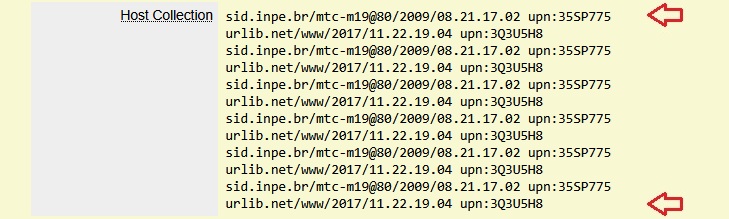
Finally, in this example, at the time this note was written, the first Archive still existed meaning that there was a rearrangement of objects between two federated Archives. The propose approach ensure that the AIPs will be findable once they have been moved from an Archive to another.
-
Third example of fully persistent HTML hyperlink
Title of the Destination Object (DO): Curso 8 - Conceitos e Ferramentas para Análise de Imagens de Radar de Abertura Sintética (SAR).
Available from: upn:GJR3MH:5PFmX3pFwXQZ55QH/xUCHa
Hyperlink source code: <a href="./upn:GJR3MH:5PFmX3pFwXQZ55QH/xUCHa" target="_blank">upn:GJR3MH:5PFmX3pFwXQZ55QH/xUCHa</a>
In this example, again, the destination object is NO LONGER in the original DO Archive, meaning that it migrates from an Archive to another. This can be verified by consulting to the complete metadata of the destination object: upn:GJR3MH:5PFmX3pFwXQZ55QH/xUCHa:.
In the Host Collection line of the complete metadata, the Provenance Information indicates that the destination object was created/submitted in the Archive identified as upn:GJR3MH (see the top red arrow in Figure 3). Nevertheless, as time passes, this Archive, created in 2002, needed to be disable and part of its collection be migrated to another Archive created in 2009 and identified as upn:35SP775 (see the bottom red arrow in Figure 3).Figure 3. Screenshot of the Host Collection line of the complete metadata of the destination object, showing its migration from the Archive identified as: upn:GJR3MH to the Archive identified as: upn:35SP775 (see the two red arrows) – Screenshot taken on November 26, 2025.

Ultimately, in this example, at the time this note was written, the first Archive upn:GJR3MH no longer existed. This means that there must have been an agreement between the two federated Archive to ensure the continued effective preservation of, at least, part of the threatened holdings, in case the original Archive ceases to operate. The propose approach ensure that the AIPs will be findable once they have been moved to a successor Archive.
Observation 1: All digital objects hosted in Web Archives are potential destination objects (DOs). To distinguish an object on the Web from others, in addition to the local identification made by each Archive, we use the namespace prefix assigned to the Archive in which the object was created/submitted. When a destination object migrates to another Archive, the original namespace prefix that forms its URI must NOT be changed since it may already have been referenced by some source objects (SOs) on the Web. In other words, in the list of Archives (i.e., of host collections) that have hosted a given object (see Examples 2 and 3 above), the namespace prefix of the FIRST Archive (i.e., the first host collection) is the one to be considered in forming the URI.
Observation 2: Table 1 illustrates how the Archive $localSite works as a source resolver to solve the above three examples. As with any resolver, the URL path component (e.g., upn:3Q3U5H8:8JMKD3MGP3W34R/44C25PS — see Line 1 of Table 1) is here the URI of the destination resource.
The namespace prefix of this URI (e.g., upn:3Q3U5H8) identifies a possible destination resolver for the resolution of the destination resource identifier (e.g., 8JMKD3MGP3W34R/44C25PS).
In turn, the URL of a possible resolver (e.g., ${upn:3Q3U5H8ResolverURL} for upn:3Q3U5H8 — see Line 2 of Table 1) is assigned to each namespace prefix (e.g., upn:3Q3U5H8) thus forming a mapping that we call "Prefix-ResolverURL".
Table 1 - Source resolver operation
| Source resolver | http://$localSite/upn:3Q3U5H8:8JMKD3MGP3W34R/44C25PS |
| Assigment to upn:3Q3U5H8 | upn:3Q3U5H8 ↦ ${upn:3Q3U5H8ResolverURL} |
| Destination resolver | ${upn:3Q3U5H8ResolverURL}/upn:3Q3U5H8:8JMKD3MGP3W34R/44C25PS |
| Source resolver | http://$localSite/upn:35SP775:8JMKD3MGP7W/36U89RH |
| Assigment to upn:35SP775 | upn:35SP775 ↦ {${upn:35SP775ResolverURL}} |
| Destination resolver | $url2 |
| Source resolver | http://$localSite/upn:GJR3MH:5PFmX3pFwXQZ55QH/xUCHa |
| Assigment to upn:GJR3MH | upn:GJR3MH ↦ ${upn:GJR3MHResolverURL} |
| Destination resolver | ${upn:GJR3MHResolverURL}/upn:GJR3MH:5PFmX3pFwXQZ55QH/xUCHa |
Observation 3: It is sufficient for an Almost Fully Persistent Hyperlink (from a SO to a DO) to become a fully persistent hyperlink (from a SO to a DO) to ensure that the destination resolution doesn't depend on a global destination resolver, that is, it only depends on the local destination resolver of each DO Archive.
Observation 4: The upn URI scheme still needs to be registered with IANA. The acronym upn stands for Uniform Package Name. Inicially, this scheme was designed to identify any Archival Information Package (AIP) hosted on Archives of the URLib platform, nevertheless it can be used to identify any destination object deposited in appropriate Archives. To create and register a new UPN namespace ID point to ibi-:QABCDSTQQW/4DMTTQE and send an e-mail to <gerald.urlibservice@gmail.com> stating the resolver's domain name for the created UPN namespace ID.
A next note introduces yet another definition of hyperlink, the so-called robust hyperlink, which is the last stage of the proposed advanced hyperlink types and contributes to solving the problem of the continued existence of Web resources #!#4#@#.
References
#!#1#@# THE CONSULTATIVE COMMITTEE FOR SPACE DATA SYSTEMS (CCSDS). Reference Model for an Open Archival Information System (OAIS) - CCSDS 650.0-M-3. Reston: CCSDS, 2024. 150 p. (CCSDS 650.0-M-3). Available from: https://ccsds.org/wp-content/uploads/gravity_forms/5-448e85c647331d9cbaf66c096458bdd5/2025/01//650x0m3.pdf.#!#2#@# BANON, G. J. F. Example of three almost fully persistent HTML hyperlinks. #!#S.l.#@# Deposited in the URLib collection, 2023. IBI: <QABCDSTQQW/49884CP>. Available from: upn:EFDBHS:QABCDSTQQW/49884CP.
#!#3#@# COMISSÃO-DE-ESTUDOS ABNT/CB08/SC010/CE70. System for IBI generation. São José dos Campos: Comissão-de-Estudo ABNT/CB08/SC010/CE70, version: 2021-11-14. 48 p. IBI: <J8LNKB5R7W/3NSP3DL>. Available from: upn:32NSFRP:J8LNKB5R7W/3NSP3DL.
#!#4#@# BANON, G. J. F. Example of robust hypertext and authentic data. #!#S.l.#@# Deposited in the URLib collection, 2023. IBI: <QABCDSTQQW/4AEFPDB>. Available from: <upn:E8KGRE:QABCDSTQQW/4AEFPDB>.
‡The objects involved in these hyperlinks may or may not be interpreted as Archival Information Packages (AIPs).
Example of three Fully Persistent Hyperlinks
Work in progress
by Gérald Jean Francis Banon
November 2023
Updated in January 2026
Introduction
The need to preserve digital information in the long term is a primary concern of many initiatives, one of which is the development of the Reference Model for an Open Archival Information System (OAIS) by the Consultative Committee on Spatial Data Systems (CCSDS) and the International Organization for Standardization (ISO) #!#1#@#.
One of the preservation problem is how to maintain the integrity of hyperlinks in the long-term, which may extend indefinitely.
In a previous note, the existence of a digital service that turns the Persistent Hyperlinks independent of the protocol and the resolver domain name has been shown #!#2#@#. Essentially, this digital service consists in what we call a Source Resolver.
The purpose of this note is to illustrate the use of that digital service, for example, in the case of a Federation of Archives #!#1#@#, that allows Persistent Hyperlinks to work with Local Destination Resolvers (each one being an Archive extention) instead of a global Destination Resolver.
By Local Destination Resolver, it is intended that the Archive which contain the destination resources works also as a resolver for all its Archival Information Packages (AIPs) identifiers #!#1#@#, i.e. both have the same domain name. In turn, the Archive hosting the AIP containing the source resource (e.g., this HTML page) works as a Source Resolver #!#2#@#, i.e. both have also the same domain name. In the two cases, we say that the resolver is an extention of the Archive.
Inicially, it is suposed that each Archive identifies its AIPs independent of each other. In this way, as commented in #!#1#@#: "when an Archive joins a Federation, there is no assurance that some of its current AIP identifiers are not already used by other members of the Federation. An example of a general solution to this problem is to form the AIP identifiers in the Federation by assigning a Unique ID for each Archive in the Federation and concatenating it to the identifier for each AIP preserved by that Archive".
Here, to assign a unique ID to each Archive we propose a simpler alternative standard to ISO X.500 Directory Services Naming. This standard reuses part of the standard presented in #!#3#@#. Futhermore, to refer to the unique ID of an Archive, we use the general expression "Namespace Prefix" (see definition below), already used in #!#2#@# to identify a naming system†.
This HTML page contains three examples of Fully Persistent Hyperlinks (see definition below). In each example, the hyperlink point to a destination resource hosted by an Archive that is a member of an open Federation of Archives whose members have each a registered Namespace Prefix that identifies them.
The three corresponding destination resources are hosted in two Archives that belong this open Federation. They are identified by the Namespace Prefix: upn:3Q3U5H8 and upn:35SP775. The source resource does not need to be hosted in a federated Archive. However, for security reasons and to avoid confusion with malicious Archives (see Observation 7 below), it should be hosted in a federated Archive, as is the case with this page.
Definitions
In the context of the definitions below regarding URI identifier resolution, the word object applies to terms such as resource, package or even AIP, all of which are targets of the preservation in Archives.
– A Source Object (SO) is an object which cites another object.
– A Destination Object (DO) is an object which is cited by another object.
– A Source Archive is an Archive which contains one or more Source Objects.
– A Destination Archive is an Archive which contains one or more Destination Objects.
– A Hyperlink (from a Source Object - SO to a Destination Object - DO) is a computational command inserted into the SO, whose argument specifies the URL of the DO, and which, when activated, brings the DO on the user's screen. Example: https://www.sciencedirect.com/science/article/abs/pii/S0034425721003874.
– A Namespace is a set of names.
– An Identifier (of an object) is a unique name within a specific Namespace that is assigned permanently to that object by an Archive. Example: 10.1016/j.rse.2021.112667.
– A Namespace Prefix (of an Archive or a resolver) is a unique name assigned to an Archive or a resolver, used to form the URI of potential Destination Objects. Example: urn:doi.
– A URI (of an object) is the concatenation of an Archive, or a resolver, Namespace Prefix and the Identifier of that object. Example: urn:doi:10.1016/j.rse.2021.112667.
– A Browser Resolver is a browser feature that concatenates the default base URL to the value of the each relative hyperlink contained in a Source Object.
– A Source Resolver is an extension of a Source Archive that maps/directs each Namespace Prefix to an appropriate Destination Resolver URL from a set of one or more possible URLs.
– A Destination Resolver is an independent resolver or an extension of an Destination Archive that maps/directs each Destination Object Identifier to the corresponding current Destination Object URL.
– A Persistent Hyperlink (from a Source Object - SO to a Destination Object - DO) is a computational command inserted into the SO, whose argument specifies a protocol, a global Destination Resolver domain name and the DO Identifier, and which, when activated, brings the DO on the user's screen. Example: https://doi.org/10.1016/j.rse.2021.112667.
– A Relative Persistent Hyperlink (from a Source Object - SO to a Destination Object - DO) is a relative Persistent Hyperlink (from the SO to the DO) whose DO Identifier is resolved by a global Destination Resolver, at the request of a Source Resolver. Example: urn:doi:10.1016/j.rse.2021.112667.
In other words, a Relative Persistent Hyperlink is a computational command whose argument specifies neither the protocol nor the domain name of the resolver, but it does specify the Namespace Prefix (e.g., urn:doi) which is resolved by the Source Archive working as a Source Resolver. In the background, the DO Identifier need be resolved by a global Destination Resolver.
– A Local Destination Resolver is an extension of an Archive that maps/directs each of his Destination Object Identifier to the corresponding current Destination Object URL.
– A Fully Persistent Hyperlink (from a Source Object - SO to a Destination Object - DO) is a Relative Persistent Hyperlink (from the SO to the DO) whose DO Identifier is resolved by a local Destination Resolver, at the request of a Source Resolver. Example: upn:3Q3U5H8:8JMKD3MGP3W34R/44C25PS (see Example 1 below).
Examples of three Relative Persistent Hyperlinks were given in #!#2#@#. In the next section, examples of three Fully Persistent Hyperlinks are now presented.Examples
The three hyperlinks below are relative Persistent Hyperlinks‡. This can be verified by looking at the value of the respective href attribute in the source code of this HTML page.
They are Fully Persistent because the Source Archive works as a Source Resolver that triggers the Local Destination Resolver which is an extention of the Destination Archive.
-
First example of Fully Persistent HTML hyperlink
Title of the Destination Object (DO): The Internet Based Identifier (IBI) and the IBI Network.
Available from: upn:3Q3U5H8:8JMKD3MGP3W34R/44C25PS
Hyperlink source code: <a href="./upn:3Q3U5H8:8JMKD3MGP3W34R/44C25PS" target="_blank">upn:3Q3U5H8:8JMKD3MGP3W34R/44C25PS</a>
In this example the Destination Object is in the original Destination Archive, that is, in the Archive in which its URI was formed, and not in an Archive to which it was migrated. This was, at least, the situation at the time this note was written, and this can be verified by consulting to the complete metadata of the Destination Object: upn:3Q3U5H8:8JMKD3MGP3W34R/44C25PS: (the final colon (:) redirects to the complete metadata).
The Site and Identifier lines of the complete metadata, in the first field area called Identify statement, indicate that the Destination Object is hosted in the Archive (Site) registered under the Namespace Prefix upn:3Q3U5H8 and its Identifier is 8JMKD3MGP3W34R/44C25PS (see Figure 1a).Figure 1a. Screenshot of the Site and Identifier lines of the complete metadata of the Destination Object, showing the Namespace Prefix: upn:3Q3U5H8 of the Archive hosting it and its Identifier 8JMKD3MGP3W34R/44C25PS – Screenshot taken on November 26, 2025.
In the Host Collection line of the complete metadata, in the second field area called Context, there is the Provenance Information indicating that the Destination Object was submitted in, or disseminated from the Archive registered under the Namespace Prefix upn:3Q3U5H8, and that it continued hosted there until the time this note was written (see Figure 1b).
Figure 1b. Screenshot of the Host Collection line of the complete metadata of the Destination Object, showing the Namespace Prefix: upn:3Q3U5H8 of the Archive hosting it (see red arrow) – Screenshot taken on November 26, 2025.
-
Second example of Fully Persistent HTML hyperlink
Title of the Destination Object (DO): Research and development on a small Spherical Tokamak.
Available from: upn:35SP775:8JMKD3MGP7W/36U89RH
Hyperlink source code: <a href="./upn:35SP775:8JMKD3MGP7W/36U89RH" target="_blank">upn:35SP775:8JMKD3MGP7W/36U89RH</a>
In this example the Destination Object is NO LONGER in the original Destination Archive, meaning that after been hosted there and assigned a URI, it migrated to another Archive. This was, at least, the situation at the time this note was written, and this can be verified by consulting to the complete metadata of the Destination Object: upn:35SP775:8JMKD3MGP7W/36U89RH:.
The Site and Identifier lines of the complete metadata, in the first field area called Identify statement, indicate that the Destination Object is hosted in the Archive (Site) registered under the Namespace Prefix upn:3Q3U5H8 and its Identifier is 8JMKD3MGP7W/36U89RH (see Figure 2a).Figure 2a. Screenshot of the Site and Identifier lines of the complete metadata of the Destination Object, showing the Namespace Prefix: upn:3Q3U5H8 of the Archive hosting it and its Identifier 8JMKD3MGP7W/36U89RH – Screenshot taken on November 26, 2025.
In the Host Collection line of the complete metadata, there is the Provenance Information indicating that the Destination Object was submitted in, or disseminated from the Archive registered under the Namespace Prefix upn:35SP775 (see the top red arrow in Figure 2b), but for some reason, after a sequence of migrations it is now hosted in a second Archive registered under the Namespace Prefix upn:3Q3U5H8 (see the bottom red arrow in Figure 2b), and that it remained hosted there until the time this note was written.
Figure 2b. Screenshot of the Host Collection line of the complete metadata of the Destination Object, showing a list of its successive migrations from top to bottom, namely, between the Archive identified as: upn:35SP775 and the Archive identified as: upn:3Q3U5H8 – Screenshot taken on November 26, 2025.
Finally, in this example, at the time this note was written, the first Archive still existed meaning that there was a rearrangement of objects between two federated Archives.
The propose approach ensure that the Destination Objects (AIPs) will be findable once they have been moved from a federated Archive to another, provided that the Destination Archives are able to resolve the Identifiers created by other Archives in the Federation.
-
Third example of Fully Persistent HTML hyperlink
Title of the Destination Object (DO): Curso 8 - Conceitos e Ferramentas para Análise de Imagens de Radar de Abertura Sintética (SAR).
Available from: upn:GJR3MH:5PFmX3pFwXQZ55QH/xUCHa
Hyperlink source code: <a href="./upn:GJR3MH:5PFmX3pFwXQZ55QH/xUCHa" target="_blank">upn:GJR3MH:5PFmX3pFwXQZ55QH/xUCHa</a>
In this example, again, the Destination Object is NO LONGER in the original Destination Archive, meaning that it migrates from an Archive to another. This can be verified by consulting to the complete metadata of the Destination Object: upn:GJR3MH:5PFmX3pFwXQZ55QH/xUCHa:.
The Site and Identifier lines of the complete metadata, in the first field area called Identify statement, indicate that the Destination Object is hosted in the Archive (Site) registered under the Namespace Prefix upn:35SP775 and its Identifier is 5PFmX3pFwXQZ55QH/xUCHa (see Figure 3a).Figure 3a. Screenshot of the Site and Identifier lines of the complete metadata of the Destination Object, showing the Namespace Prefix: upn:35SP775 of the Archive hosting it and its Identifier 5PFmX3pFwXQZ55QH/xUCHa – Screenshot taken on November 26, 2025.
In the Host Collection line of the complete metadata, the Provenance Information indicates that the Destination Object was submitted in, or disseminated from the Archive registered under the Namespace Prefix upn:GJR3MH (see the top red arrow in Figure 3b). However, as time passes, this Archive, created in 2002, needed to be disable and part of its collection be migrated to another Archive created in 2009 and registered under the Namespace Prefix as upn:35SP775 (see the bottom red arrow in Figure 3b).
Figure 3b. Screenshot of the Host Collection line of the complete metadata of the Destination Object, showing its migration from the Archive identified as: upn:GJR3MH to the Archive identified as: upn:35SP775 (see the two red arrows) – Screenshot taken on November 26, 2025.
Ultimately, in this example, at the time this note was written, the first Archive upn:GJR3MH no longer existed. This means that there must have been an agreement between the two federated Archives to ensure the continued effective preservation of, at least, part of the threatened holdings, should the original Archive cease to operate. The propose approach ensure that the Destination Objects (AIPs) will be findable once they have been moved to a successor Archive.
When using Local Destination Resolvers rather than global Destination Resolvers, two important rules must be followed to ensure that the URIs of potential Destination Objects are formed based on the correct Namespace Prefix for dissemination and use by fully persistent hyperlinks in future Source Objects. The two rules are:
• Once an Archive has registered its own Namespace Prefix, it must preserve the newly created Namespace Prefix in the Provenance Information of the potential Destination Objects that do not yet have such Provenance Information.
• Once an object is submitted to or disseminated from an Archive, the Archive's Namespace Prefix must be preserved in the object's Provenance Information.
Once formed, the URI of a Destination Object will never change, even if the object migrates to another Archive. Hence the importance of preserving the Namespace Prefix in the object's Provenance Information.
A convenient way to preserve the URI Namespace Prefix of a Destination Object is to retain it at the first place in a list of Archives identifiers (also call here, host collections identifiers) that chronologically describe all the Archives that have hosted the Destination Object, as in Examples 2 and 3 above (see the top red arrows in Figures 2b and 3b).
The above object's Provenance Information will play an important role to select all the Namespace Prefix currently in use in each Archive having a registered Namespace Prefix (see the mapping denoted g in Observation 5 below).
The Namespace Prefix of this URI (e.g., upn:3Q3U5H8) identifies one or more candidates to be the Local Destination Resolvers for the resolution of the specific Destination Object Identifier (e.g., 8JMKD3MGP3W34R/44C25PS).
In turn, the URLs of one or more possible Destination Resolvers (e.g., ${upn:3Q3U5H8ResolverURL} for upn:3Q3U5H8 — see Line 2 of Table 1) is assigned to each Namespace Prefix (e.g., upn:3Q3U5H8) thus forming a mapping that we call "Prefix-ResolverURL".
It may be necessary to assign more than one Destination Resolver URL to a specific Namespace Prefix (e.g., the URL list {${upn:35SP775ResolverURL}} for upn:35SP775 — see Line 5 of Table 1) because the holdings of an Archive have been distributed among more than one active Archive, as in Example 2.
In this case the Source Resolver must check which URL is responding before redirecting the client's resolution request to the appropriate Destination Resolver. This is done at the first check of the day, and the resulting appropriate Destination Resolver is then assigned to the URI (see Line 6 of Table 1).
This type of assignment leads to the construction, in each Source Resolver, of a mapping from the set of cited Destination Object URIs in its Source Objects to the set of possible Destination Resolver URLs. This mapping is used to avoid further checks until the following day.
Table 1 - Source Resolver operation
| Source Resolver | http://$localSite/upn:3Q3U5H8:8JMKD3MGP3W34R/44C25PS |
| Assigment to upn:3Q3U5H8 | upn:3Q3U5H8 ↦ {${upn:3Q3U5H8ResolverURL}} |
| Destination Resolver | ${upn:3Q3U5H8ResolverURL}/upn:3Q3U5H8:8JMKD3MGP3W34R/44C25PS |
| Source Resolver | http://$localSite/upn:35SP775:8JMKD3MGP7W/36U89RH |
| Assigment to upn:35SP775 | upn:35SP775 ↦ {${upn:35SP775ResolverURL}} |
| Assigment to the URI | upn:35SP775:8JMKD3MGP7W/36U89RH ↦ $url |
| Destination Resolver | $url2 |
| Source Resolver | http://$localSite/upn:GJR3MH:5PFmX3pFwXQZ55QH/xUCHa |
| Assigment to upn:GJR3MH | upn:GJR3MH ↦ {${upn:GJR3MHResolverURL}} |
| Destination Resolver | ${upn:GJR3MHResolverURL}/upn:GJR3MH:5PFmX3pFwXQZ55QH/xUCHa |
Currently, there is a reference Prefix-ResolverURL mapping that can be accessed by pointing to upn:9HFNHE:QABCDSTQQW/4E7MG35. This mapping need not be unique but, in this case, some kind of synchronization between them would be convenient.
• Firstly, the Browser Resolver combines the base URL:
http://gjfb0520.sid.inpe.br/col/urlib.net/www/2023/11.16.13.37/doc/
with the hyperlink:
upn:35SP775:8JMKD3MGP7W/36U89RH
what leads to the URL:
http://gjfb0520.sid.inpe.br/col/urlib.net/www/2023/11.16.13.37/doc/upn:35SP775:8JMKD3MGP7W/36U89RH
• Secondly, this URL activates the Source Resolver which gets from the Prefix-ResolverURL mapping the following assignment:
upn:35SP775 ↦ {${upn:35SP775ResolverURL}}
after check of which Destination Resolver is responding, the Source Resolver establishes the following assignment:
upn:35SP775:8JMKD3MGP7W/36U89RH ↦ $url.
what leads to the URL:
http://mtc-m21c.sid.inpe.br/upn:35SP775:8JMKD3MGP7W/36U89RH
• Thirdly, this URL activates the Destination Resolver which uses the following assignment:
8JMKD3MGP7W/36U89RH ↦ col/sid.inpe.br/mtc-m19@80/2010/02.12.16.37/doc/publicacao.pdf
what leads to the URL:
http://mtc-m21c.sid.inpe.br/col/sid.inpe.br/mtc-m19@80/2010/02.12.16.37/doc/publicacao.pdf
Figure 1. Resolution process of the hyperlink of Example 2 on November 26, 2025.
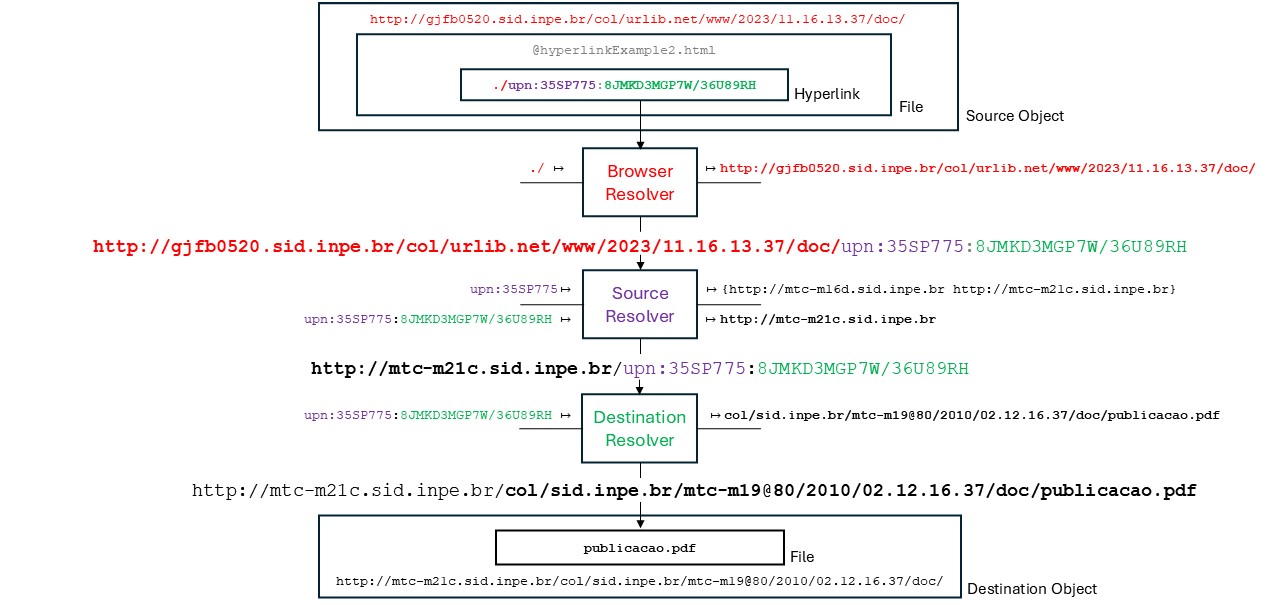
Source: Author
• A is a set of possibly IANA registered name-type URI Namespace Prefix, and
• B is a set of URLs that resolved, or that can resolve some URI having a Namespace Prefix in the set A.
The subset f(a) of B consists of the URL(s) that can currently resolve some URI having a as its Namespace Prefix.
The rules for the construction of a reference Prefix-ResolverURL are:
– When a new Namespace Prefix a (e.g., upn:3Q3U5H8) is registered with the information that the assigned Destination Resolver's URL is b (e.g., http://mtc-m21c.sid.inpe.br), a is added to A, if necessary b is added to B (b may have existed serving another Archive), and f(a) set to the value {b}. Hence, the pair (a, {b}), is added to the graph of the f mapping. Here is an example of such added pair (case of Example 1):
– When, a DO with Namespace Prefix a (e.g., upn:35SP7758) migrates, from one Archive to another with URL b (e.g., http://mtc-m21c.sid.inpe.br) and is the first to do so, b is inserted into f(a). Here is an example of an updated pair after a URL insertion (case of Example 2):
– When, an Archive with Namespace Prefix a (e.g., upn:GJR3MH) and URL b1 (e.g., http://lagavulin.ltid.inpe.br) is discontinued and its holdings are migrated to another Archive with URL b2 (e.g., http://mtc-m16d.sid.inpe.br), b1 is removed from f(a) and b2 is added in place. Here is an example of an updated pair after such holdings migration (case of Example 3):
The mappings f and g verify that, for any a in A and b in B,
We say that the pair of mappings (f, g) forms a connection between the sets A and B. An essential property of that connection is that one mapping uniquely determines the other:
Considering that the two mappings f and g of the above connection induce, respectively, two relations: "b is in f(a)" on A × B and "a is in g(b)" on B × A which are mutally transpose, we say that f and g are also Mutually Transpose.
Hence, a reference Prefix-ResolverURL mapping f can be updated and recreated at any time from its transpose g whose values can be obtained from each Archive that have a registered Namespace Prefix and a fixed IP address.
The idea is to have a specific standard to define a communication protocol for an Archive b to send its list g(b) of UPNs to the existing organizations that maintain a reference Prefix-ResolverURL mapping f.
All UPNs must have the same syntax as URNs #!#5#@#. This applies in particular to the syntax of the Namespace-Specific String, which is the part of the UPN URI that is not the Namespcae Prefix.
To create and register a new UPN Namespace ID, point to upn:LPEJ5E-:QABCDSTQQW/4DMTTQE and send an e-mail (for example, to <urlibservice@gmail.com>) stating the unique Destination Resolver's URL for the created UPN Namespace ID.
The Source Resolver is an extension of the Archive that contains the SO. In turn, the Archive is a member of an open Federation of Archives, whose members have registered Namespace Prefix and are interested in using relative hyperlinks to preserve the integrity of their hypertexts.
A malicious Archive that is probably not part of the Federation may have made a copy of a SO from a federated Archive, and its Source Resolver may assemble a malicious URL to be directed straight forward to the client's browser for redirection. In this case, the client, upon clicking a SO relative hyperlink that points to a DO, will likely see a different DO than expected.
For security reasons, it would be necessary to verify the Source Resolvers of each federated Archive at the time of registering its UPN namespace ID and rely on the client's Browser Resolvers to display a warning message whenever, in the presence of relative URI hyperlink, the fully qualified domain name of the Archive does not belong to those of the Federation.
Consequently, in the presence of relative URI hyperlink, browsers would need to consult the list of federated Archives such as upn:9HFNHE:QABCDSTQQW/4E7MG35/federatedArchives.txt, avaliable in January 2026, to decide whether or not to display the warning message.
A next note introduces yet another definition of hyperlink, the so-called Robust Hyperlink, which is the last stage of the proposed advanced hyperlink types and contributes to solving the problem of the continued existence of Web resources #!#4#@#.
References
#!#1#@# THE CONSULTATIVE COMMITTEE FOR SPACE DATA SYSTEMS (CCSDS). Reference Model for an Open Archival Information System (OAIS) - CCSDS 650.0-M-3. Reston: CCSDS, 2024. 150 p. (CCSDS 650.0-M-3). Available from: https://ccsds.org/wp-content/uploads/gravity_forms/5-448e85c647331d9cbaf66c096458bdd5/2025/01//650x0m3.pdf.#!#2#@# BANON, G. J. F. Example of three Relative Persistent Hyperlinks. #!#S.l.#@# Deposited in the URLib collection, 2023. IBI: <QABCDSTQQW/49884CP>. Available from: upn:EFDBHS:QABCDSTQQW/49884CP.
#!#3#@# COMISSÃO-DE-ESTUDOS ABNT/CB08/SC010/CE70. System for IBI generation. São José dos Campos: Comissão-de-Estudo ABNT/CB08/SC010/CE70, version: 2021-11-14. 48 p. IBI: <J8LNKB5R7W/3NSP3DL>. Available from: upn:32NSFRP:J8LNKB5R7W/3NSP3DL.
#!#4#@# BANON, G. J. F. Example of Robust Hypertext and authentic data. #!#S.l.#@# Deposited in the URLib collection, 2023. IBI: <QABCDSTQQW/4AEFPDB>. Available from: <upn:E8KGRE:QABCDSTQQW/4AEFPDB>.
#!#5#@# SAINT-ANDRE, P.; FILAMENT and KLENSIN, J. Uniform Resource Names (URNs) #!#S.l.#@# Internet Engineering Task Force (IETF). Request for Comments: 8141. ISSN: 2070-1721. Available from: <doi:10.17487/RFC8141>.
‡The objects involved in these hyperlinks may or may not be interpreted as Archival Information Packages (AIPs).
Example of three Fully Persistent Hyperlinks
Work in progress
by Gérald Jean Francis Banon
November 2023
Updated in January 2026
Introduction
The need to preserve digital information in the long term is a primary concern of many initiatives, one of which is the development of the Reference Model for an Open Archival Information System (OAIS) by the Consultative Committee on Spatial Data Systems (CCSDS) and the International Organization for Standardization (ISO) #!#1#@#.
One of the preservation problem is how to maintain the integrity of hyperlinks in the long-term, which may extend indefinitely.
In a previous note, the existence of a digital service that turns the Persistent Hyperlinks independent of the protocol and the resolver domain name has been shown #!#2#@#. Essentially, this digital service consists in what we call a Source Resolver.
The purpose of this note is to illustrate the use of that digital service, for example, in the case of a Federation of Archives #!#1#@#, that allows Persistent Hyperlinks to work with Local Destination Resolvers (each one being an Archive extention) instead of a global Destination Resolver.
By Local Destination Resolver, it is intended that the Archive which contain the destination resources works also as a resolver for all its Archival Information Packages (AIPs) identifiers #!#1#@#, i.e. both have the same domain name. In turn, the Archive hosting the AIP containing the source resource (e.g., this HTML page) works as a Source Resolver #!#2#@#, i.e. both have also the same domain name. In the two cases, we say that the resolver is an extention of the Archive.
Inicially, it is suposed that each Archive identifies its AIPs independent of each other. In this way, as commented in #!#1#@#: "when an Archive joins a Federation, there is no assurance that some of its current AIP identifiers are not already used by other members of the Federation. An example of a general solution to this problem is to form the AIP identifiers in the Federation by assigning a Unique ID for each Archive in the Federation and concatenating it to the identifier for each AIP preserved by that Archive".
Here, to assign a unique ID to each Archive we propose a simpler alternative standard to ISO X.500 Directory Services Naming. This standard reuses part of the standard presented in #!#3#@#. Futhermore, to refer to the unique ID of an Archive, we use the general expression "Namespace Prefix" (see definition below), already used in #!#2#@# to identify a naming system†.
This HTML page contains three examples of Fully Persistent Hyperlinks (see definition below). In each example, the hyperlink point to a destination resource hosted by an Archive that is a member of an open Federation of Archives whose members have each a registered Namespace Prefix that identifies them.
The three corresponding destination resources are hosted in two Archives that belong this open Federation. They are identified by the Namespace Prefix: upn:3Q3U5H8 and upn:35SP775. The source resource does not need to be hosted in a federated Archive. However, for security reasons and to avoid confusion with malicious Archives (see Observation 7 below), it should be hosted in a federated Archive, as is the case with this page.
Definitions
In the context of the definitions below regarding URI identifier resolution, the word object applies to terms such as resource, package or even AIP, all of which are targets of the preservation in Archives.
– A Source Object (SO) is an object which cites another object.
– A Destination Object (DO) is an object which is cited by another object.
– A Source Archive is an Archive which contains one or more Source Objects.
– A Destination Archive is an Archive which contains one or more Destination Objects.
– A Hyperlink (from a Source Object - SO to a Destination Object - DO) is a computational command inserted into the SO, whose argument specifies the URL of the DO, and which, when activated, brings the DO on the user's screen. Example: https://www.sciencedirect.com/science/article/abs/pii/S0034425721003874.
– A Namespace is a set of names.
– An Identifier (of an object) is a unique name within a specific Namespace that is assigned permanently to that object by an Archive. Example: 10.1016/j.rse.2021.112667.
– A Namespace Prefix (of an Archive or a resolver) is a unique name assigned to an Archive or a resolver, used to form the URI of potential Destination Objects. Example: urn:doi.
– A URI (of an object) is the concatenation of an Archive, or a resolver, Namespace Prefix and the Identifier of that object. Example: urn:doi:10.1016/j.rse.2021.112667.
– A Browser Resolver is a browser feature that concatenates the default base URL to the value of the each relative hyperlink contained in a Source Object.
– A Source Resolver is an extension of a Source Archive that maps/directs each Namespace Prefix to an appropriate Destination Resolver URL from a set of one or more possible URLs.
– A Destination Resolver is an independent resolver or an extension of an Destination Archive that maps/directs each Destination Object Identifier to the corresponding current Destination Object URL.
– A Persistent Hyperlink (from a Source Object - SO to a Destination Object - DO) is a computational command inserted into the SO, whose argument specifies a protocol, a global Destination Resolver domain name and the DO Identifier, and which, when activated, brings the DO on the user's screen. Example: https://doi.org/10.1016/j.rse.2021.112667.
– A Relative Persistent Hyperlink (from a Source Object - SO to a Destination Object - DO) is a relative Persistent Hyperlink (from the SO to the DO) whose DO Identifier is resolved by a global Destination Resolver, at the request of a Source Resolver. Example: urn:doi:10.1016/j.rse.2021.112667.
In other words, a Relative Persistent Hyperlink is a computational command whose argument specifies neither the protocol nor the domain name of the resolver, but it does specify the Namespace Prefix (e.g., urn:doi) which is resolved by the Source Archive working as a Source Resolver. In the background, the DO Identifier need be resolved by a global Destination Resolver.
– A Local Destination Resolver is an extension of an Archive that maps/directs each of his Destination Object Identifier to the corresponding current Destination Object URL.
– A Fully Persistent Hyperlink (from a Source Object - SO to a Destination Object - DO) is a Relative Persistent Hyperlink (from the SO to the DO) whose DO Identifier is resolved by a local Destination Resolver, at the request of a Source Resolver. Example: upn:3Q3U5H8:8JMKD3MGP3W34R/44C25PS (see Example 1 below).
Examples of three Relative Persistent Hyperlinks were given in #!#2#@#. In the next section, examples of three Fully Persistent Hyperlinks are now presented.Examples
The three hyperlinks below are relative Persistent Hyperlinks‡. This can be verified by looking at the value of the respective href attribute in the source code of this HTML page.
They are Fully Persistent because the Source Archive works as a Source Resolver that triggers the Local Destination Resolver which is an extention of the Destination Archive.
-
First example of Fully Persistent HTML hyperlink
Title of the Destination Object (DO): The Internet Based Identifier (IBI) and the IBI Network.
Available from: upn:3Q3U5H8:8JMKD3MGP3W34R/44C25PS
Hyperlink source code: <a href="./upn:3Q3U5H8:8JMKD3MGP3W34R/44C25PS" target="_blank">upn:3Q3U5H8:8JMKD3MGP3W34R/44C25PS</a>
In this example the Destination Object is in the original Destination Archive, that is, in the Archive in which its URI was formed, and not in an Archive to which it was migrated. This was, at least, the situation at the time this note was written, and this can be verified by consulting to the complete metadata of the Destination Object: upn:3Q3U5H8:8JMKD3MGP3W34R/44C25PS: (the final colon (:) redirects to the complete metadata).
The Site and Identifier lines of the complete metadata, in the first field area called Identify statement, indicate that the Destination Object is hosted in the Archive (Site) registered under the Namespace Prefix upn:3Q3U5H8 and its Identifier is 8JMKD3MGP3W34R/44C25PS (see Figure 1a).Figure 1a. Screenshot of the Site and Identifier lines of the complete metadata of the Destination Object, showing the Namespace Prefix: upn:3Q3U5H8 of the Archive hosting it and its Identifier 8JMKD3MGP3W34R/44C25PS – Screenshot taken on November 26, 2025.
In the Host Collection line of the complete metadata, in the second field area called Context, there is the Provenance Information indicating that the Destination Object was submitted in, or disseminated from the Archive registered under the Namespace Prefix upn:3Q3U5H8, and that it continued hosted there until the time this note was written (see Figure 1b).
Figure 1b. Screenshot of the Host Collection line of the complete metadata of the Destination Object, showing the Namespace Prefix: upn:3Q3U5H8 of the Archive hosting it (see red arrow) – Screenshot taken on November 26, 2025.
-
Second example of Fully Persistent HTML hyperlink
Title of the Destination Object (DO): Research and development on a small Spherical Tokamak.
Available from: upn:35SP775:8JMKD3MGP7W/36U89RH
Hyperlink source code: <a href="./upn:35SP775:8JMKD3MGP7W/36U89RH" target="_blank">upn:35SP775:8JMKD3MGP7W/36U89RH</a>
In this example the Destination Object is NO LONGER in the original Destination Archive, meaning that after been hosted there and assigned a URI, it migrated to another Archive. This was, at least, the situation at the time this note was written, and this can be verified by consulting to the complete metadata of the Destination Object: upn:35SP775:8JMKD3MGP7W/36U89RH:.
The Site and Identifier lines of the complete metadata, in the first field area called Identify statement, indicate that the Destination Object is hosted in the Archive (Site) registered under the Namespace Prefix upn:3Q3U5H8 and its Identifier is 8JMKD3MGP7W/36U89RH (see Figure 2a).Figure 2a. Screenshot of the Site and Identifier lines of the complete metadata of the Destination Object, showing the Namespace Prefix: upn:3Q3U5H8 of the Archive hosting it and its Identifier 8JMKD3MGP7W/36U89RH – Screenshot taken on November 26, 2025.
In the Host Collection line of the complete metadata, there is the Provenance Information indicating that the Destination Object was submitted in, or disseminated from the Archive registered under the Namespace Prefix upn:35SP775 (see the top red arrow in Figure 2b), but for some reason, after a sequence of migrations it is now hosted in a second Archive registered under the Namespace Prefix upn:3Q3U5H8 (see the bottom red arrow in Figure 2b), and that it remained hosted there until the time this note was written.
Figure 2b. Screenshot of the Host Collection line of the complete metadata of the Destination Object, showing a list of its successive migrations from top to bottom, namely, between the Archive identified as: upn:35SP775 and the Archive identified as: upn:3Q3U5H8 – Screenshot taken on November 26, 2025.
Finally, in this example, at the time this note was written, the first Archive still existed meaning that there was a rearrangement of objects between two federated Archives.
The propose approach ensure that the Destination Objects (AIPs) will be findable once they have been moved from a federated Archive to another, provided that the Destination Archives are able to resolve the Identifiers created by other Archives in the Federation.
-
Third example of Fully Persistent HTML hyperlink
Title of the Destination Object (DO): Curso 8 - Conceitos e Ferramentas para Análise de Imagens de Radar de Abertura Sintética (SAR).
Available from: upn:GJR3MH:5PFmX3pFwXQZ55QH/xUCHa
Hyperlink source code: <a href="./upn:GJR3MH:5PFmX3pFwXQZ55QH/xUCHa" target="_blank">upn:GJR3MH:5PFmX3pFwXQZ55QH/xUCHa</a>
In this example, again, the Destination Object is NO LONGER in the original Destination Archive, meaning that it migrates from an Archive to another. This can be verified by consulting to the complete metadata of the Destination Object: upn:GJR3MH:5PFmX3pFwXQZ55QH/xUCHa:.
The Site and Identifier lines of the complete metadata, in the first field area called Identify statement, indicate that the Destination Object is hosted in the Archive (Site) registered under the Namespace Prefix upn:35SP775 and its Identifier is 5PFmX3pFwXQZ55QH/xUCHa (see Figure 3a).Figure 3a. Screenshot of the Site and Identifier lines of the complete metadata of the Destination Object, showing the Namespace Prefix: upn:35SP775 of the Archive hosting it and its Identifier 5PFmX3pFwXQZ55QH/xUCHa – Screenshot taken on November 26, 2025.
In the Host Collection line of the complete metadata, the Provenance Information indicates that the Destination Object was submitted in, or disseminated from the Archive registered under the Namespace Prefix upn:GJR3MH (see the top red arrow in Figure 3b). However, as time passes, this Archive, created in 2002, needed to be disable and part of its collection be migrated to another Archive created in 2009 and registered under the Namespace Prefix as upn:35SP775 (see the bottom red arrow in Figure 3b).
Figure 3b. Screenshot of the Host Collection line of the complete metadata of the Destination Object, showing its migration from the Archive identified as: upn:GJR3MH to the Archive identified as: upn:35SP775 (see the two red arrows) – Screenshot taken on November 26, 2025.
Ultimately, in this example, at the time this note was written, the first Archive upn:GJR3MH no longer existed. This means that there must have been an agreement between the two federated Archives to ensure the continued effective preservation of, at least, part of the threatened holdings, should the original Archive cease to operate. The propose approach ensure that the Destination Objects (AIPs) will be findable once they have been moved to a successor Archive.
When using Local Destination Resolvers rather than global Destination Resolvers, two important rules must be followed to ensure that the URIs of potential Destination Objects are formed based on the correct Namespace Prefix for dissemination and use by fully persistent hyperlinks in future Source Objects. The two rules are:
• Once an Archive has registered its own Namespace Prefix, it must preserve the newly created Namespace Prefix in the Provenance Information of the potential Destination Objects that do not yet have such Provenance Information.
• Once an object is submitted to or disseminated from an Archive, the Archive's Namespace Prefix must be preserved in the object's Provenance Information.
Once formed, the URI of a Destination Object will never change, even if the object migrates to another Archive. Hence the importance of preserving the Namespace Prefix in the object's Provenance Information.
A convenient way to preserve the URI Namespace Prefix of a Destination Object is to retain it at the first place in a list of Archives identifiers (also call here, host collections identifiers) that chronologically describe all the Archives that have hosted the Destination Object, as in Examples 2 and 3 above (see the top red arrows in Figures 2b and 3b).
The above object's Provenance Information will play an important role to select all the Namespace Prefix currently in use in each Archive having a registered Namespace Prefix (see the mapping denoted g in Observation 5 below).
The Namespace Prefix of this URI (e.g., upn:3Q3U5H8) identifies one or more candidates to be the Local Destination Resolvers for the resolution of the specific Destination Object Identifier (e.g., 8JMKD3MGP3W34R/44C25PS).
In turn, the URLs of one or more possible Destination Resolvers (e.g., ${upn:3Q3U5H8ResolverURL} for upn:3Q3U5H8 — see Line 2 of Table 1) is assigned to each Namespace Prefix (e.g., upn:3Q3U5H8) thus forming a mapping that we call "Prefix-ResolverURL".
It may be necessary to assign more than one Destination Resolver URL to a specific Namespace Prefix (e.g., the URL list {${upn:35SP775ResolverURL}} for upn:35SP775 — see Line 5 of Table 1) because the holdings of an Archive have been distributed among more than one active Archive, as in Example 2.
In this case the Source Resolver must check which URL is responding before redirecting the client's resolution request to the appropriate Destination Resolver. This is done at the first check of the day, and the resulting appropriate Destination Resolver is then assigned to the URI (see Line 6 of Table 1).
This type of assignment leads to the construction, in each Source Resolver, of a mapping from the set of cited Destination Object URIs in its Source Objects to the set of possible Destination Resolver URLs. This mapping is used to avoid further checks until the following day.
Table 1 - Source Resolver operation
| Source Resolver | http://$localSite/upn:3Q3U5H8:8JMKD3MGP3W34R/44C25PS |
| Assigment to upn:3Q3U5H8 | upn:3Q3U5H8 ↦ {${upn:3Q3U5H8ResolverURL}} |
| Destination Resolver | ${upn:3Q3U5H8ResolverURL}/upn:3Q3U5H8:8JMKD3MGP3W34R/44C25PS |
| Source Resolver | http://$localSite/upn:35SP775:8JMKD3MGP7W/36U89RH |
| Assigment to upn:35SP775 | upn:35SP775 ↦ {${upn:35SP775ResolverURL}} |
| Assigment to the URI | upn:35SP775:8JMKD3MGP7W/36U89RH ↦ $url |
| Destination Resolver | $url2 |
| Source Resolver | http://$localSite/upn:GJR3MH:5PFmX3pFwXQZ55QH/xUCHa |
| Assigment to upn:GJR3MH | upn:GJR3MH ↦ {${upn:GJR3MHResolverURL}} |
| Destination Resolver | ${upn:GJR3MHResolverURL}/upn:GJR3MH:5PFmX3pFwXQZ55QH/xUCHa |
Currently, there is a reference Prefix-ResolverURL mapping that can be accessed by pointing to upn:9HFNHE:QABCDSTQQW/4E7MG35. This mapping need not be unique but, in this case, some kind of synchronization between them would be convenient.
• Firstly, the Browser Resolver combines the base URL:
http://gjfb0520.sid.inpe.br/col/urlib.net/www/2023/11.16.13.37/doc/
with the hyperlink:
upn:35SP775:8JMKD3MGP7W/36U89RH
what leads to the URL:
http://gjfb0520.sid.inpe.br/col/urlib.net/www/2023/11.16.13.37/doc/upn:35SP775:8JMKD3MGP7W/36U89RH
• Secondly, this URL activates the Source Resolver which gets from the Prefix-ResolverURL mapping the following assignment:
upn:35SP775 ↦ {${upn:35SP775ResolverURL}}
after check of which Destination Resolver is responding, the Source Resolver establishes the following assignment:
upn:35SP775:8JMKD3MGP7W/36U89RH ↦ $url.
what leads to the URL:
http://mtc-m21c.sid.inpe.br/upn:35SP775:8JMKD3MGP7W/36U89RH
• Thirdly, this URL activates the Destination Resolver which uses the following assignment:
8JMKD3MGP7W/36U89RH ↦ col/sid.inpe.br/mtc-m19@80/2010/02.12.16.37/doc/publicacao.pdf
what leads to the URL:
http://mtc-m21c.sid.inpe.br/col/sid.inpe.br/mtc-m19@80/2010/02.12.16.37/doc/publicacao.pdf
Figure 1. Resolution process of the hyperlink of Example 2 on November 26, 2025.
Source: Author
• A is a set of possibly IANA registered name-type URI Namespace Prefix, and
• B is a set of URLs that resolved, or that can resolve some URI having a Namespace Prefix in the set A.
The subset f(a) of B consists of the URL(s) that can currently resolve some URI having a as its Namespace Prefix.
The rules for the construction of a reference Prefix-ResolverURL are:
– When a new Namespace Prefix a (e.g., upn:3Q3U5H8) is registered with the information that the assigned Destination Resolver's URL is b (e.g., http://mtc-m21c.sid.inpe.br), a is added to A, if necessary b is added to B (b may have existed serving another Archive), and f(a) set to the value {b}. Hence, the pair (a, {b}), is added to the graph of the f mapping. Here is an example of such added pair (case of Example 1):
– When, a DO with Namespace Prefix a (e.g., upn:35SP7758) migrates, from one Archive to another with URL b (e.g., http://mtc-m21c.sid.inpe.br) and is the first to do so, b is inserted into f(a). Here is an example of an updated pair after a URL insertion (case of Example 2):
– When, an Archive with Namespace Prefix a (e.g., upn:GJR3MH) and URL b1 (e.g., http://lagavulin.ltid.inpe.br) is discontinued and its holdings are migrated to another Archive with URL b2 (e.g., http://mtc-m16d.sid.inpe.br), b1 is removed from f(a) and b2 is added in place. Here is an example of an updated pair after such holdings migration (case of Example 3):
The mappings f and g verify that, for any a in A and b in B,
We say that the pair of mappings (f, g) forms a connection between the sets A and B. An essential property of that connection is that one mapping uniquely determines the other:
Considering that the two mappings f and g of the above connection induce, respectively, two relations: "b is in f(a)" on A × B and "a is in g(b)" on B × A which are mutally transpose, we say that f and g are also Mutually Transpose.
Hence, a reference Prefix-ResolverURL mapping f can be updated and recreated at any time from its transpose g whose values can be obtained from each Archive that have a registered Namespace Prefix and a fixed IP address.
The idea is to have a specific standard to define a communication protocol for an Archive b to send its list g(b) of UPNs to the existing organizations that maintain a reference Prefix-ResolverURL mapping f.
All UPNs must have the same syntax as URNs #!#5#@#. This applies in particular to the syntax of the Namespace-Specific String, which is the part of the UPN URI that is not the Namespcae Prefix.
To create and register a new UPN Namespace ID, point to upn:LPEJ5E-:QABCDSTQQW/4DMTTQE and send an e-mail (for example, to <urlibservice@gmail.com>) stating the unique Destination Resolver's URL for the created UPN Namespace ID.
The Source Resolver is an extension of the Archive that contains the SO. In turn, the Archive is a member of an open Federation of Archives, whose members have registered Namespace Prefix and are interested in using relative hyperlinks to preserve the integrity of their hypertexts.
A malicious Archive that is probably not part of the Federation may have made a copy of a SO from a federated Archive, and its Source Resolver may assemble a malicious URL to be directed straight forward to the client's browser for redirection. In this case, the client, upon clicking a SO relative hyperlink that points to a DO, will likely see a different DO than expected.
For security reasons, it would be necessary to verify the Source Resolvers of each federated Archive at the time of registering its UPN namespace ID and rely on the client's Browser Resolvers to display a warning message whenever, in the presence of relative URI hyperlink, the fully qualified domain name of the Archive does not belong to those of the Federation.
Consequently, in the presence of relative URI hyperlink, browsers would need to consult the list of federated Archives such as upn:9HFNHE:QABCDSTQQW/4E7MG35/federatedArchives.txt, avaliable in January 2026, to decide whether or not to display the warning message.
A next note introduces yet another definition of hyperlink, the so-called Robust Hyperlink, which is the last stage of the proposed advanced hyperlink types and contributes to solving the problem of the continued existence of Web resources #!#4#@#.
References
#!#1#@# THE CONSULTATIVE COMMITTEE FOR SPACE DATA SYSTEMS (CCSDS). Reference Model for an Open Archival Information System (OAIS) - CCSDS 650.0-M-3. Reston: CCSDS, 2024. 150 p. (CCSDS 650.0-M-3). Available from: https://ccsds.org/wp-content/uploads/gravity_forms/5-448e85c647331d9cbaf66c096458bdd5/2025/01//650x0m3.pdf.#!#2#@# BANON, G. J. F. Example of three Relative Persistent Hyperlinks. #!#S.l.#@# Deposited in the URLib collection, 2023. IBI: <QABCDSTQQW/49884CP>. Available from: upn:EFDBHS:QABCDSTQQW/49884CP.
#!#3#@# COMISSÃO-DE-ESTUDOS ABNT/CB08/SC010/CE70. System for IBI generation. São José dos Campos: Comissão-de-Estudo ABNT/CB08/SC010/CE70, version: 2021-11-14. 48 p. IBI: <J8LNKB5R7W/3NSP3DL>. Available from: upn:32NSFRP:J8LNKB5R7W/3NSP3DL.
#!#4#@# BANON, G. J. F. Example of Robust Hypertext and authentic data. #!#S.l.#@# Deposited in the URLib collection, 2023. IBI: <QABCDSTQQW/4AEFPDB>. Available from: <upn:E8KGRE:QABCDSTQQW/4AEFPDB>.
#!#5#@# SAINT-ANDRE, P.; FILAMENT and KLENSIN, J. Uniform Resource Names (URNs) #!#S.l.#@# Internet Engineering Task Force (IETF). Request for Comments: 8141. ISSN: 2070-1721. Available from: <doi:10.17487/RFC8141>.
‡The objects involved in these hyperlinks may or may not be interpreted as Archival Information Packages (AIPs).
Example of three Fully Persistent Hyperlinks
Work in progress
by Gérald Jean Francis Banon
November 2023
Updated in January 2026
Introduction
The need to preserve digital information in the long term is a primary concern of many initiatives, one of which is the development of the Reference Model for an Open Archival Information System (OAIS) by the Consultative Committee on Spatial Data Systems (CCSDS) and the International Organization for Standardization (ISO) #!#1#@#.
One of the preservation problem is how to maintain the integrity of hyperlinks in the long-term, which may extend indefinitely.
In a previous note, the existence of a digital service that turns the Persistent Hyperlinks independent of the protocol and the resolver domain name has been shown #!#2#@#. Essentially, this digital service consists in what we call a Source Resolver.
The purpose of this note is to illustrate the use of that digital service, for example, in the case of a Federation of Archives #!#1#@#, that allows Persistent Hyperlinks to work with Local Destination Resolvers (each one being an Archive extention) instead of a global Destination Resolver.
By Local Destination Resolver, it is intended that the Archive which contain the destination resources works also as a resolver for all its Archival Information Packages (AIPs) identifiers #!#1#@#, i.e. both have the same domain name. In turn, the Archive hosting the AIP containing the source resource (e.g., this HTML page) works as a Source Resolver #!#2#@#, i.e. both have also the same domain name. In the two cases, we say that the resolver is an extention of the Archive.
Inicially, it is suposed that each Archive identifies its AIPs independent of each other. In this way, as commented in #!#1#@#: "when an Archive joins a Federation, there is no assurance that some of its current AIP identifiers are not already used by other members of the Federation. An example of a general solution to this problem is to form the AIP identifiers in the Federation by assigning a Unique ID for each Archive in the Federation and concatenating it to the identifier for each AIP preserved by that Archive".
Here, to assign a unique ID to each Archive we propose a simpler alternative standard to ISO X.500 Directory Services Naming. This standard reuses part of the standard presented in #!#3#@#. Futhermore, to refer to the unique ID of an Archive, we use the general expression "Namespace Prefix" (see definition below), already used in #!#2#@# to identify a naming system†.
This HTML page contains three examples of Fully Persistent Hyperlinks (see definition below). In each example, the hyperlink point to a destination resource hosted by an Archive that is a member of an open Federation of Archives whose members have each a registered Namespace Prefix that identifies them.
The three corresponding destination resources are hosted in two Archives that belong this open Federation. They are identified by the Namespace Prefix: upn:3Q3U5H8 and upn:35SP775. The source resource does not need to be hosted in a federated Archive. However, for security reasons and to avoid confusion with malicious Archives (see Observation 7 below), it should be hosted in a federated Archive, as is the case with this page.
Definitions
In the context of the definitions below regarding URI identifier resolution, the word object applies to terms such as resource, package or even AIP, all of which are targets of the preservation in Archives.
– A Source Object (SO) is an object which cites another object.
– A Destination Object (DO) is an object which is cited by another object.
– A Source Archive is an Archive which contains one or more Source Objects.
– A Destination Archive is an Archive which contains one or more Destination Objects.
– A Hyperlink (from a Source Object - SO to a Destination Object - DO) is a computational command inserted into the SO, whose argument specifies the URL of the DO, and which, when activated, brings the DO on the user's screen. Example: https://www.sciencedirect.com/science/article/abs/pii/S0034425721003874.
– A Namespace is a set of names.
– An Identifier (of an object) is a unique name within a specific Namespace that is assigned permanently to that object by an Archive. Example: 10.1016/j.rse.2021.112667.
– A Namespace Prefix (of an Archive or a resolver) is a unique name assigned to an Archive or a resolver, used to form the URI of potential Destination Objects. Example: urn:doi.
– A URI (of an object) is the concatenation of an Archive, or a resolver, Namespace Prefix and the Identifier of that object. Example: urn:doi:10.1016/j.rse.2021.112667.
– A Browser Resolver is a browser feature that concatenates the default base URL to the value of the each relative hyperlink contained in a Source Object.
– A Source Resolver is an extension of a Source Archive that maps/directs each Namespace Prefix to an appropriate Destination Resolver URL from a set of one or more possible URLs.
– A Destination Resolver is an independent resolver or an extension of an Destination Archive that maps/directs each Destination Object Identifier to the corresponding current Destination Object URL.
– A Persistent Hyperlink (from a Source Object - SO to a Destination Object - DO) is a computational command inserted into the SO, whose argument specifies a protocol, a global Destination Resolver domain name and the DO Identifier, and which, when activated, brings the DO on the user's screen. Example: https://doi.org/10.1016/j.rse.2021.112667.
– A Relative Persistent Hyperlink (from a Source Object - SO to a Destination Object - DO) is a relative Persistent Hyperlink (from the SO to the DO) whose DO Identifier is resolved by a global Destination Resolver, at the request of a Source Resolver. Example: urn:doi:10.1016/j.rse.2021.112667.
In other words, a Relative Persistent Hyperlink is a computational command whose argument specifies neither the protocol nor the domain name of the resolver, but it does specify the Namespace Prefix (e.g., urn:doi) which is resolved by the Source Archive working as a Source Resolver. In the background, the DO Identifier need be resolved by a global Destination Resolver.
– A Local Destination Resolver is an extension of an Archive that maps/directs each of his Destination Object Identifier to the corresponding current Destination Object URL.
– A Fully Persistent Hyperlink (from a Source Object - SO to a Destination Object - DO) is a Relative Persistent Hyperlink (from the SO to the DO) whose DO Identifier is resolved by a local Destination Resolver, at the request of a Source Resolver. Example: upn:3Q3U5H8:8JMKD3MGP3W34R/44C25PS (see Example 1 below).
Examples of three Relative Persistent Hyperlinks were given in #!#2#@#. In the next section, examples of three Fully Persistent Hyperlinks are now presented.Examples
The three hyperlinks below are relative Persistent Hyperlinks‡. This can be verified by looking at the value of the respective href attribute in the source code of this HTML page.
They are Fully Persistent because the Source Archive works as a Source Resolver that triggers the Local Destination Resolver which is an extention of the Destination Archive.
-
First example of Fully Persistent HTML hyperlink
Title of the Destination Object (DO): The Internet Based Identifier (IBI) and the IBI Network.
Available from: upn:3Q3U5H8:8JMKD3MGP3W34R/44C25PS
Hyperlink source code: <a href="./upn:3Q3U5H8:8JMKD3MGP3W34R/44C25PS" target="_blank">upn:3Q3U5H8:8JMKD3MGP3W34R/44C25PS</a>
In this example the Destination Object is in the original Destination Archive, that is, in the Archive in which its URI was formed, and not in an Archive to which it was migrated. This was, at least, the situation at the time this note was written, and this can be verified by consulting to the complete metadata of the Destination Object: upn:3Q3U5H8:8JMKD3MGP3W34R/44C25PS: (the final colon (:) redirects to the complete metadata).
The Site and Identifier lines of the complete metadata, in the first field area called Identify statement, indicate that the Destination Object is hosted in the Archive (Site) registered under the Namespace Prefix upn:3Q3U5H8 and its Identifier is 8JMKD3MGP3W34R/44C25PS (see Figure 1a).Figure 1a. Screenshot of the Site and Identifier lines of the complete metadata of the Destination Object, showing the Namespace Prefix: upn:3Q3U5H8 of the Archive hosting it and its Identifier 8JMKD3MGP3W34R/44C25PS – Screenshot taken on November 26, 2025.
In the Host Collection line of the complete metadata, in the second field area called Context, there is the Provenance Information indicating that the Destination Object was submitted in, or disseminated from the Archive registered under the Namespace Prefix upn:3Q3U5H8, and that it continued hosted there until the time this note was written (see Figure 1b).
Figure 1b. Screenshot of the Host Collection line of the complete metadata of the Destination Object, showing the Namespace Prefix: upn:3Q3U5H8 of the Archive hosting it (see red arrow) – Screenshot taken on November 26, 2025.
-
Second example of Fully Persistent HTML hyperlink
Title of the Destination Object (DO): Research and development on a small Spherical Tokamak.
Available from: upn:35SP775:8JMKD3MGP7W/36U89RH
Hyperlink source code: <a href="./upn:35SP775:8JMKD3MGP7W/36U89RH" target="_blank">upn:35SP775:8JMKD3MGP7W/36U89RH</a>
In this example the Destination Object is NO LONGER in the original Destination Archive, meaning that after been hosted there and assigned a URI, it migrated to another Archive. This was, at least, the situation at the time this note was written, and this can be verified by consulting to the complete metadata of the Destination Object: upn:35SP775:8JMKD3MGP7W/36U89RH:.
The Site and Identifier lines of the complete metadata, in the first field area called Identify statement, indicate that the Destination Object is hosted in the Archive (Site) registered under the Namespace Prefix upn:3Q3U5H8 and its Identifier is 8JMKD3MGP7W/36U89RH (see Figure 2a).Figure 2a. Screenshot of the Site and Identifier lines of the complete metadata of the Destination Object, showing the Namespace Prefix: upn:3Q3U5H8 of the Archive hosting it and its Identifier 8JMKD3MGP7W/36U89RH – Screenshot taken on November 26, 2025.
In the Host Collection line of the complete metadata, there is the Provenance Information indicating that the Destination Object was submitted in, or disseminated from the Archive registered under the Namespace Prefix upn:35SP775 (see the top red arrow in Figure 2b), but for some reason, after a sequence of migrations it is now hosted in a second Archive registered under the Namespace Prefix upn:3Q3U5H8 (see the bottom red arrow in Figure 2b), and that it remained hosted there until the time this note was written.
Figure 2b. Screenshot of the Host Collection line of the complete metadata of the Destination Object, showing a list of its successive migrations from top to bottom, namely, between the Archive identified as: upn:35SP775 and the Archive identified as: upn:3Q3U5H8 – Screenshot taken on November 26, 2025.
Finally, in this example, at the time this note was written, the first Archive still existed meaning that there was a rearrangement of objects between two federated Archives.
The propose approach ensure that the Destination Objects (AIPs) will be findable once they have been moved from a federated Archive to another, provided that the Destination Archives are able to resolve the Identifiers created by other Archives in the Federation.
-
Third example of Fully Persistent HTML hyperlink
Title of the Destination Object (DO): Curso 8 - Conceitos e Ferramentas para Análise de Imagens de Radar de Abertura Sintética (SAR).
Available from: upn:GJR3MH:5PFmX3pFwXQZ55QH/xUCHa
Hyperlink source code: <a href="./upn:GJR3MH:5PFmX3pFwXQZ55QH/xUCHa" target="_blank">upn:GJR3MH:5PFmX3pFwXQZ55QH/xUCHa</a>
In this example, again, the Destination Object is NO LONGER in the original Destination Archive, meaning that it migrates from an Archive to another. This can be verified by consulting to the complete metadata of the Destination Object: upn:GJR3MH:5PFmX3pFwXQZ55QH/xUCHa:.
The Site and Identifier lines of the complete metadata, in the first field area called Identify statement, indicate that the Destination Object is hosted in the Archive (Site) registered under the Namespace Prefix upn:35SP775 and its Identifier is 5PFmX3pFwXQZ55QH/xUCHa (see Figure 3a).Figure 3a. Screenshot of the Site and Identifier lines of the complete metadata of the Destination Object, showing the Namespace Prefix: upn:35SP775 of the Archive hosting it and its Identifier 5PFmX3pFwXQZ55QH/xUCHa – Screenshot taken on November 26, 2025.
In the Host Collection line of the complete metadata, the Provenance Information indicates that the Destination Object was submitted in, or disseminated from the Archive registered under the Namespace Prefix upn:GJR3MH (see the top red arrow in Figure 3b). However, as time passes, this Archive, created in 2002, needed to be disable and part of its collection be migrated to another Archive created in 2009 and registered under the Namespace Prefix as upn:35SP775 (see the bottom red arrow in Figure 3b).
Figure 3b. Screenshot of the Host Collection line of the complete metadata of the Destination Object, showing its migration from the Archive identified as: upn:GJR3MH to the Archive identified as: upn:35SP775 (see the two red arrows) – Screenshot taken on November 26, 2025.
Ultimately, in this example, at the time this note was written, the first Archive upn:GJR3MH no longer existed. This means that there must have been an agreement between the two federated Archives to ensure the continued effective preservation of, at least, part of the threatened holdings, should the original Archive cease to operate. The propose approach ensure that the Destination Objects (AIPs) will be findable once they have been moved to a successor Archive.
When using Local Destination Resolvers rather than global Destination Resolvers, two important rules must be followed to ensure that the URIs of potential Destination Objects are formed based on the correct Namespace Prefix for dissemination and use by fully persistent hyperlinks in future Source Objects. The two rules are:
• Once an Archive has registered its own Namespace Prefix, it must preserve the newly created Namespace Prefix in the Provenance Information of the potential Destination Objects that do not yet have such Provenance Information.
• Once an object is submitted to or disseminated from an Archive, the Archive's Namespace Prefix must be preserved in the object's Provenance Information.
Once formed, the URI of a Destination Object will never change, even if the object migrates to another Archive. Hence the importance of preserving the Namespace Prefix in the object's Provenance Information.
A convenient way to preserve the URI Namespace Prefix of a Destination Object is to retain it at the first place in a list of Archives identifiers (also call here, host collections identifiers) that chronologically describe all the Archives that have hosted the Destination Object, as in Examples 2 and 3 above (see the top red arrows in Figures 2b and 3b).
The above object's Provenance Information will play an important role to select all the Namespace Prefix currently in use in each Archive having a registered Namespace Prefix (see the mapping denoted g in Observation 5 below).
The Namespace Prefix of this URI (e.g., upn:3Q3U5H8) identifies one or more candidates to be the Local Destination Resolvers for the resolution of the specific Destination Object Identifier (e.g., 8JMKD3MGP3W34R/44C25PS).
In turn, the URLs of one or more possible Destination Resolvers (e.g., ${upn:3Q3U5H8ResolverURL} for upn:3Q3U5H8 — see Line 2 of Table 1) is assigned to each Namespace Prefix (e.g., upn:3Q3U5H8) thus forming a mapping that we call "Prefix-ResolverURL".
It may be necessary to assign more than one Destination Resolver URL to a specific Namespace Prefix (e.g., the URL list {${upn:35SP775ResolverURL}} for upn:35SP775 — see Line 5 of Table 1) because the holdings of an Archive have been distributed among more than one active Archive, as in Example 2.
In this case the Source Resolver must check which URL is responding before redirecting the client's resolution request to the appropriate Destination Resolver. This is done at the first check of the day, and the resulting appropriate Destination Resolver is then assigned to the URI (see Line 6 of Table 1).
This type of assignment leads to the construction, in each Source Resolver, of a mapping from the set of cited Destination Object URIs in its Source Objects to the set of possible Destination Resolver URLs. This mapping is used to avoid further checks until the following day.
Table 1 - Source Resolver operation
| Source Resolver | http://$localSite/upn:3Q3U5H8:8JMKD3MGP3W34R/44C25PS |
| Assigment to upn:3Q3U5H8 | upn:3Q3U5H8 ↦ {${upn:3Q3U5H8ResolverURL}} |
| Destination Resolver | ${upn:3Q3U5H8ResolverURL}/upn:3Q3U5H8:8JMKD3MGP3W34R/44C25PS |
| Source Resolver | http://$localSite/upn:35SP775:8JMKD3MGP7W/36U89RH |
| Assigment to upn:35SP775 | upn:35SP775 ↦ {${upn:35SP775ResolverURL}} |
| Assigment to the URI | upn:35SP775:8JMKD3MGP7W/36U89RH ↦ $url |
| Destination Resolver | $url2 |
| Source Resolver | http://$localSite/upn:GJR3MH:5PFmX3pFwXQZ55QH/xUCHa |
| Assigment to upn:GJR3MH | upn:GJR3MH ↦ {${upn:GJR3MHResolverURL}} |
| Destination Resolver | ${upn:GJR3MHResolverURL}/upn:GJR3MH:5PFmX3pFwXQZ55QH/xUCHa |
Currently, there is a reference Prefix-ResolverURL mapping that can be accessed by pointing to upn:9HFNHE:QABCDSTQQW/4E7MG35. This mapping need not be unique but, in this case, some kind of synchronization between them would be convenient.
• Firstly, the Browser Resolver combines the base URL:
http://gjfb0520.sid.inpe.br/col/urlib.net/www/2023/11.16.13.37/doc/
with the hyperlink:
upn:35SP775:8JMKD3MGP7W/36U89RH
what leads to the URL:
http://gjfb0520.sid.inpe.br/col/urlib.net/www/2023/11.16.13.37/doc/upn:35SP775:8JMKD3MGP7W/36U89RH
• Secondly, this URL activates the Source Resolver which gets from the Prefix-ResolverURL mapping the following assignment:
upn:35SP775 ↦ {${upn:35SP775ResolverURL}}
after check of which Destination Resolver is responding, the Source Resolver establishes the following assignment:
upn:35SP775:8JMKD3MGP7W/36U89RH ↦ $url.
what leads to the URL:
http://mtc-m21c.sid.inpe.br/upn:35SP775:8JMKD3MGP7W/36U89RH
• Thirdly, this URL activates the Destination Resolver which uses the following assignment:
8JMKD3MGP7W/36U89RH ↦ col/sid.inpe.br/mtc-m19@80/2010/02.12.16.37/doc/publicacao.pdf
what leads to the URL:
http://mtc-m21c.sid.inpe.br/col/sid.inpe.br/mtc-m19@80/2010/02.12.16.37/doc/publicacao.pdf
Figure 1. Resolution process of the hyperlink of Example 2 on November 26, 2025.
Source: Author
• A is a set of possibly IANA registered name-type URI Namespace Prefix, and
• B is a set of URLs that resolved, or that can resolve some URI having a Namespace Prefix in the set A.
The subset f(a) of B consists of the URL(s) that can currently resolve some URI having a as its Namespace Prefix.
The rules for the construction of a reference Prefix-ResolverURL are:
– When a new Namespace Prefix a (e.g., upn:3Q3U5H8) is registered with the information that the assigned Destination Resolver's URL is b (e.g., http://mtc-m21c.sid.inpe.br), a is added to A, if necessary b is added to B (b may have existed serving another Archive), and f(a) set to the value {b}. Hence, the pair (a, {b}), is added to the graph of the f mapping. Here is an example of such added pair (case of Example 1):
– When, a DO with Namespace Prefix a (e.g., upn:35SP7758) migrates, from one Archive to another with URL b (e.g., http://mtc-m21c.sid.inpe.br) and is the first to do so, b is inserted into f(a). Here is an example of an updated pair after a URL insertion (case of Example 2):
– When, an Archive with Namespace Prefix a (e.g., upn:GJR3MH) and URL b1 (e.g., http://lagavulin.ltid.inpe.br) is discontinued and its holdings are migrated to another Archive with URL b2 (e.g., http://mtc-m16d.sid.inpe.br), b1 is removed from f(a) and b2 is added in place. Here is an example of an updated pair after such holdings migration (case of Example 3):
The mappings f and g verify that, for any a in A and b in B,
We say that the pair of mappings (f, g) forms a connection between the sets A and B. An essential property of that connection is that one mapping uniquely determines the other:
Considering that the two mappings f and g of the above connection induce, respectively, two relations: "b is in f(a)" on A × B and "a is in g(b)" on B × A which are mutally transpose, we say that f and g are also Mutually Transpose.
Hence, a reference Prefix-ResolverURL mapping f can be updated and recreated at any time from its transpose g whose values can be obtained from each Archive that have a registered Namespace Prefix and a fixed IP address.
The idea is to have a specific standard to define a communication protocol for an Archive b to send its list g(b) of UPNs to the existing organizations that maintain a reference Prefix-ResolverURL mapping f.
All UPNs must have the same syntax as URNs #!#5#@#. This applies in particular to the syntax of the Namespace-Specific String, which is the part of the UPN URI that is not the Namespcae Prefix.
To create and register a new UPN Namespace ID, point to upn:LPEJ5E:QABCDSTQQW/4DMTTQE and send an e-mail (for example, to <urlibservice@gmail.com>) stating the unique Destination Resolver's URL for the created UPN Namespace ID.
The Source Resolver is an extension of the Archive that contains the SO. In turn, the Archive is a member of an open Federation of Archives, whose members have registered Namespace Prefix and are interested in using relative hyperlinks to preserve the integrity of their hypertexts.
A malicious Archive that is probably not part of the Federation may have made a copy of a SO from a federated Archive, and its Source Resolver may assemble a malicious URL to be directed straight forward to the client's browser for redirection. In this case, the client, upon clicking a SO relative hyperlink that points to a DO, will likely see a different DO than expected.
For security reasons, it would be necessary to verify the Source Resolvers of each federated Archive at the time of registering its UPN namespace ID and rely on the client's Browser Resolvers to display a warning message whenever, in the presence of relative URI hyperlink, the fully qualified domain name of the Archive does not belong to those of the Federation.
Consequently, in the presence of relative URI hyperlink, browsers would need to consult the list of federated Archives such as upn:9HFNHE:QABCDSTQQW/4E7MG35/federatedArchives.txt, avaliable in January 2026, to decide whether or not to display the warning message.
A next note introduces yet another definition of hyperlink, the so-called Robust Hyperlink, which is the last stage of the proposed advanced hyperlink types and contributes to solving the problem of the continued existence of Web resources #!#4#@#.
References
#!#1#@# THE CONSULTATIVE COMMITTEE FOR SPACE DATA SYSTEMS (CCSDS). Reference Model for an Open Archival Information System (OAIS) - CCSDS 650.0-M-3. Reston: CCSDS, 2024. 150 p. (CCSDS 650.0-M-3). Available from: https://ccsds.org/wp-content/uploads/gravity_forms/5-448e85c647331d9cbaf66c096458bdd5/2025/01//650x0m3.pdf.#!#2#@# BANON, G. J. F. Example of three Relative Persistent Hyperlinks. #!#S.l.#@# Deposited in the URLib collection, 2023. IBI: <QABCDSTQQW/49884CP>. Available from: upn:EFDBHS:QABCDSTQQW/49884CP.
#!#3#@# COMISSÃO-DE-ESTUDOS ABNT/CB08/SC010/CE70. System for IBI generation. São José dos Campos: Comissão-de-Estudo ABNT/CB08/SC010/CE70, version: 2021-11-14. 48 p. IBI: <J8LNKB5R7W/3NSP3DL>. Available from: upn:32NSFRP:J8LNKB5R7W/3NSP3DL.
#!#4#@# BANON, G. J. F. Example of Robust Hypertext and authentic data. #!#S.l.#@# Deposited in the URLib collection, 2023. IBI: <QABCDSTQQW/4AEFPDB>. Available from: <upn:E8KGRE:QABCDSTQQW/4AEFPDB>.
#!#5#@# SAINT-ANDRE, P.; FILAMENT and KLENSIN, J. Uniform Resource Names (URNs) #!#S.l.#@# Internet Engineering Task Force (IETF). Request for Comments: 8141. ISSN: 2070-1721. Available from: <doi:10.17487/RFC8141>.
‡The objects involved in these hyperlinks may or may not be interpreted as Archival Information Packages (AIPs).
Example of three Fully Persistent Hyperlinks
Work in progress
by Gérald Jean Francis Banon
November 2023
Updated in January 2026
Introduction
The need to preserve digital information in the long term is a primary concern of many initiatives, one of which is the development of the Reference Model for an Open Archival Information System (OAIS) by the Consultative Committee on Spatial Data Systems (CCSDS) and the International Organization for Standardization (ISO) #!#1#@#.
One of the preservation problem is how to maintain the integrity of hyperlinks in the long-term, which may extend indefinitely.
In a previous note, the existence of a digital service that turns the Persistent Hyperlinks independent of the protocol and the resolver domain name has been shown #!#2#@#. Essentially, this digital service consists in what we call a Source Resolver.
The purpose of this note is to illustrate the use of that digital service, for example, in the case of a Federation of Archives #!#1#@#, that allows Persistent Hyperlinks to work with Local Destination Resolvers (each one being an Archive extention) instead of a global Destination Resolver.
By Local Destination Resolver, it is intended that the Archive which contain the destination resources works also as a resolver for all its Archival Information Packages (AIPs) identifiers #!#1#@#, i.e. both have the same domain name. In turn, the Archive hosting the AIP containing the source resource (e.g., this HTML page) works as a Source Resolver #!#2#@#, i.e. both have also the same domain name. In the two cases, we say that the resolver is an extention of the Archive.
Inicially, it is suposed that each Archive identifies its AIPs independent of each other. In this way, as commented in #!#1#@#: "when an Archive joins a Federation, there is no assurance that some of its current AIP identifiers are not already used by other members of the Federation. An example of a general solution to this problem is to form the AIP identifiers in the Federation by assigning a Unique ID for each Archive in the Federation and concatenating it to the identifier for each AIP preserved by that Archive".
Here, to assign a unique ID to each Archive we propose a simpler alternative standard to ISO X.500 Directory Services Naming. This standard reuses part of the standard presented in #!#3#@#. Futhermore, to refer to the unique ID of an Archive, we use the general expression "Namespace Prefix" (see definition below), already used in #!#2#@# to identify a naming system†.
This HTML page contains three examples of Fully Persistent Hyperlinks (see definition below). In each example, the hyperlink point to a destination resource hosted by an Archive that is a member of an open Federation of Archives whose members have each a registered Namespace Prefix that identifies them.
The three corresponding destination resources are hosted in two Archives that belong this open Federation. They are identified by the Namespace Prefix: upn:3Q3U5H8 and upn:35SP775. The source resource does not need to be hosted in a federated Archive. However, for security reasons and to avoid confusion with malicious Archives (see Observation 7 below), it should be hosted in a federated Archive, as is the case with this page.
Definitions
In the context of the definitions below regarding URI identifier resolution, the word object applies to terms such as resource, package or even AIP, all of which are targets of the preservation in Archives.
– A Source Object (SO) is an object which cites another object.
– A Destination Object (DO) is an object which is cited by another object.
– A Source Archive is an Archive which contains one or more Source Objects.
– A Destination Archive is an Archive which contains one or more Destination Objects.
– A Hyperlink (from a Source Object - SO to a Destination Object - DO) is a computational command inserted into the SO, whose argument specifies the URL of the DO, and which, when activated, brings the DO on the user's screen. Example: https://www.sciencedirect.com/science/article/abs/pii/S0034425721003874.
– A Namespace is a set of names.
– An Identifier (of an object) is a unique name within a specific Namespace that is assigned permanently to that object by an Archive. Example: 10.1016/j.rse.2021.112667.
– A Namespace Prefix (of an Archive or a resolver) is a unique name assigned to an Archive or a resolver, used to form the URI of potential Destination Objects. Example: urn:doi.
– A URI (of an object) is the concatenation of an Archive, or a resolver, Namespace Prefix and the Identifier of that object. Example: urn:doi:10.1016/j.rse.2021.112667.
– A Browser Resolver is a browser feature that concatenates the default base URL to the value of the each relative hyperlink contained in a Source Object.
– A Source Resolver is an extension of a Source Archive that maps/directs each Namespace Prefix to an appropriate Destination Resolver URL from a set of one or more possible URLs.
– A Destination Resolver is an independent resolver or an extension of an Destination Archive that maps/directs each Destination Object Identifier to the corresponding current Destination Object URL.
– A Persistent Hyperlink (from a Source Object - SO to a Destination Object - DO) is a computational command inserted into the SO, whose argument specifies a protocol, a global Destination Resolver domain name and the DO Identifier, and which, when activated, brings the DO on the user's screen. Example: https://doi.org/10.1016/j.rse.2021.112667.
– A Relative Persistent Hyperlink (from a Source Object - SO to a Destination Object - DO) is a relative Persistent Hyperlink (from the SO to the DO) whose DO Identifier is resolved by a global Destination Resolver, at the request of a Source Resolver. Example: urn:doi:10.1016/j.rse.2021.112667.
In other words, a Relative Persistent Hyperlink is a computational command whose argument specifies neither the protocol nor the domain name of the resolver, but it does specify the Namespace Prefix (e.g., urn:doi) which is resolved by the Source Archive working as a Source Resolver. In the background, the DO Identifier need be resolved by a global Destination Resolver.
– A Local Destination Resolver is an extension of an Archive that maps/directs each of his Destination Object Identifier to the corresponding current Destination Object URL.
– A Fully Persistent Hyperlink (from a Source Object - SO to a Destination Object - DO) is a Relative Persistent Hyperlink (from the SO to the DO) whose DO Identifier is resolved by a local Destination Resolver, at the request of a Source Resolver. Example: upn:3Q3U5H8:8JMKD3MGP3W34R/44C25PS (see Example 1 below).
Examples of three Relative Persistent Hyperlinks were given in #!#2#@#. In the next section, examples of three Fully Persistent Hyperlinks are now presented.Examples
The three hyperlinks below are relative Persistent Hyperlinks‡. This can be verified by looking at the value of the respective href attribute in the source code of this HTML page.
They are Fully Persistent because the Source Archive works as a Source Resolver that triggers the Local Destination Resolver which is an extention of the Destination Archive.
-
First example of Fully Persistent HTML hyperlink
Title of the Destination Object (DO): The Internet Based Identifier (IBI) and the IBI Network.
Available from: upn:3Q3U5H8:8JMKD3MGP3W34R/44C25PS
Hyperlink source code: <a href="./upn:3Q3U5H8:8JMKD3MGP3W34R/44C25PS" target="_blank">upn:3Q3U5H8:8JMKD3MGP3W34R/44C25PS</a>
In this example the Destination Object is in the original Destination Archive, that is, in the Archive in which its URI was formed, and not in an Archive to which it was migrated. This was, at least, the situation at the time this note was written, and this can be verified by consulting to the complete metadata of the Destination Object: upn:3Q3U5H8:8JMKD3MGP3W34R/44C25PS: (the final colon (:) redirects to the complete metadata).
The Site and Identifier lines of the complete metadata, in the first field area called Identify statement, indicate that the Destination Object is hosted in the Archive (Site) registered under the Namespace Prefix upn:3Q3U5H8 and its Identifier is 8JMKD3MGP3W34R/44C25PS (see Figure 1a).Figure 1a. Screenshot of the Site and Identifier lines of the complete metadata of the Destination Object, showing the Namespace Prefix: upn:3Q3U5H8 of the Archive hosting it and its Identifier 8JMKD3MGP3W34R/44C25PS – Screenshot taken on November 26, 2025.
In the Host Collection line of the complete metadata, in the second field area called Context, there is the Provenance Information indicating that the Destination Object was submitted in, or disseminated from the Archive registered under the Namespace Prefix upn:3Q3U5H8, and that it continued hosted there until the time this note was written (see Figure 1b).
Figure 1b. Screenshot of the Host Collection line of the complete metadata of the Destination Object, showing the Namespace Prefix: upn:3Q3U5H8 of the Archive hosting it (see red arrow) – Screenshot taken on November 26, 2025.
-
Second example of Fully Persistent HTML hyperlink
Title of the Destination Object (DO): Research and development on a small Spherical Tokamak.
Available from: upn:35SP775:8JMKD3MGP7W/36U89RH
Hyperlink source code: <a href="./upn:35SP775:8JMKD3MGP7W/36U89RH" target="_blank">upn:35SP775:8JMKD3MGP7W/36U89RH</a>
In this example the Destination Object is NO LONGER in the original Destination Archive, meaning that after been hosted there and assigned a URI, it migrated to another Archive. This was, at least, the situation at the time this note was written, and this can be verified by consulting to the complete metadata of the Destination Object: upn:35SP775:8JMKD3MGP7W/36U89RH:.
The Site and Identifier lines of the complete metadata, in the first field area called Identify statement, indicate that the Destination Object is hosted in the Archive (Site) registered under the Namespace Prefix upn:3Q3U5H8 and its Identifier is 8JMKD3MGP7W/36U89RH (see Figure 2a).Figure 2a. Screenshot of the Site and Identifier lines of the complete metadata of the Destination Object, showing the Namespace Prefix: upn:3Q3U5H8 of the Archive hosting it and its Identifier 8JMKD3MGP7W/36U89RH – Screenshot taken on November 26, 2025.
In the Host Collection line of the complete metadata, there is the Provenance Information indicating that the Destination Object was submitted in, or disseminated from the Archive registered under the Namespace Prefix upn:35SP775 (see the top red arrow in Figure 2b), but for some reason, after a sequence of migrations it is now hosted in a second Archive registered under the Namespace Prefix upn:3Q3U5H8 (see the bottom red arrow in Figure 2b), and that it remained hosted there until the time this note was written.
Figure 2b. Screenshot of the Host Collection line of the complete metadata of the Destination Object, showing a list of its successive migrations from top to bottom, namely, between the Archive identified as: upn:35SP775 and the Archive identified as: upn:3Q3U5H8 – Screenshot taken on November 26, 2025.
Finally, in this example, at the time this note was written, the first Archive still existed meaning that there was a rearrangement of objects between two federated Archives.
The propose approach ensure that the Destination Objects (AIPs) will be findable once they have been moved from a federated Archive to another, provided that the Destination Archives are able to resolve the Identifiers created by other Archives in the Federation.
-
Third example of Fully Persistent HTML hyperlink
Title of the Destination Object (DO): Curso 8 - Conceitos e Ferramentas para Análise de Imagens de Radar de Abertura Sintética (SAR).
Available from: upn:GJR3MH:5PFmX3pFwXQZ55QH/xUCHa
Hyperlink source code: <a href="./upn:GJR3MH:5PFmX3pFwXQZ55QH/xUCHa" target="_blank">upn:GJR3MH:5PFmX3pFwXQZ55QH/xUCHa</a>
In this example, again, the Destination Object is NO LONGER in the original Destination Archive, meaning that it migrates from an Archive to another. This can be verified by consulting to the complete metadata of the Destination Object: upn:GJR3MH:5PFmX3pFwXQZ55QH/xUCHa:.
The Site and Identifier lines of the complete metadata, in the first field area called Identify statement, indicate that the Destination Object is hosted in the Archive (Site) registered under the Namespace Prefix upn:35SP775 and its Identifier is 5PFmX3pFwXQZ55QH/xUCHa (see Figure 3a).Figure 3a. Screenshot of the Site and Identifier lines of the complete metadata of the Destination Object, showing the Namespace Prefix: upn:35SP775 of the Archive hosting it and its Identifier 5PFmX3pFwXQZ55QH/xUCHa – Screenshot taken on November 26, 2025.
In the Host Collection line of the complete metadata, the Provenance Information indicates that the Destination Object was submitted in, or disseminated from the Archive registered under the Namespace Prefix upn:GJR3MH (see the top red arrow in Figure 3b). However, as time passes, this Archive, created in 2002, needed to be disable and part of its collection be migrated to another Archive created in 2009 and registered under the Namespace Prefix as upn:35SP775 (see the bottom red arrow in Figure 3b).
Figure 3b. Screenshot of the Host Collection line of the complete metadata of the Destination Object, showing its migration from the Archive identified as: upn:GJR3MH to the Archive identified as: upn:35SP775 (see the two red arrows) – Screenshot taken on November 26, 2025.
Ultimately, in this example, at the time this note was written, the first Archive upn:GJR3MH no longer existed. This means that there must have been an agreement between the two federated Archives to ensure the continued effective preservation of, at least, part of the threatened holdings, should the original Archive cease to operate. The propose approach ensure that the Destination Objects (AIPs) will be findable once they have been moved to a successor Archive.
When using Local Destination Resolvers rather than global Destination Resolvers, two important rules must be followed to ensure that the URIs of potential Destination Objects are formed based on the correct Namespace Prefix for dissemination and use by fully persistent hyperlinks in future Source Objects. The two rules are:
• Once an Archive has registered its own Namespace Prefix, it must preserve the newly created Namespace Prefix in the Provenance Information of the potential Destination Objects that do not yet have such Provenance Information.
• Once an object is submitted to or disseminated from an Archive, the Archive's Namespace Prefix must be preserved in the object's Provenance Information.
Once formed, the URI of a Destination Object will never change, even if the object migrates to another Archive. Hence the importance of preserving the Namespace Prefix in the object's Provenance Information.
A convenient way to preserve the URI Namespace Prefix of a Destination Object is to retain it at the first place in a list of Archives identifiers (also call here, host collections identifiers) that chronologically describe all the Archives that have hosted the Destination Object, as in Examples 2 and 3 above (see the top red arrows in Figures 2b and 3b).
The above object's Provenance Information will play an important role to select all the Namespace Prefix currently in use in each Archive having a registered Namespace Prefix (see the mapping denoted g in Observation 5 below).
The Namespace Prefix of this URI (e.g., upn:3Q3U5H8) identifies one or more candidates to be the Local Destination Resolvers for the resolution of the specific Destination Object Identifier (e.g., 8JMKD3MGP3W34R/44C25PS).
In turn, the URLs of one or more possible Destination Resolvers (e.g., ${upn:3Q3U5H8ResolverURL} for upn:3Q3U5H8 — see Line 2 of Table 1) is assigned to each Namespace Prefix (e.g., upn:3Q3U5H8) thus forming a mapping that we call "Prefix-ResolverURL".
It may be necessary to assign more than one Destination Resolver URL to a specific Namespace Prefix (e.g., the URL list {${upn:35SP775ResolverURL}} for upn:35SP775 — see Line 5 of Table 1) because the holdings of an Archive have been distributed among more than one active Archive, as in Example 2.
In this case the Source Resolver must check which URL is responding before redirecting the client's resolution request to the appropriate Destination Resolver. This is done at the first check of the day, and the resulting appropriate Destination Resolver is then assigned to the URI (see Line 6 of Table 1).
This type of assignment leads to the construction, in each Source Resolver, of a mapping from the set of cited Destination Object URIs in its Source Objects to the set of possible Destination Resolver URLs. This mapping is used to avoid further checks until the following day.
Table 1 - Source Resolver operation
| Source Resolver | http://$localSite/upn:3Q3U5H8:8JMKD3MGP3W34R/44C25PS |
| Assigment to upn:3Q3U5H8 | upn:3Q3U5H8 ↦ {${upn:3Q3U5H8ResolverURL}} |
| Destination Resolver | ${upn:3Q3U5H8ResolverURL}/upn:3Q3U5H8:8JMKD3MGP3W34R/44C25PS |
| Source Resolver | http://$localSite/upn:35SP775:8JMKD3MGP7W/36U89RH |
| Assigment to upn:35SP775 | upn:35SP775 ↦ {${upn:35SP775ResolverURL}} |
| Assigment to the URI | upn:35SP775:8JMKD3MGP7W/36U89RH ↦ $url |
| Destination Resolver | $url2 |
| Source Resolver | http://$localSite/upn:GJR3MH:5PFmX3pFwXQZ55QH/xUCHa |
| Assigment to upn:GJR3MH | upn:GJR3MH ↦ {${upn:GJR3MHResolverURL}} |
| Destination Resolver | ${upn:GJR3MHResolverURL}/upn:GJR3MH:5PFmX3pFwXQZ55QH/xUCHa |
Currently, there is a reference Prefix-ResolverURL mapping that can be accessed by pointing to upn:9HFNHE:QABCDSTQQW/4E7MG35. This mapping need not be unique but, in this case, some kind of synchronization between them would be convenient.
• Firstly, the Browser Resolver combines the base URL:
http://gjfb0520.sid.inpe.br/col/urlib.net/www/2023/11.16.13.37/doc/
with the hyperlink:
upn:35SP775:8JMKD3MGP7W/36U89RH
what leads to the URL:
http://gjfb0520.sid.inpe.br/col/urlib.net/www/2023/11.16.13.37/doc/upn:35SP775:8JMKD3MGP7W/36U89RH
• Secondly, this URL activates the Source Resolver which gets from the Prefix-ResolverURL mapping the following assignment:
upn:35SP775 ↦ {${upn:35SP775ResolverURL}}
after check of which Destination Resolver is responding, the Source Resolver establishes the following assignment:
upn:35SP775:8JMKD3MGP7W/36U89RH ↦ $url.
what leads to the URL:
http://mtc-m21c.sid.inpe.br/upn:35SP775:8JMKD3MGP7W/36U89RH
• Thirdly, this URL activates the Destination Resolver which uses the following assignment:
8JMKD3MGP7W/36U89RH ↦ col/sid.inpe.br/mtc-m19@80/2010/02.12.16.37/doc/publicacao.pdf
what leads to the URL:
http://mtc-m21c.sid.inpe.br/col/sid.inpe.br/mtc-m19@80/2010/02.12.16.37/doc/publicacao.pdf
Figure 1. Resolution process of the hyperlink of Example 2 on November 26, 2025.
Source: Author
• A is a set of possibly IANA registered name-type URI Namespace Prefix, and
• B is a set of URLs that resolved, or that can resolve some URI having a Namespace Prefix in the set A.
The subset f(a) of B consists of the URL(s) that can currently resolve some URI having a as its Namespace Prefix.
The rules for the construction of a reference Prefix-ResolverURL are:
– When a new Namespace Prefix a (e.g., upn:3Q3U5H8) is registered with the information that the assigned Destination Resolver's URL is b (e.g., http://mtc-m21c.sid.inpe.br), a is added to A, if necessary b is added to B (b may have existed serving another Archive), and f(a) set to the value {b}. Hence, the pair (a, {b}), is added to the graph of the f mapping. Here is an example of such added pair (case of Example 1):
– When, a DO with Namespace Prefix a (e.g., upn:35SP7758) migrates, from one Archive to another with URL b (e.g., http://mtc-m21c.sid.inpe.br) and is the first to do so, b is inserted into f(a). Here is an example of an updated pair after a URL insertion (case of Example 2):
– When, an Archive with Namespace Prefix a (e.g., upn:GJR3MH) and URL b1 (e.g., http://lagavulin.ltid.inpe.br) is discontinued and its holdings are migrated to another Archive with URL b2 (e.g., http://mtc-m16d.sid.inpe.br), b1 is removed from f(a) and b2 is added in place. Here is an example of an updated pair after such holdings migration (case of Example 3):
The mappings f and g verify that, for any a in A and b in B,
We say that the pair of mappings (f, g) forms a connection between the sets A and B. An essential property of that connection is that one mapping uniquely determines the other:
Considering that the two mappings f and g of the above connection induce, respectively, two relations: "b is in f(a)" on A × B and "a is in g(b)" on B × A which are mutally transpose, we say that f and g are also Mutually Transpose.
Hence, a reference Prefix-ResolverURL mapping f can be updated and recreated at any time from its transpose g whose values can be obtained from each Archive that have a registered Namespace Prefix and a fixed IP address.
The idea is to have a specific standard to define a communication protocol for an Archive b to send its list g(b) of UPNs to the existing organizations that maintain a reference Prefix-ResolverURL mapping f.
All UPNs must have the same syntax as URNs #!#5#@#. This applies in particular to the syntax of the Namespace-Specific String, which is the part of the UPN URI that is not the Namespcae Prefix.
Toxxx create and register a new UPN Namespace ID, point to upn:LPEJ5E:QABCDSTQQW/4DMTTQE and send an e-mail (for example, to <urlibservice@gmail.com>) stating the unique Destination Resolver's URL for the created UPN Namespace ID.
The Source Resolver is an extension of the Archive that contains the SO. In turn, the Archive is a member of an open Federation of Archives, whose members have registered Namespace Prefix and are interested in using relative hyperlinks to preserve the integrity of their hypertexts.
A malicious Archive that is probably not part of the Federation may have made a copy of a SO from a federated Archive, and its Source Resolver may assemble a malicious URL to be directed straight forward to the client's browser for redirection. In this case, the client, upon clicking a SO relative hyperlink that points to a DO, will likely see a different DO than expected.
For security reasons, it would be necessary to verify the Source Resolvers of each federated Archive at the time of registering its UPN namespace ID and rely on the client's Browser Resolvers to display a warning message whenever, in the presence of relative URI hyperlink, the fully qualified domain name of the Archive does not belong to those of the Federation.
Consequently, in the presence of relative URI hyperlink, browsers would need to consult the list of federated Archives such as upn:9HFNHE:QABCDSTQQW/4E7MG35/federatedArchives.txt, avaliable in January 2026, to decide whether or not to display the warning message.
A next note introduces yet another definition of hyperlink, the so-called Robust Hyperlink, which is the last stage of the proposed advanced hyperlink types and contributes to solving the problem of the continued existence of Web resources #!#4#@#.
References
#!#1#@# THE CONSULTATIVE COMMITTEE FOR SPACE DATA SYSTEMS (CCSDS). Reference Model for an Open Archival Information System (OAIS) - CCSDS 650.0-M-3. Reston: CCSDS, 2024. 150 p. (CCSDS 650.0-M-3). Available from: https://ccsds.org/wp-content/uploads/gravity_forms/5-448e85c647331d9cbaf66c096458bdd5/2025/01//650x0m3.pdf.#!#2#@# BANON, G. J. F. Example of three Relative Persistent Hyperlinks. #!#S.l.#@# Deposited in the URLib collection, 2023. IBI: <QABCDSTQQW/49884CP>. Available from: upn:EFDBHS:QABCDSTQQW/49884CP.
#!#3#@# COMISSÃO-DE-ESTUDOS ABNT/CB08/SC010/CE70. System for IBI generation. São José dos Campos: Comissão-de-Estudo ABNT/CB08/SC010/CE70, version: 2021-11-14. 48 p. IBI: <J8LNKB5R7W/3NSP3DL>. Available from: upn:32NSFRP:J8LNKB5R7W/3NSP3DL.
#!#4#@# BANON, G. J. F. Example of Robust Hypertext and authentic data. #!#S.l.#@# Deposited in the URLib collection, 2023. IBI: <QABCDSTQQW/4AEFPDB>. Available from: <upn:E8KGRE:QABCDSTQQW/4AEFPDB>.
#!#5#@# SAINT-ANDRE, P.; FILAMENT and KLENSIN, J. Uniform Resource Names (URNs) #!#S.l.#@# Internet Engineering Task Force (IETF). Request for Comments: 8141. ISSN: 2070-1721. Available from: <doi:10.17487/RFC8141>.
‡The objects involved in these hyperlinks may or may not be interpreted as Archival Information Packages (AIPs).
Example of three Fully Persistent Hyperlinks
Work in progress
by Gérald Jean Francis Banon
November 2023
Updated in January 2026
Introduction
The need to preserve digital information in the long term is a primary concern of many initiatives, one of which is the development of the Reference Model for an Open Archival Information System (OAIS) by the Consultative Committee on Spatial Data Systems (CCSDS) and the International Organization for Standardization (ISO) #!#1#@#.
One of the preservation problem is how to maintain the integrity of hyperlinks in the long-term, which may extend indefinitely.
In a previous note, the existence of a digital service that turns the Persistent Hyperlinks independent of the protocol and the resolver domain name has been shown #!#2#@#. Essentially, this digital service consists in what we call a Source Resolver.
The purpose of this note is to illustrate the use of that digital service, for example, in the case of a Federation of Archives #!#1#@#, that allows Persistent Hyperlinks to work with Local Destination Resolvers (each one being an Archive extention) instead of a global Destination Resolver.
By Local Destination Resolver, it is intended that the Archive which contain the destination resources works also as a resolver for all its Archival Information Packages (AIPs) identifiers #!#1#@#, i.e. both have the same domain name. In turn, the Archive hosting the AIP containing the source resource (e.g., this HTML page) works as a Source Resolver #!#2#@#, i.e. both have also the same domain name. In the two cases, we say that the resolver is an extention of the Archive.
Inicially, it is suposed that each Archive identifies its AIPs independent of each other. In this way, as commented in #!#1#@#: "when an Archive joins a Federation, there is no assurance that some of its current AIP identifiers are not already used by other members of the Federation. An example of a general solution to this problem is to form the AIP identifiers in the Federation by assigning a Unique ID for each Archive in the Federation and concatenating it to the identifier for each AIP preserved by that Archive".
Here, to assign a unique ID to each Archive we propose a simpler alternative standard to ISO X.500 Directory Services Naming. This standard reuses part of the standard presented in #!#3#@#. Futhermore, to refer to the unique ID of an Archive, we use the general expression "Namespace Prefix" (see definition below), already used in #!#2#@# to identify a naming system†.
This HTML page contains three examples of Fully Persistent Hyperlinks (see definition below). In each example, the hyperlink point to a destination resource hosted by an Archive that is a member of an open Federation of Archives whose members have each a registered Namespace Prefix that identifies them.
The three corresponding destination resources are hosted in two Archives that belong this open Federation. They are identified by the Namespace Prefix: upn:3Q3U5H8 and upn:35SP775. The source resource does not need to be hosted in a federated Archive. However, for security reasons and to avoid confusion with malicious Archives (see Observation 7 below), it should be hosted in a federated Archive, as is the case with this page.
Definitions
In the context of the definitions below regarding URI identifier resolution, the word object applies to terms such as resource, package or even AIP, all of which are targets of the preservation in Archives.
– A Source Object (SO) is an object which cites another object.
– A Destination Object (DO) is an object which is cited by another object.
– A Source Archive is an Archive which contains one or more Source Objects.
– A Destination Archive is an Archive which contains one or more Destination Objects.
– A Hyperlink (from a Source Object - SO to a Destination Object - DO) is a computational command inserted into the SO, whose argument specifies the URL of the DO, and which, when activated, brings the DO on the user's screen. Example: https://www.sciencedirect.com/science/article/abs/pii/S0034425721003874.
– A Namespace is a set of names.
– An Identifier (of an object) is a unique name within a specific Namespace that is assigned permanently to that object by an Archive. Example: 10.1016/j.rse.2021.112667.
– A Namespace Prefix (of an Archive or a resolver) is a unique name assigned to an Archive or a resolver, used to form the URI of potential Destination Objects. Example: urn:doi.
– A URI (of an object) is the concatenation of an Archive, or a resolver, Namespace Prefix and the Identifier of that object. Example: urn:doi:10.1016/j.rse.2021.112667.
– A Browser Resolver is a browser feature that concatenates the default base URL to the value of the each relative hyperlink contained in a Source Object.
– A Source Resolver is an extension of a Source Archive that maps/directs each Namespace Prefix to an appropriate Destination Resolver URL from a set of one or more possible URLs.
– A Destination Resolver is an independent resolver or an extension of an Destination Archive that maps/directs each Destination Object Identifier to the corresponding current Destination Object URL.
– A Persistent Hyperlink (from a Source Object - SO to a Destination Object - DO) is a computational command inserted into the SO, whose argument specifies a protocol, a global Destination Resolver domain name and the DO Identifier, and which, when activated, brings the DO on the user's screen. Example: https://doi.org/10.1016/j.rse.2021.112667.
– A Relative Persistent Hyperlink (from a Source Object - SO to a Destination Object - DO) is a relative Persistent Hyperlink (from the SO to the DO) whose DO Identifier is resolved by a global Destination Resolver, at the request of a Source Resolver. Example: urn:doi:10.1016/j.rse.2021.112667.
In other words, a Relative Persistent Hyperlink is a computational command whose argument specifies neither the protocol nor the domain name of the resolver, but it does specify the Namespace Prefix (e.g., urn:doi) which is resolved by the Source Archive working as a Source Resolver. In the background, the DO Identifier need be resolved by a global Destination Resolver.
– A Local Destination Resolver is an extension of an Archive that maps/directs each of his Destination Object Identifier to the corresponding current Destination Object URL.
– A Fully Persistent Hyperlink (from a Source Object - SO to a Destination Object - DO) is a Relative Persistent Hyperlink (from the SO to the DO) whose DO Identifier is resolved by a local Destination Resolver, at the request of a Source Resolver. Example: upn:3Q3U5H8:8JMKD3MGP3W34R/44C25PS (see Example 1 below).
Examples of three Relative Persistent Hyperlinks were given in #!#2#@#. In the next section, examples of three Fully Persistent Hyperlinks are now presented.Examples
The three hyperlinks below are relative Persistent Hyperlinks‡. This can be verified by looking at the value of the respective href attribute in the source code of this HTML page.
They are Fully Persistent because the Source Archive works as a Source Resolver that triggers the Local Destination Resolver which is an extention of the Destination Archive.
-
First example of Fully Persistent HTML hyperlink
Title of the Destination Object (DO): The Internet Based Identifier (IBI) and the IBI Network.
Available from: upn:3Q3U5H8:8JMKD3MGP3W34R/44C25PS
Hyperlink source code: <a href="./upn:3Q3U5H8:8JMKD3MGP3W34R/44C25PS" target="_blank">upn:3Q3U5H8:8JMKD3MGP3W34R/44C25PS</a>
In this example the Destination Object is in the original Destination Archive, that is, in the Archive in which its URI was formed, and not in an Archive to which it was migrated. This was, at least, the situation at the time this note was written, and this can be verified by consulting to the complete metadata of the Destination Object: upn:3Q3U5H8:8JMKD3MGP3W34R/44C25PS: (the final colon (:) redirects to the complete metadata).
The Site and Identifier lines of the complete metadata, in the first field area called Identify statement, indicate that the Destination Object is hosted in the Archive (Site) registered under the Namespace Prefix upn:3Q3U5H8 and its Identifier is 8JMKD3MGP3W34R/44C25PS (see Figure 1a).Figure 1a. Screenshot of the Site and Identifier lines of the complete metadata of the Destination Object, showing the Namespace Prefix: upn:3Q3U5H8 of the Archive hosting it and its Identifier 8JMKD3MGP3W34R/44C25PS – Screenshot taken on November 26, 2025.
In the Host Collection line of the complete metadata, in the second field area called Context, there is the Provenance Information indicating that the Destination Object was submitted in, or disseminated from the Archive registered under the Namespace Prefix upn:3Q3U5H8, and that it continued hosted there until the time this note was written (see Figure 1b).
Figure 1b. Screenshot of the Host Collection line of the complete metadata of the Destination Object, showing the Namespace Prefix: upn:3Q3U5H8 of the Archive hosting it (see red arrow) – Screenshot taken on November 26, 2025.
-
Second example of Fully Persistent HTML hyperlink
Title of the Destination Object (DO): Research and development on a small Spherical Tokamak.
Available from: upn:35SP775:8JMKD3MGP7W/36U89RH
Hyperlink source code: <a href="./upn:35SP775:8JMKD3MGP7W/36U89RH" target="_blank">upn:35SP775:8JMKD3MGP7W/36U89RH</a>
In this example the Destination Object is NO LONGER in the original Destination Archive, meaning that after been hosted there and assigned a URI, it migrated to another Archive. This was, at least, the situation at the time this note was written, and this can be verified by consulting to the complete metadata of the Destination Object: upn:35SP775:8JMKD3MGP7W/36U89RH:.
The Site and Identifier lines of the complete metadata, in the first field area called Identify statement, indicate that the Destination Object is hosted in the Archive (Site) registered under the Namespace Prefix upn:3Q3U5H8 and its Identifier is 8JMKD3MGP7W/36U89RH (see Figure 2a).Figure 2a. Screenshot of the Site and Identifier lines of the complete metadata of the Destination Object, showing the Namespace Prefix: upn:3Q3U5H8 of the Archive hosting it and its Identifier 8JMKD3MGP7W/36U89RH – Screenshot taken on November 26, 2025.
In the Host Collection line of the complete metadata, there is the Provenance Information indicating that the Destination Object was submitted in, or disseminated from the Archive registered under the Namespace Prefix upn:35SP775 (see the top red arrow in Figure 2b), but for some reason, after a sequence of migrations it is now hosted in a second Archive registered under the Namespace Prefix upn:3Q3U5H8 (see the bottom red arrow in Figure 2b), and that it remained hosted there until the time this note was written.
Figure 2b. Screenshot of the Host Collection line of the complete metadata of the Destination Object, showing a list of its successive migrations from top to bottom, namely, between the Archive identified as: upn:35SP775 and the Archive identified as: upn:3Q3U5H8 – Screenshot taken on November 26, 2025.
Finally, in this example, at the time this note was written, the first Archive still existed meaning that there was a rearrangement of objects between two federated Archives.
The propose approach ensure that the Destination Objects (AIPs) will be findable once they have been moved from a federated Archive to another, provided that the Destination Archives are able to resolve the Identifiers created by other Archives in the Federation.
-
Third example of Fully Persistent HTML hyperlink
Title of the Destination Object (DO): Curso 8 - Conceitos e Ferramentas para Análise de Imagens de Radar de Abertura Sintética (SAR).
Available from: upn:GJR3MH:5PFmX3pFwXQZ55QH/xUCHa
Hyperlink source code: <a href="./upn:GJR3MH:5PFmX3pFwXQZ55QH/xUCHa" target="_blank">upn:GJR3MH:5PFmX3pFwXQZ55QH/xUCHa</a>
In this example, again, the Destination Object is NO LONGER in the original Destination Archive, meaning that it migrates from an Archive to another. This can be verified by consulting to the complete metadata of the Destination Object: upn:GJR3MH:5PFmX3pFwXQZ55QH/xUCHa:.
The Site and Identifier lines of the complete metadata, in the first field area called Identify statement, indicate that the Destination Object is hosted in the Archive (Site) registered under the Namespace Prefix upn:35SP775 and its Identifier is 5PFmX3pFwXQZ55QH/xUCHa (see Figure 3a).Figure 3a. Screenshot of the Site and Identifier lines of the complete metadata of the Destination Object, showing the Namespace Prefix: upn:35SP775 of the Archive hosting it and its Identifier 5PFmX3pFwXQZ55QH/xUCHa – Screenshot taken on November 26, 2025.
In the Host Collection line of the complete metadata, the Provenance Information indicates that the Destination Object was submitted in, or disseminated from the Archive registered under the Namespace Prefix upn:GJR3MH (see the top red arrow in Figure 3b). However, as time passes, this Archive, created in 2002, needed to be disable and part of its collection be migrated to another Archive created in 2009 and registered under the Namespace Prefix as upn:35SP775 (see the bottom red arrow in Figure 3b).
Figure 3b. Screenshot of the Host Collection line of the complete metadata of the Destination Object, showing its migration from the Archive identified as: upn:GJR3MH to the Archive identified as: upn:35SP775 (see the two red arrows) – Screenshot taken on November 26, 2025.
Ultimately, in this example, at the time this note was written, the first Archive upn:GJR3MH no longer existed. This means that there must have been an agreement between the two federated Archives to ensure the continued effective preservation of, at least, part of the threatened holdings, should the original Archive cease to operate. The propose approach ensure that the Destination Objects (AIPs) will be findable once they have been moved to a successor Archive.
When using Local Destination Resolvers rather than global Destination Resolvers, two important rules must be followed to ensure that the URIs of potential Destination Objects are formed based on the correct Namespace Prefix for dissemination and use by fully persistent hyperlinks in future Source Objects. The two rules are:
• Once an Archive has registered its own Namespace Prefix, it must preserve the newly created Namespace Prefix in the Provenance Information of the potential Destination Objects that do not yet have such Provenance Information.
• Once an object is submitted to or disseminated from an Archive, the Archive's Namespace Prefix must be preserved in the object's Provenance Information.
Once formed, the URI of a Destination Object will never change, even if the object migrates to another Archive. Hence the importance of preserving the Namespace Prefix in the object's Provenance Information.
A convenient way to preserve the URI Namespace Prefix of a Destination Object is to retain it at the first place in a list of Archives identifiers (also call here, host collections identifiers) that chronologically describe all the Archives that have hosted the Destination Object, as in Examples 2 and 3 above (see the top red arrows in Figures 2b and 3b).
The above object's Provenance Information will play an important role to select all the Namespace Prefix currently in use in each Archive having a registered Namespace Prefix (see the mapping denoted g in Observation 5 below).
The Namespace Prefix of this URI (e.g., upn:3Q3U5H8) identifies one or more candidates to be the Local Destination Resolvers for the resolution of the specific Destination Object Identifier (e.g., 8JMKD3MGP3W34R/44C25PS).
In turn, the URLs of one or more possible Destination Resolvers (e.g., ${upn:3Q3U5H8ResolverURL} for upn:3Q3U5H8 — see Line 2 of Table 1) is assigned to each Namespace Prefix (e.g., upn:3Q3U5H8) thus forming a mapping that we call "Prefix-ResolverURL".
It may be necessary to assign more than one Destination Resolver URL to a specific Namespace Prefix (e.g., the URL list {${upn:35SP775ResolverURL}} for upn:35SP775 — see Line 5 of Table 1) because the holdings of an Archive have been distributed among more than one active Archive, as in Example 2.
In this case the Source Resolver must check which URL is responding before redirecting the client's resolution request to the appropriate Destination Resolver. This is done at the first check of the day, and the resulting appropriate Destination Resolver is then assigned to the URI (see Line 6 of Table 1).
This type of assignment leads to the construction, in each Source Resolver, of a mapping from the set of cited Destination Object URIs in its Source Objects to the set of possible Destination Resolver URLs. This mapping is used to avoid further checks until the following day.
Table 1 - Source Resolver operation
| Source Resolver | http://$localSite/upn:3Q3U5H8:8JMKD3MGP3W34R/44C25PS |
| Assigment to upn:3Q3U5H8 | upn:3Q3U5H8 ↦ {${upn:3Q3U5H8ResolverURL}} |
| Destination Resolver | ${upn:3Q3U5H8ResolverURL}/upn:3Q3U5H8:8JMKD3MGP3W34R/44C25PS |
| Source Resolver | http://$localSite/upn:35SP775:8JMKD3MGP7W/36U89RH |
| Assigment to upn:35SP775 | upn:35SP775 ↦ {${upn:35SP775ResolverURL}} |
| Assigment to the URI | upn:35SP775:8JMKD3MGP7W/36U89RH ↦ $url |
| Destination Resolver | $url2 |
| Source Resolver | http://$localSite/upn:GJR3MH:5PFmX3pFwXQZ55QH/xUCHa |
| Assigment to upn:GJR3MH | upn:GJR3MH ↦ {${upn:GJR3MHResolverURL}} |
| Destination Resolver | ${upn:GJR3MHResolverURL}/upn:GJR3MH:5PFmX3pFwXQZ55QH/xUCHa |
Currently, there is a reference Prefix-ResolverURL mapping that can be accessed by pointing to upn:9HFNHE:QABCDSTQQW/4E7MG35. This mapping need not be unique but, in this case, some kind of synchronization between them would be convenient.
• Firstly, the Browser Resolver combines the base URL:
http://gjfb0520.sid.inpe.br/col/urlib.net/www/2023/11.16.13.37/doc/
with the hyperlink:
upn:35SP775:8JMKD3MGP7W/36U89RH
what leads to the URL:
http://gjfb0520.sid.inpe.br/col/urlib.net/www/2023/11.16.13.37/doc/upn:35SP775:8JMKD3MGP7W/36U89RH
• Secondly, this URL activates the Source Resolver which gets from the Prefix-ResolverURL mapping the following assignment:
upn:35SP775 ↦ {${upn:35SP775ResolverURL}}
after check of which Destination Resolver is responding, the Source Resolver establishes the following assignment:
upn:35SP775:8JMKD3MGP7W/36U89RH ↦ $url.
what leads to the URL:
http://mtc-m21c.sid.inpe.br/upn:35SP775:8JMKD3MGP7W/36U89RH
• Thirdly, this URL activates the Destination Resolver which uses the following assignment:
8JMKD3MGP7W/36U89RH ↦ col/sid.inpe.br/mtc-m19@80/2010/02.12.16.37/doc/publicacao.pdf
what leads to the URL:
http://mtc-m21c.sid.inpe.br/col/sid.inpe.br/mtc-m19@80/2010/02.12.16.37/doc/publicacao.pdf
Figure 1. Resolution process of the hyperlink of Example 2 on November 26, 2025.
Source: Author
• A is a set of possibly IANA registered name-type URI Namespace Prefix, and
• B is a set of URLs that resolved, or that can resolve some URI having a Namespace Prefix in the set A.
The subset f(a) of B consists of the URL(s) that can currently resolve some URI having a as its Namespace Prefix.
The rules for the construction of a reference Prefix-ResolverURL are:
– When a new Namespace Prefix a (e.g., upn:3Q3U5H8) is registered with the information that the assigned Destination Resolver's URL is b (e.g., http://mtc-m21c.sid.inpe.br), a is added to A, if necessary b is added to B (b may have existed serving another Archive), and f(a) set to the value {b}. Hence, the pair (a, {b}), is added to the graph of the f mapping. Here is an example of such added pair (case of Example 1):
– When, a DO with Namespace Prefix a (e.g., upn:35SP7758) migrates, from one Archive to another with URL b (e.g., http://mtc-m21c.sid.inpe.br) and is the first to do so, b is inserted into f(a). Here is an example of an updated pair after a URL insertion (case of Example 2):
– When, an Archive with Namespace Prefix a (e.g., upn:GJR3MH) and URL b1 (e.g., http://lagavulin.ltid.inpe.br) is discontinued and its holdings are migrated to another Archive with URL b2 (e.g., http://mtc-m16d.sid.inpe.br), b1 is removed from f(a) and b2 is added in place. Here is an example of an updated pair after such holdings migration (case of Example 3):
The mappings f and g verify that, for any a in A and b in B,
We say that the pair of mappings (f, g) forms a connection between the sets A and B. An essential property of that connection is that one mapping uniquely determines the other:
Considering that the two mappings f and g of the above connection induce, respectively, two relations: "b is in f(a)" on A × B and "a is in g(b)" on B × A which are mutally transpose, we say that f and g are also Mutually Transpose.
Hence, a reference Prefix-ResolverURL mapping f can be updated and recreated at any time from its transpose g whose values can be obtained from each Archive that have a registered Namespace Prefix and a fixed IP address.
The idea is to have a specific standard to define a communication protocol for an Archive b to send its list g(b) of UPNs to the existing organizations that maintain a reference Prefix-ResolverURL mapping f.
All UPNs must have the same syntax as URNs #!#5#@#. This applies in particular to the syntax of the Namespace-Specific String, which is the part of the UPN URI that is not the Namespcae Prefix.
Toxxx create and register a new UPN Namespace ID, point to upn:LPEJ5E:QABCDSTQQW/4DMTTQE and send an e-mail (for example, to <urlibservice@gmail.com>) stating the unique Destination Resolver's URL for the created UPN Namespace ID.
The Source Resolver is an extension of the Archive that contains the SO. In turn, the Archive is a member of an open Federation of Archives, whose members have registered Namespace Prefix and are interested in using relative hyperlinks to preserve the integrity of their hypertexts.
A malicious Archive that is probably not part of the Federation may have made a copy of a SO from a federated Archive, and its Source Resolver may assemble a malicious URL to be directed straight forward to the client's browser for redirection. In this case, the client, upon clicking a SO relative hyperlink that points to a DO, will likely see a different DO than expected.
For security reasons, it would be necessary to verify the Source Resolvers of each federated Archive at the time of registering its UPN namespace ID and rely on the client's Browser Resolvers to display a warning message whenever, in the presence of relative URI hyperlink, the fully qualified domain name of the Archive does not belong to those of the Federation.
Consequently, in the presence of relative URI hyperlink, browsers would need to consult the list of federated Archives such as upn:9HFNHE:QABCDSTQQW/4E7MG35/federatedArchives.txt, avaliable in January 2026, to decide whether or not to display the warning message.
A next note introduces yet another definition of hyperlink, the so-called Robust Hyperlink, which is the last stage of the proposed advanced hyperlink types and contributes to solving the problem of the continued existence of Web resources #!#4#@#.
References
#!#1#@# THE CONSULTATIVE COMMITTEE FOR SPACE DATA SYSTEMS (CCSDS). Reference Model for an Open Archival Information System (OAIS) - CCSDS 650.0-M-3. Reston: CCSDS, 2024. 150 p. (CCSDS 650.0-M-3). Available from: https://ccsds.org/wp-content/uploads/gravity_forms/5-448e85c647331d9cbaf66c096458bdd5/2025/01//650x0m3.pdf.#!#2#@# BANON, G. J. F. Example of three Relative Persistent Hyperlinks. #!#S.l.#@# Deposited in the URLib collection, 2023. IBI: <QABCDSTQQW/49884CP>. Available from: upn:EFDBHS:QABCDSTQQW/49884CP.
#!#3#@# COMISSÃO-DE-ESTUDOS ABNT/CB08/SC010/CE70. System for IBI generation. São José dos Campos: Comissão-de-Estudo ABNT/CB08/SC010/CE70, version: 2021-11-14. 48 p. IBI: <J8LNKB5R7W/3NSP3DL>. Available from: upn:32NSFRP:J8LNKB5R7W/3NSP3DL.
#!#4#@# BANON, G. J. F. Example of Robust Hypertext and authentic data. #!#S.l.#@# Deposited in the URLib collection, 2023. IBI: <QABCDSTQQW/4AEFPDB>. Available from: <upn:E8KGRE:QABCDSTQQW/4AEFPDB>.
#!#5#@# SAINT-ANDRE, P.; FILAMENT and KLENSIN, J. Uniform Resource Names (URNs) #!#S.l.#@# Internet Engineering Task Force (IETF). Request for Comments: 8141. ISSN: 2070-1721. Available from: <doi:10.17487/RFC8141>.
‡The objects involved in these hyperlinks may or may not be interpreted as Archival Information Packages (AIPs).
Example of three Fully Persistent Hyperlinks
Work in progress
by Gérald Jean Francis Banon
November 2023
Updated in January 2026
Introduction
The need to preserve digital information in the long term is a primary concern of many initiatives, one of which is the development of the Reference Model for an Open Archival Information System (OAIS) by the Consultative Committee on Spatial Data Systems (CCSDS) and the International Organization for Standardization (ISO) #!#1#@#.
One of the preservation problem is how to maintain the integrity of hyperlinks in the long-term, which may extend indefinitely.
In a previous note, the existence of a digital service that turns the Persistent Hyperlinks independent of the protocol and the resolver domain name has been shown #!#2#@#. Essentially, this digital service consists in what we call a Source Resolver.
The purpose of this note is to illustrate the use of that digital service, for example, in the case of a Federation of Archives #!#1#@#, that allows Persistent Hyperlinks to work with Local Destination Resolvers (each one being an Archive extention) instead of a global Destination Resolver.
By Local Destination Resolver, it is intended that the Archive which contain the destination resources works also as a resolver for all its Archival Information Packages (AIPs) identifiers #!#1#@#, i.e. both have the same domain name. In turn, the Archive hosting the AIP containing the source resource (e.g., this HTML page) works as a Source Resolver #!#2#@#, i.e. both have also the same domain name. In the two cases, we say that the resolver is an extention of the Archive.
Inicially, it is suposed that each Archive identifies its AIPs independent of each other. In this way, as commented in #!#1#@#: "when an Archive joins a Federation, there is no assurance that some of its current AIP identifiers are not already used by other members of the Federation. An example of a general solution to this problem is to form the AIP identifiers in the Federation by assigning a Unique ID for each Archive in the Federation and concatenating it to the identifier for each AIP preserved by that Archive".
Here, to assign a unique ID to each Archive we propose a simpler alternative standard to ISO X.500 Directory Services Naming. This standard reuses part of the standard presented in #!#3#@#. Futhermore, to refer to the unique ID of an Archive, we use the general expression "Namespace Prefix" (see definition below), already used in #!#2#@# to identify a naming system†.
This HTML page contains three examples of Fully Persistent Hyperlinks (see definition below). In each example, the hyperlink point to a destination resource hosted by an Archive that is a member of an open Federation of Archives whose members have each a registered Namespace Prefix that identifies them.
The three corresponding destination resources are hosted in two Archives that belong this open Federation. They are identified by the Namespace Prefix: upn:3Q3U5H8 and upn:35SP775. The source resource does not need to be hosted in a federated Archive. However, for security reasons and to avoid confusion with malicious Archives (see Observation 7 below), it should be hosted in a federated Archive, as is the case with this page.
Definitions
In the context of the definitions below regarding URI identifier resolution, the word object applies to terms such as resource, package or even AIP, all of which are targets of the preservation in Archives.
– A Source Object (SO) is an object which cites another object.
– A Destination Object (DO) is an object which is cited by another object.
– A Source Archive is an Archive which contains one or more Source Objects.
– A Destination Archive is an Archive which contains one or more Destination Objects.
– A Hyperlink (from a Source Object - SO to a Destination Object - DO) is a computational command inserted into the SO, whose argument specifies the URL of the DO, and which, when activated, brings the DO on the user's screen. Example: https://www.sciencedirect.com/science/article/abs/pii/S0034425721003874.
– A Namespace is a set of names.
– An Identifier (of an object) is a unique name within a specific Namespace that is assigned permanently to that object by an Archive. Example: 10.1016/j.rse.2021.112667.
– A Namespace Prefix (of an Archive or a resolver) is a unique name assigned to an Archive or a resolver, used to form the URI of potential Destination Objects. Example: urn:doi.
– A URI (of an object) is the concatenation of an Archive, or a resolver, Namespace Prefix and the Identifier of that object. Example: urn:doi:10.1016/j.rse.2021.112667.
– A Browser Resolver is a browser feature that concatenates the default base URL to the value of the each relative hyperlink contained in a Source Object.
– A Source Resolver is an extension of a Source Archive that maps/directs each Namespace Prefix to an appropriate Destination Resolver URL from a set of one or more possible URLs.
– A Destination Resolver is an independent resolver or an extension of an Destination Archive that maps/directs each Destination Object Identifier to the corresponding current Destination Object URL.
– A Persistent Hyperlink (from a Source Object - SO to a Destination Object - DO) is a computational command inserted into the SO, whose argument specifies a protocol, a global Destination Resolver domain name and the DO Identifier, and which, when activated, brings the DO on the user's screen. Example: https://doi.org/10.1016/j.rse.2021.112667.
– A Relative Persistent Hyperlink (from a Source Object - SO to a Destination Object - DO) is a relative Persistent Hyperlink (from the SO to the DO) whose DO Identifier is resolved by a global Destination Resolver, at the request of a Source Resolver. Example: urn:doi:10.1016/j.rse.2021.112667.
In other words, a Relative Persistent Hyperlink is a computational command whose argument specifies neither the protocol nor the domain name of the resolver, but it does specify the Namespace Prefix (e.g., urn:doi) which is resolved by the Source Archive working as a Source Resolver. In the background, the DO Identifier need be resolved by a global Destination Resolver.
– A Local Destination Resolver is an extension of an Archive that maps/directs each of his Destination Object Identifier to the corresponding current Destination Object URL.
– A Fully Persistent Hyperlink (from a Source Object - SO to a Destination Object - DO) is a Relative Persistent Hyperlink (from the SO to the DO) whose DO Identifier is resolved by a local Destination Resolver, at the request of a Source Resolver. Example: upn:3Q3U5H8:8JMKD3MGP3W34R/44C25PS (see Example 1 below).
Examples of three Relative Persistent Hyperlinks were given in #!#2#@#. In the next section, examples of three Fully Persistent Hyperlinks are now presented.Examples
The three hyperlinks below are relative Persistent Hyperlinks‡. This can be verified by looking at the value of the respective href attribute in the source code of this HTML page.
They are Fully Persistent because the Source Archive works as a Source Resolver that triggers the Local Destination Resolver which is an extention of the Destination Archive.
-
First example of Fully Persistent HTML hyperlink
Title of the Destination Object (DO): The Internet Based Identifier (IBI) and the IBI Network.
Available from: upn:3Q3U5H8:8JMKD3MGP3W34R/44C25PS
Hyperlink source code: <a href="./upn:3Q3U5H8:8JMKD3MGP3W34R/44C25PS" target="_blank">upn:3Q3U5H8:8JMKD3MGP3W34R/44C25PS</a>
In this example the Destination Object is in the original Destination Archive, that is, in the Archive in which its URI was formed, and not in an Archive to which it was migrated. This was, at least, the situation at the time this note was written, and this can be verified by consulting to the complete metadata of the Destination Object: upn:3Q3U5H8:8JMKD3MGP3W34R/44C25PS: (the final colon (:) redirects to the complete metadata).
The Site and Identifier lines of the complete metadata, in the first field area called Identify statement, indicate that the Destination Object is hosted in the Archive (Site) registered under the Namespace Prefix upn:3Q3U5H8 and its Identifier is 8JMKD3MGP3W34R/44C25PS (see Figure 1a).Figure 1a. Screenshot of the Site and Identifier lines of the complete metadata of the Destination Object, showing the Namespace Prefix: upn:3Q3U5H8 of the Archive hosting it and its Identifier 8JMKD3MGP3W34R/44C25PS – Screenshot taken on November 26, 2025.
In the Host Collection line of the complete metadata, in the second field area called Context, there is the Provenance Information indicating that the Destination Object was submitted in, or disseminated from the Archive registered under the Namespace Prefix upn:3Q3U5H8, and that it continued hosted there until the time this note was written (see Figure 1b).
Figure 1b. Screenshot of the Host Collection line of the complete metadata of the Destination Object, showing the Namespace Prefix: upn:3Q3U5H8 of the Archive hosting it (see red arrow) – Screenshot taken on November 26, 2025.
-
Second example of Fully Persistent HTML hyperlink
Title of the Destination Object (DO): Research and development on a small Spherical Tokamak.
Available from: upn:35SP775:8JMKD3MGP7W/36U89RH
Hyperlink source code: <a href="./upn:35SP775:8JMKD3MGP7W/36U89RH" target="_blank">upn:35SP775:8JMKD3MGP7W/36U89RH</a>
In this example the Destination Object is NO LONGER in the original Destination Archive, meaning that after been hosted there and assigned a URI, it migrated to another Archive. This was, at least, the situation at the time this note was written, and this can be verified by consulting to the complete metadata of the Destination Object: upn:35SP775:8JMKD3MGP7W/36U89RH:.
The Site and Identifier lines of the complete metadata, in the first field area called Identify statement, indicate that the Destination Object is hosted in the Archive (Site) registered under the Namespace Prefix upn:3Q3U5H8 and its Identifier is 8JMKD3MGP7W/36U89RH (see Figure 2a).Figure 2a. Screenshot of the Site and Identifier lines of the complete metadata of the Destination Object, showing the Namespace Prefix: upn:3Q3U5H8 of the Archive hosting it and its Identifier 8JMKD3MGP7W/36U89RH – Screenshot taken on November 26, 2025.
In the Host Collection line of the complete metadata, there is the Provenance Information indicating that the Destination Object was submitted in, or disseminated from the Archive registered under the Namespace Prefix upn:35SP775 (see the top red arrow in Figure 2b), but for some reason, after a sequence of migrations it is now hosted in a second Archive registered under the Namespace Prefix upn:3Q3U5H8 (see the bottom red arrow in Figure 2b), and that it remained hosted there until the time this note was written.
Figure 2b. Screenshot of the Host Collection line of the complete metadata of the Destination Object, showing a list of its successive migrations from top to bottom, namely, between the Archive identified as: upn:35SP775 and the Archive identified as: upn:3Q3U5H8 – Screenshot taken on November 26, 2025.
Finally, in this example, at the time this note was written, the first Archive still existed meaning that there was a rearrangement of objects between two federated Archives.
The propose approach ensure that the Destination Objects (AIPs) will be findable once they have been moved from a federated Archive to another, provided that the Destination Archives are able to resolve the Identifiers created by other Archives in the Federation.
-
Third example of Fully Persistent HTML hyperlink
Title of the Destination Object (DO): Curso 8 - Conceitos e Ferramentas para Análise de Imagens de Radar de Abertura Sintética (SAR).
Available from: upn:GJR3MH:5PFmX3pFwXQZ55QH/xUCHa
Hyperlink source code: <a href="./upn:GJR3MH:5PFmX3pFwXQZ55QH/xUCHa" target="_blank">upn:GJR3MH:5PFmX3pFwXQZ55QH/xUCHa</a>
In this example, again, the Destination Object is NO LONGER in the original Destination Archive, meaning that it migrates from an Archive to another. This can be verified by consulting to the complete metadata of the Destination Object: upn:GJR3MH:5PFmX3pFwXQZ55QH/xUCHa:.
The Site and Identifier lines of the complete metadata, in the first field area called Identify statement, indicate that the Destination Object is hosted in the Archive (Site) registered under the Namespace Prefix upn:35SP775 and its Identifier is 5PFmX3pFwXQZ55QH/xUCHa (see Figure 3a).Figure 3a. Screenshot of the Site and Identifier lines of the complete metadata of the Destination Object, showing the Namespace Prefix: upn:35SP775 of the Archive hosting it and its Identifier 5PFmX3pFwXQZ55QH/xUCHa – Screenshot taken on November 26, 2025.
In the Host Collection line of the complete metadata, the Provenance Information indicates that the Destination Object was submitted in, or disseminated from the Archive registered under the Namespace Prefix upn:GJR3MH (see the top red arrow in Figure 3b). However, as time passes, this Archive, created in 2002, needed to be disable and part of its collection be migrated to another Archive created in 2009 and registered under the Namespace Prefix as upn:35SP775 (see the bottom red arrow in Figure 3b).
Figure 3b. Screenshot of the Host Collection line of the complete metadata of the Destination Object, showing its migration from the Archive identified as: upn:GJR3MH to the Archive identified as: upn:35SP775 (see the two red arrows) – Screenshot taken on November 26, 2025.
Ultimately, in this example, at the time this note was written, the first Archive upn:GJR3MH no longer existed. This means that there must have been an agreement between the two federated Archives to ensure the continued effective preservation of, at least, part of the threatened holdings, should the original Archive cease to operate. The propose approach ensure that the Destination Objects (AIPs) will be findable once they have been moved to a successor Archive.
When using Local Destination Resolvers rather than global Destination Resolvers, two important rules must be followed to ensure that the URIs of potential Destination Objects are formed based on the correct Namespace Prefix for dissemination and use by fully persistent hyperlinks in future Source Objects. The two rules are:
• Once an Archive has registered its own Namespace Prefix, it must preserve the newly created Namespace Prefix in the Provenance Information of the potential Destination Objects that do not yet have such Provenance Information.
• Once an object is submitted to or disseminated from an Archive, the Archive's Namespace Prefix must be preserved in the object's Provenance Information.
Once formed, the URI of a Destination Object will never change, even if the object migrates to another Archive. Hence the importance of preserving the Namespace Prefix in the object's Provenance Information.
A convenient way to preserve the URI Namespace Prefix of a Destination Object is to retain it at the first place in a list of Archives identifiers (also call here, host collections identifiers) that chronologically describe all the Archives that have hosted the Destination Object, as in Examples 2 and 3 above (see the top red arrows in Figures 2b and 3b).
The above object's Provenance Information will play an important role to select all the Namespace Prefix currently in use in each Archive having a registered Namespace Prefix (see the mapping denoted g in Observation 5 below).
The Namespace Prefix of this URI (e.g., upn:3Q3U5H8) identifies one or more candidates to be the Local Destination Resolvers for the resolution of the specific Destination Object Identifier (e.g., 8JMKD3MGP3W34R/44C25PS).
In turn, the URLs of one or more possible Destination Resolvers (e.g., ${upn:3Q3U5H8ResolverURL} for upn:3Q3U5H8 — see Line 2 of Table 1) is assigned to each Namespace Prefix (e.g., upn:3Q3U5H8) thus forming a mapping that we call "Prefix-ResolverURL".
It may be necessary to assign more than one Destination Resolver URL to a specific Namespace Prefix (e.g., the URL list {${upn:35SP775ResolverURL}} for upn:35SP775 — see Line 5 of Table 1) because the holdings of an Archive have been distributed among more than one active Archive, as in Example 2.
In this case the Source Resolver must check which URL is responding before redirecting the client's resolution request to the appropriate Destination Resolver. This is done at the first check of the day, and the resulting appropriate Destination Resolver is then assigned to the URI (see Line 6 of Table 1).
This type of assignment leads to the construction, in each Source Resolver, of a mapping from the set of cited Destination Object URIs in its Source Objects to the set of possible Destination Resolver URLs. This mapping is used to avoid further checks until the following day.
Table 1 - Source Resolver operation
| Source Resolver | http://$localSite/upn:3Q3U5H8:8JMKD3MGP3W34R/44C25PS |
| Assigment to upn:3Q3U5H8 | upn:3Q3U5H8 ↦ {${upn:3Q3U5H8ResolverURL}} |
| Destination Resolver | ${upn:3Q3U5H8ResolverURL}/upn:3Q3U5H8:8JMKD3MGP3W34R/44C25PS |
| Source Resolver | http://$localSite/upn:35SP775:8JMKD3MGP7W/36U89RH |
| Assigment to upn:35SP775 | upn:35SP775 ↦ {${upn:35SP775ResolverURL}} |
| Assigment to the URI | upn:35SP775:8JMKD3MGP7W/36U89RH ↦ $url |
| Destination Resolver | $url2 |
| Source Resolver | http://$localSite/upn:GJR3MH:5PFmX3pFwXQZ55QH/xUCHa |
| Assigment to upn:GJR3MH | upn:GJR3MH ↦ {${upn:GJR3MHResolverURL}} |
| Destination Resolver | ${upn:GJR3MHResolverURL}/upn:GJR3MH:5PFmX3pFwXQZ55QH/xUCHa |
Currently, there is a reference Prefix-ResolverURL mapping that can be accessed by pointing to upn:9HFNHE:QABCDSTQQW/4E7MG35. This mapping need not be unique but, in this case, some kind of synchronization between them would be convenient.
• Firstly, the Browser Resolver combines the base URL:
http://gjfb0520.sid.inpe.br/col/urlib.net/www/2023/11.16.13.37/doc/
with the hyperlink:
upn:35SP775:8JMKD3MGP7W/36U89RH
what leads to the URL:
http://gjfb0520.sid.inpe.br/col/urlib.net/www/2023/11.16.13.37/doc/upn:35SP775:8JMKD3MGP7W/36U89RH
• Secondly, this URL activates the Source Resolver which gets from the Prefix-ResolverURL mapping the following assignment:
upn:35SP775 ↦ {${upn:35SP775ResolverURL}}
after check of which Destination Resolver is responding, the Source Resolver establishes the following assignment:
upn:35SP775:8JMKD3MGP7W/36U89RH ↦ $url.
what leads to the URL:
http://mtc-m21c.sid.inpe.br/upn:35SP775:8JMKD3MGP7W/36U89RH
• Thirdly, this URL activates the Destination Resolver which uses the following assignment:
8JMKD3MGP7W/36U89RH ↦ col/sid.inpe.br/mtc-m19@80/2010/02.12.16.37/doc/publicacao.pdf
what leads to the URL:
http://mtc-m21c.sid.inpe.br/col/sid.inpe.br/mtc-m19@80/2010/02.12.16.37/doc/publicacao.pdf
Figure 1. Resolution process of the hyperlink of Example 2 on November 26, 2025.
Source: Author
• A is a set of possibly IANA registered name-type URI Namespace Prefix, and
• B is a set of URLs that resolved, or that can resolve some URI having a Namespace Prefix in the set A.
The subset f(a) of B consists of the URL(s) that can currently resolve some URI having a as its Namespace Prefix.
The rules for the construction of a reference Prefix-ResolverURL are:
– When a new Namespace Prefix a (e.g., upn:3Q3U5H8) is registered with the information that the assigned Destination Resolver's URL is b (e.g., http://mtc-m21c.sid.inpe.br), a is added to A, if necessary b is added to B (b may have existed serving another Archive), and f(a) set to the value {b}. Hence, the pair (a, {b}), is added to the graph of the f mapping. Here is an example of such added pair (case of Example 1):
– When, a DO with Namespace Prefix a (e.g., upn:35SP7758) migrates, from one Archive to another with URL b (e.g., http://mtc-m21c.sid.inpe.br) and is the first to do so, b is inserted into f(a). Here is an example of an updated pair after a URL insertion (case of Example 2):
– When, an Archive with Namespace Prefix a (e.g., upn:GJR3MH) and URL b1 (e.g., http://lagavulin.ltid.inpe.br) is discontinued and its holdings are migrated to another Archive with URL b2 (e.g., http://mtc-m16d.sid.inpe.br), b1 is removed from f(a) and b2 is added in place. Here is an example of an updated pair after such holdings migration (case of Example 3):
The mappings f and g verify that, for any a in A and b in B,
We say that the pair of mappings (f, g) forms a connection between the sets A and B. An essential property of that connection is that one mapping uniquely determines the other:
Considering that the two mappings f and g of the above connection induce, respectively, two relations: "b is in f(a)" on A × B and "a is in g(b)" on B × A which are mutally transpose, we say that f and g are also Mutually Transpose.
Hence, a reference Prefix-ResolverURL mapping f can be updated and recreated at any time from its transpose g whose values can be obtained from each Archive that have a registered Namespace Prefix and a fixed IP address.
The idea is to have a specific standard to define a communication protocol for an Archive b to send its list g(b) of UPNs to the existing organizations that maintain a reference Prefix-ResolverURL mapping f.
All UPNs must have the same syntax as URNs #!#5#@#. This applies in particular to the syntax of the Namespace-Specific String, which is the part of the UPN URI that is not the Namespcae Prefix.
Toxxx create and register a new UPN Namespace ID, point to upn:LPEJ5E:QABCDSTQQW/4DMTTQE and send an e-mail (for example, to <urlibservice@gmail.com>) stating the unique Destination Resolver's URL for the created UPN Namespace ID.
The Source Resolver is an extension of the Archive that contains the SO. In turn, the Archive is a member of an open Federation of Archives, whose members have registered Namespace Prefix and are interested in using relative hyperlinks to preserve the integrity of their hypertexts.
A malicious Archive that is probably not part of the Federation may have made a copy of a SO from a federated Archive, and its Source Resolver may assemble a malicious URL to be directed straight forward to the client's browser for redirection. In this case, the client, upon clicking a SO relative hyperlink that points to a DO, will likely see a different DO than expected.
For security reasons, it would be necessary to verify the Source Resolvers of each federated Archive at the time of registering its UPN namespace ID and rely on the client's Browser Resolvers to display a warning message whenever, in the presence of relative URI hyperlink, the fully qualified domain name of the Archive does not belong to those of the Federation.
Consequently, in the presence of relative URI hyperlink, browsers would need to consult the list of federated Archives such as upn:9HFNHE:QABCDSTQQW/4E7MG35/federatedArchives.txt, avaliable in January 2026, to decide whether or not to display the warning message.
A next note introduces yet another definition of hyperlink, the so-called Robust Hyperlink, which is the last stage of the proposed advanced hyperlink types and contributes to solving the problem of the continued existence of Web resources #!#4#@#.
References
#!#1#@# THE CONSULTATIVE COMMITTEE FOR SPACE DATA SYSTEMS (CCSDS). Reference Model for an Open Archival Information System (OAIS) - CCSDS 650.0-M-3. Reston: CCSDS, 2024. 150 p. (CCSDS 650.0-M-3). Available from: https://ccsds.org/wp-content/uploads/gravity_forms/5-448e85c647331d9cbaf66c096458bdd5/2025/01//650x0m3.pdf.#!#2#@# BANON, G. J. F. Example of three Relative Persistent Hyperlinks. #!#S.l.#@# Deposited in the URLib collection, 2023. IBI: <QABCDSTQQW/49884CP>. Available from: upn:EFDBHS:QABCDSTQQW/49884CP.
#!#3#@# COMISSÃO-DE-ESTUDOS ABNT/CB08/SC010/CE70. System for IBI generation. São José dos Campos: Comissão-de-Estudo ABNT/CB08/SC010/CE70, version: 2021-11-14. 48 p. IBI: <J8LNKB5R7W/3NSP3DL>. Available from: upn:32NSFRP:J8LNKB5R7W/3NSP3DL.
#!#4#@# BANON, G. J. F. Example of Robust Hypertext and authentic data. #!#S.l.#@# Deposited in the URLib collection, 2023. IBI: <QABCDSTQQW/4AEFPDB>. Available from: <upn:E8KGRE:QABCDSTQQW/4AEFPDB>.
#!#5#@# SAINT-ANDRE, P.; FILAMENT and KLENSIN, J. Uniform Resource Names (URNs) #!#S.l.#@# Internet Engineering Task Force (IETF). Request for Comments: 8141. ISSN: 2070-1721. Available from: <doi:10.17487/RFC8141>.
‡The objects involved in these hyperlinks may or may not be interpreted as Archival Information Packages (AIPs).
Example of three Fully Persistent Hyperlinks
Work in progress
by Gérald Jean Francis Banon
November 2023
Updated in January 2026
Introduction
The need to preserve digital information in the long term is a primary concern of many initiatives, one of which is the development of the Reference Model for an Open Archival Information System (OAIS) by the Consultative Committee on Spatial Data Systems (CCSDS) and the International Organization for Standardization (ISO) #!#1#@#.
One of the preservation problem is how to maintain the integrity of hyperlinks in the long-term, which may extend indefinitely.
In a previous note, the existence of a digital service that turns the Persistent Hyperlinks independent of the protocol and the resolver domain name has been shown #!#2#@#. Essentially, this digital service consists in what we call a Source Resolver.
The purpose of this note is to illustrate the use of that digital service, for example, in the case of a Federation of Archives #!#1#@#, that allows Persistent Hyperlinks to work with Local Destination Resolvers (each one being an Archive extention) instead of a global Destination Resolver.
By Local Destination Resolver, it is intended that the Archive which contain the destination resources works also as a resolver for all its Archival Information Packages (AIPs) identifiers #!#1#@#, i.e. both have the same domain name. In turn, the Archive hosting the AIP containing the source resource (e.g., this HTML page) works as a Source Resolver #!#2#@#, i.e. both have also the same domain name. In the two cases, we say that the resolver is an extention of the Archive.
Inicially, it is suposed that each Archive identifies its AIPs independent of each other. In this way, as commented in #!#1#@#: "when an Archive joins a Federation, there is no assurance that some of its current AIP identifiers are not already used by other members of the Federation. An example of a general solution to this problem is to form the AIP identifiers in the Federation by assigning a Unique ID for each Archive in the Federation and concatenating it to the identifier for each AIP preserved by that Archive".
Here, to assign a unique ID to each Archive we propose a simpler alternative standard to ISO X.500 Directory Services Naming. This standard reuses part of the standard presented in #!#3#@#. Futhermore, to refer to the unique ID of an Archive, we use the general expression "Namespace Prefix" (see definition below), already used in #!#2#@# to identify a naming system†.
This HTML page contains three examples of Fully Persistent Hyperlinks (see definition below). In each example, the hyperlink point to a destination resource hosted by an Archive that is a member of an open Federation of Archives whose members have each a registered Namespace Prefix that identifies them.
The three corresponding destination resources are hosted in two Archives that belong this open Federation. They are identified by the Namespace Prefix: upn:3Q3U5H8 and upn:35SP775. The source resource does not need to be hosted in a federated Archive. However, for security reasons and to avoid confusion with malicious Archives (see Observation 7 below), it should be hosted in a federated Archive, as is the case with this page.
Definitions
In the context of the definitions below regarding URI identifier resolution, the word object applies to terms such as resource, package or even AIP, all of which are targets of the preservation in Archives.
– A Source Object (SO) is an object which cites another object.
– A Destination Object (DO) is an object which is cited by another object.
– A Source Archive is an Archive which contains one or more Source Objects.
– A Destination Archive is an Archive which contains one or more Destination Objects.
– A Hyperlink (from a Source Object - SO to a Destination Object - DO) is a computational command inserted into the SO, whose argument specifies the URL of the DO, and which, when activated, brings the DO on the user's screen. Example: https://www.sciencedirect.com/science/article/abs/pii/S0034425721003874.
– A Namespace is a set of names.
– An Identifier (of an object) is a unique name within a specific Namespace that is assigned permanently to that object by an Archive. Example: 10.1016/j.rse.2021.112667.
– A Namespace Prefix (of an Archive or a resolver) is a unique name assigned to an Archive or a resolver, used to form the URI of potential Destination Objects. Example: urn:doi.
– A URI (of an object) is the concatenation of an Archive, or a resolver, Namespace Prefix and the Identifier of that object. Example: urn:doi:10.1016/j.rse.2021.112667.
– A Browser Resolver is a browser feature that concatenates the default base URL to the value of the each relative hyperlink contained in a Source Object.
– A Source Resolver is an extension of a Source Archive that maps/directs each Namespace Prefix to an appropriate Destination Resolver URL from a set of one or more possible URLs.
– A Destination Resolver is an independent resolver or an extension of an Destination Archive that maps/directs each Destination Object Identifier to the corresponding current Destination Object URL.
– A Persistent Hyperlink (from a Source Object - SO to a Destination Object - DO) is a computational command inserted into the SO, whose argument specifies a protocol, a global Destination Resolver domain name and the DO Identifier, and which, when activated, brings the DO on the user's screen. Example: https://doi.org/10.1016/j.rse.2021.112667.
– A Relative Persistent Hyperlink (from a Source Object - SO to a Destination Object - DO) is a relative Persistent Hyperlink (from the SO to the DO) whose DO Identifier is resolved by a global Destination Resolver, at the request of a Source Resolver. Example: urn:doi:10.1016/j.rse.2021.112667.
In other words, a Relative Persistent Hyperlink is a computational command whose argument specifies neither the protocol nor the domain name of the resolver, but it does specify the Namespace Prefix (e.g., urn:doi) which is resolved by the Source Archive working as a Source Resolver. In the background, the DO Identifier need be resolved by a global Destination Resolver.
– A Local Destination Resolver is an extension of an Archive that maps/directs each of his Destination Object Identifier to the corresponding current Destination Object URL.
– A Fully Persistent Hyperlink (from a Source Object - SO to a Destination Object - DO) is a Relative Persistent Hyperlink (from the SO to the DO) whose DO Identifier is resolved by a local Destination Resolver, at the request of a Source Resolver. Example: upn:3Q3U5H8:8JMKD3MGP3W34R/44C25PS (see Example 1 below).
Examples of three Relative Persistent Hyperlinks were given in #!#2#@#. In the next section, examples of three Fully Persistent Hyperlinks are now presented.Examples
The three hyperlinks below are relative Persistent Hyperlinks‡. This can be verified by looking at the value of the respective href attribute in the source code of this HTML page.
They are Fully Persistent because the Source Archive works as a Source Resolver that triggers the Local Destination Resolver which is an extention of the Destination Archive.
-
First example of Fully Persistent HTML hyperlink
Title of the Destination Object (DO): The Internet Based Identifier (IBI) and the IBI Network.
Available from: upn:3Q3U5H8:8JMKD3MGP3W34R/44C25PS
Hyperlink source code: <a href="./upn:3Q3U5H8:8JMKD3MGP3W34R/44C25PS" target="_blank">upn:3Q3U5H8:8JMKD3MGP3W34R/44C25PS</a>
In this example the Destination Object is in the original Destination Archive, that is, in the Archive in which its URI was formed, and not in an Archive to which it was migrated. This was, at least, the situation at the time this note was written, and this can be verified by consulting to the complete metadata of the Destination Object: upn:3Q3U5H8:8JMKD3MGP3W34R/44C25PS: (the final colon (:) redirects to the complete metadata).
The Site and Identifier lines of the complete metadata, in the first field area called Identify statement, indicate that the Destination Object is hosted in the Archive (Site) registered under the Namespace Prefix upn:3Q3U5H8 and its Identifier is 8JMKD3MGP3W34R/44C25PS (see Figure 1a).Figure 1a. Screenshot of the Site and Identifier lines of the complete metadata of the Destination Object, showing the Namespace Prefix: upn:3Q3U5H8 of the Archive hosting it and its Identifier 8JMKD3MGP3W34R/44C25PS – Screenshot taken on November 26, 2025.
In the Host Collection line of the complete metadata, in the second field area called Context, there is the Provenance Information indicating that the Destination Object was submitted in, or disseminated from the Archive registered under the Namespace Prefix upn:3Q3U5H8, and that it continued hosted there until the time this note was written (see Figure 1b).
Figure 1b. Screenshot of the Host Collection line of the complete metadata of the Destination Object, showing the Namespace Prefix: upn:3Q3U5H8 of the Archive hosting it (see red arrow) – Screenshot taken on November 26, 2025.
-
Second example of Fully Persistent HTML hyperlink
Title of the Destination Object (DO): Research and development on a small Spherical Tokamak.
Available from: upn:35SP775:8JMKD3MGP7W/36U89RH
Hyperlink source code: <a href="./upn:35SP775:8JMKD3MGP7W/36U89RH" target="_blank">upn:35SP775:8JMKD3MGP7W/36U89RH</a>
In this example the Destination Object is NO LONGER in the original Destination Archive, meaning that after been hosted there and assigned a URI, it migrated to another Archive. This was, at least, the situation at the time this note was written, and this can be verified by consulting to the complete metadata of the Destination Object: upn:35SP775:8JMKD3MGP7W/36U89RH:.
The Site and Identifier lines of the complete metadata, in the first field area called Identify statement, indicate that the Destination Object is hosted in the Archive (Site) registered under the Namespace Prefix upn:3Q3U5H8 and its Identifier is 8JMKD3MGP7W/36U89RH (see Figure 2a).Figure 2a. Screenshot of the Site and Identifier lines of the complete metadata of the Destination Object, showing the Namespace Prefix: upn:3Q3U5H8 of the Archive hosting it and its Identifier 8JMKD3MGP7W/36U89RH – Screenshot taken on November 26, 2025.
In the Host Collection line of the complete metadata, there is the Provenance Information indicating that the Destination Object was submitted in, or disseminated from the Archive registered under the Namespace Prefix upn:35SP775 (see the top red arrow in Figure 2b), but for some reason, after a sequence of migrations it is now hosted in a second Archive registered under the Namespace Prefix upn:3Q3U5H8 (see the bottom red arrow in Figure 2b), and that it remained hosted there until the time this note was written.
Figure 2b. Screenshot of the Host Collection line of the complete metadata of the Destination Object, showing a list of its successive migrations from top to bottom, namely, between the Archive identified as: upn:35SP775 and the Archive identified as: upn:3Q3U5H8 – Screenshot taken on November 26, 2025.
Finally, in this example, at the time this note was written, the first Archive still existed meaning that there was a rearrangement of objects between two federated Archives.
The propose approach ensure that the Destination Objects (AIPs) will be findable once they have been moved from a federated Archive to another, provided that the Destination Archives are able to resolve the Identifiers created by other Archives in the Federation.
-
Third example of Fully Persistent HTML hyperlink
Title of the Destination Object (DO): Curso 8 - Conceitos e Ferramentas para Análise de Imagens de Radar de Abertura Sintética (SAR).
Available from: upn:GJR3MH:5PFmX3pFwXQZ55QH/xUCHa
Hyperlink source code: <a href="./upn:GJR3MH:5PFmX3pFwXQZ55QH/xUCHa" target="_blank">upn:GJR3MH:5PFmX3pFwXQZ55QH/xUCHa</a>
In this example, again, the Destination Object is NO LONGER in the original Destination Archive, meaning that it migrates from an Archive to another. This can be verified by consulting to the complete metadata of the Destination Object: upn:GJR3MH:5PFmX3pFwXQZ55QH/xUCHa:.
The Site and Identifier lines of the complete metadata, in the first field area called Identify statement, indicate that the Destination Object is hosted in the Archive (Site) registered under the Namespace Prefix upn:35SP775 and its Identifier is 5PFmX3pFwXQZ55QH/xUCHa (see Figure 3a).Figure 3a. Screenshot of the Site and Identifier lines of the complete metadata of the Destination Object, showing the Namespace Prefix: upn:35SP775 of the Archive hosting it and its Identifier 5PFmX3pFwXQZ55QH/xUCHa – Screenshot taken on November 26, 2025.
In the Host Collection line of the complete metadata, the Provenance Information indicates that the Destination Object was submitted in, or disseminated from the Archive registered under the Namespace Prefix upn:GJR3MH (see the top red arrow in Figure 3b). However, as time passes, this Archive, created in 2002, needed to be disable and part of its collection be migrated to another Archive created in 2009 and registered under the Namespace Prefix as upn:35SP775 (see the bottom red arrow in Figure 3b).
Figure 3b. Screenshot of the Host Collection line of the complete metadata of the Destination Object, showing its migration from the Archive identified as: upn:GJR3MH to the Archive identified as: upn:35SP775 (see the two red arrows) – Screenshot taken on November 26, 2025.
Ultimately, in this example, at the time this note was written, the first Archive upn:GJR3MH no longer existed. This means that there must have been an agreement between the two federated Archives to ensure the continued effective preservation of, at least, part of the threatened holdings, should the original Archive cease to operate. The propose approach ensure that the Destination Objects (AIPs) will be findable once they have been moved to a successor Archive.
When using Local Destination Resolvers rather than global Destination Resolvers, two important rules must be followed to ensure that the URIs of potential Destination Objects are formed based on the correct Namespace Prefix for dissemination and use by fully persistent hyperlinks in future Source Objects. The two rules are:
• Once an Archive has registered its own Namespace Prefix, it must preserve the newly created Namespace Prefix in the Provenance Information of the potential Destination Objects that do not yet have such Provenance Information.
• Once an object is submitted to or disseminated from an Archive, the Archive's Namespace Prefix must be preserved in the object's Provenance Information.
Once formed, the URI of a Destination Object will never change, even if the object migrates to another Archive. Hence the importance of preserving the Namespace Prefix in the object's Provenance Information.
A convenient way to preserve the URI Namespace Prefix of a Destination Object is to retain it at the first place in a list of Archives identifiers (also call here, host collections identifiers) that chronologically describe all the Archives that have hosted the Destination Object, as in Examples 2 and 3 above (see the top red arrows in Figures 2b and 3b).
The above object's Provenance Information will play an important role to select all the Namespace Prefix currently in use in each Archive having a registered Namespace Prefix (see the mapping denoted g in Observation 5 below).
The Namespace Prefix of this URI (e.g., upn:3Q3U5H8) identifies one or more candidates to be the Local Destination Resolvers for the resolution of the specific Destination Object Identifier (e.g., 8JMKD3MGP3W34R/44C25PS).
In turn, the URLs of one or more possible Destination Resolvers (e.g., ${upn:3Q3U5H8ResolverURL} for upn:3Q3U5H8 — see Line 2 of Table 1) is assigned to each Namespace Prefix (e.g., upn:3Q3U5H8) thus forming a mapping that we call "Prefix-ResolverURL".
It may be necessary to assign more than one Destination Resolver URL to a specific Namespace Prefix (e.g., the URL list {${upn:35SP775ResolverURL}} for upn:35SP775 — see Line 5 of Table 1) because the holdings of an Archive have been distributed among more than one active Archive, as in Example 2.
In this case the Source Resolver must check which URL is responding before redirecting the client's resolution request to the appropriate Destination Resolver. This is done at the first check of the day, and the resulting appropriate Destination Resolver is then assigned to the URI (see Line 6 of Table 1).
This type of assignment leads to the construction, in each Source Resolver, of a mapping from the set of cited Destination Object URIs in its Source Objects to the set of possible Destination Resolver URLs. This mapping is used to avoid further checks until the following day.
Table 1 - Source Resolver operation
| Source Resolver | http://$localSite/upn:3Q3U5H8:8JMKD3MGP3W34R/44C25PS |
| Assigment to upn:3Q3U5H8 | upn:3Q3U5H8 ↦ {${upn:3Q3U5H8ResolverURL}} |
| Destination Resolver | ${upn:3Q3U5H8ResolverURL}/upn:3Q3U5H8:8JMKD3MGP3W34R/44C25PS |
| Source Resolver | http://$localSite/upn:35SP775:8JMKD3MGP7W/36U89RH |
| Assigment to upn:35SP775 | upn:35SP775 ↦ {${upn:35SP775ResolverURL}} |
| Assigment to the URI | upn:35SP775:8JMKD3MGP7W/36U89RH ↦ $url |
| Destination Resolver | $url2 |
| Source Resolver | http://$localSite/upn:GJR3MH:5PFmX3pFwXQZ55QH/xUCHa |
| Assigment to upn:GJR3MH | upn:GJR3MH ↦ {${upn:GJR3MHResolverURL}} |
| Destination Resolver | ${upn:GJR3MHResolverURL}/upn:GJR3MH:5PFmX3pFwXQZ55QH/xUCHa |
Currently, there is a reference Prefix-ResolverURL mapping that can be accessed by pointing to upn:9HFNHE:QABCDSTQQW/4E7MG35. This mapping need not be unique but, in this case, some kind of synchronization between them would be convenient.
• Firstly, the Browser Resolver combines the base URL:
http://gjfb0520.sid.inpe.br/col/urlib.net/www/2023/11.16.13.37/doc/
with the hyperlink:
upn:35SP775:8JMKD3MGP7W/36U89RH
what leads to the URL:
http://gjfb0520.sid.inpe.br/col/urlib.net/www/2023/11.16.13.37/doc/upn:35SP775:8JMKD3MGP7W/36U89RH
• Secondly, this URL activates the Source Resolver which gets from the Prefix-ResolverURL mapping the following assignment:
upn:35SP775 ↦ {${upn:35SP775ResolverURL}}
after check of which Destination Resolver is responding, the Source Resolver establishes the following assignment:
upn:35SP775:8JMKD3MGP7W/36U89RH ↦ $url.
what leads to the URL:
http://mtc-m21c.sid.inpe.br/upn:35SP775:8JMKD3MGP7W/36U89RH
• Thirdly, this URL activates the Destination Resolver which uses the following assignment:
8JMKD3MGP7W/36U89RH ↦ col/sid.inpe.br/mtc-m19@80/2010/02.12.16.37/doc/publicacao.pdf
what leads to the URL:
http://mtc-m21c.sid.inpe.br/col/sid.inpe.br/mtc-m19@80/2010/02.12.16.37/doc/publicacao.pdf
Figure 1. Resolution process of the hyperlink of Example 2 on November 26, 2025.
Source: Author
• A is a set of possibly IANA registered name-type URI Namespace Prefix, and
• B is a set of URLs that resolved, or that can resolve some URI having a Namespace Prefix in the set A.
The subset f(a) of B consists of the URL(s) that can currently resolve some URI having a as its Namespace Prefix.
The rules for the construction of a reference Prefix-ResolverURL are:
– When a new Namespace Prefix a (e.g., upn:3Q3U5H8) is registered with the information that the assigned Destination Resolver's URL is b (e.g., http://mtc-m21c.sid.inpe.br), a is added to A, if necessary b is added to B (b may have existed serving another Archive), and f(a) set to the value {b}. Hence, the pair (a, {b}), is added to the graph of the f mapping. Here is an example of such added pair (case of Example 1):
– When, a DO with Namespace Prefix a (e.g., upn:35SP7758) migrates, from one Archive to another with URL b (e.g., http://mtc-m21c.sid.inpe.br) and is the first to do so, b is inserted into f(a). Here is an example of an updated pair after a URL insertion (case of Example 2):
– When, an Archive with Namespace Prefix a (e.g., upn:GJR3MH) and URL b1 (e.g., http://lagavulin.ltid.inpe.br) is discontinued and its holdings are migrated to another Archive with URL b2 (e.g., http://mtc-m16d.sid.inpe.br), b1 is removed from f(a) and b2 is added in place. Here is an example of an updated pair after such holdings migration (case of Example 3):
The mappings f and g verify that, for any a in A and b in B,
We say that the pair of mappings (f, g) forms a connection between the sets A and B. An essential property of that connection is that one mapping uniquely determines the other:
Considering that the two mappings f and g of the above connection induce, respectively, two relations: "b is in f(a)" on A × B and "a is in g(b)" on B × A which are mutally transpose, we say that f and g are also Mutually Transpose.
Hence, a reference Prefix-ResolverURL mapping f can be updated and recreated at any time from its transpose g whose values can be obtained from each Archive that have a registered Namespace Prefix and a fixed IP address.
The idea is to have a specific standard to define a communication protocol for an Archive b to send its list g(b) of UPNs to the existing organizations that maintain a reference Prefix-ResolverURL mapping f.
All UPNs must have the same syntax as URNs #!#5#@#. This applies in particular to the syntax of the Namespace-Specific String, which is the part of the UPN URI that is not the Namespcae Prefix.
Toxxx create and register a new UPN Namespace ID, point to upn:LPEJ5E:QABCDSTQQW/4DMTTQE and send an e-mail (for example, to <urlibservice@gmail.com>) stating the unique Destination Resolver's URL for the created UPN Namespace ID.
The Source Resolver is an extension of the Archive that contains the SO. In turn, the Archive is a member of an open Federation of Archives, whose members have registered Namespace Prefix and are interested in using relative hyperlinks to preserve the integrity of their hypertexts.
A malicious Archive that is probably not part of the Federation may have made a copy of a SO from a federated Archive, and its Source Resolver may assemble a malicious URL to be directed straight forward to the client's browser for redirection. In this case, the client, upon clicking a SO relative hyperlink that points to a DO, will likely see a different DO than expected.
For security reasons, it would be necessary to verify the Source Resolvers of each federated Archive at the time of registering its UPN namespace ID and rely on the client's Browser Resolvers to display a warning message whenever, in the presence of relative URI hyperlink, the fully qualified domain name of the Archive does not belong to those of the Federation.
Consequently, in the presence of relative URI hyperlink, browsers would need to consult the list of federated Archives such as upn:9HFNHE:QABCDSTQQW/4E7MG35/federatedArchives.txt, avaliable in January 2026, to decide whether or not to display the warning message.
A next note introduces yet another definition of hyperlink, the so-called Robust Hyperlink, which is the last stage of the proposed advanced hyperlink types and contributes to solving the problem of the continued existence of Web resources #!#4#@#.
References
#!#1#@# THE CONSULTATIVE COMMITTEE FOR SPACE DATA SYSTEMS (CCSDS). Reference Model for an Open Archival Information System (OAIS) - CCSDS 650.0-M-3. Reston: CCSDS, 2024. 150 p. (CCSDS 650.0-M-3). Available from: https://ccsds.org/wp-content/uploads/gravity_forms/5-448e85c647331d9cbaf66c096458bdd5/2025/01//650x0m3.pdf.#!#2#@# BANON, G. J. F. Example of three Relative Persistent Hyperlinks. #!#S.l.#@# Deposited in the URLib collection, 2023. IBI: <QABCDSTQQW/49884CP>. Available from: upn:EFDBHS:QABCDSTQQW/49884CP.
#!#3#@# COMISSÃO-DE-ESTUDOS ABNT/CB08/SC010/CE70. System for IBI generation. São José dos Campos: Comissão-de-Estudo ABNT/CB08/SC010/CE70, version: 2021-11-14. 48 p. IBI: <J8LNKB5R7W/3NSP3DL>. Available from: upn:32NSFRP:J8LNKB5R7W/3NSP3DL.
#!#4#@# BANON, G. J. F. Example of Robust Hypertext and authentic data. #!#S.l.#@# Deposited in the URLib collection, 2023. IBI: <QABCDSTQQW/4AEFPDB>. Available from: <upn:E8KGRE:QABCDSTQQW/4AEFPDB>.
#!#5#@# SAINT-ANDRE, P.; FILAMENT and KLENSIN, J. Uniform Resource Names (URNs) #!#S.l.#@# Internet Engineering Task Force (IETF). Request for Comments: 8141. ISSN: 2070-1721. Available from: <doi:10.17487/RFC8141>.
‡The objects involved in these hyperlinks may or may not be interpreted as Archival Information Packages (AIPs).
Example of three Fully Persistent Hyperlinks
Work in progress
by Gérald Jean Francis Banon
November 2023
Updated in January 2026
Introduction
The need to preserve digital information in the long term is a primary concern of many initiatives, one of which is the development of the Reference Model for an Open Archival Information System (OAIS) by the Consultative Committee on Spatial Data Systems (CCSDS) and the International Organization for Standardization (ISO) #!#1#@#.
One of the preservation problem is how to maintain the integrity of hyperlinks in the long-term, which may extend indefinitely.
In a previous note, the existence of a digital service that turns the Persistent Hyperlinks independent of the protocol and the resolver domain name has been shown #!#2#@#. Essentially, this digital service consists in what we call a Source Resolver.
The purpose of this note is to illustrate the use of that digital service, for example, in the case of a Federation of Archives #!#1#@#, that allows Persistent Hyperlinks to work with Local Destination Resolvers (each one being an Archive extention) instead of a global Destination Resolver.
By Local Destination Resolver, it is intended that the Archive which contain the destination resources works also as a resolver for all its Archival Information Packages (AIPs) identifiers #!#1#@#, i.e. both have the same domain name. In turn, the Archive hosting the AIP containing the source resource (e.g., this HTML page) works as a Source Resolver #!#2#@#, i.e. both have also the same domain name. In the two cases, we say that the resolver is an extention of the Archive.
Inicially, it is suposed that each Archive identifies its AIPs independent of each other. In this way, as commented in #!#1#@#: "when an Archive joins a Federation, there is no assurance that some of its current AIP identifiers are not already used by other members of the Federation. An example of a general solution to this problem is to form the AIP identifiers in the Federation by assigning a Unique ID for each Archive in the Federation and concatenating it to the identifier for each AIP preserved by that Archive".
Here, to assign a unique ID to each Archive we propose a simpler alternative standard to ISO X.500 Directory Services Naming. This standard reuses part of the standard presented in #!#3#@#. Futhermore, to refer to the unique ID of an Archive, we use the general expression "Namespace Prefix" (see definition below), already used in #!#2#@# to identify a naming system†.
This HTML page contains three examples of Fully Persistent Hyperlinks (see definition below). In each example, the hyperlink point to a destination resource hosted by an Archive that is a member of an open Federation of Archives whose members have each a registered Namespace Prefix that identifies them.
The three corresponding destination resources are hosted in two Archives that belong this open Federation. They are identified by the Namespace Prefix: upn:3Q3U5H8 and upn:35SP775. The source resource does not need to be hosted in a federated Archive. However, for security reasons and to avoid confusion with malicious Archives (see Observation 7 below), it should be hosted in a federated Archive, as is the case with this page.
Definitions
In the context of the definitions below regarding URI identifier resolution, the word object applies to terms such as resource, package or even AIP, all of which are targets of the preservation in Archives.
– A Source Object (SO) is an object which cites another object.
– A Destination Object (DO) is an object which is cited by another object.
– A Source Archive is an Archive which contains one or more Source Objects.
– A Destination Archive is an Archive which contains one or more Destination Objects.
– A Hyperlink (from a Source Object - SO to a Destination Object - DO) is a computational command inserted into the SO, whose argument specifies the URL of the DO, and which, when activated, brings the DO on the user's screen. Example: https://www.sciencedirect.com/science/article/abs/pii/S0034425721003874.
– A Namespace is a set of names.
– An Identifier (of an object) is a unique name within a specific Namespace that is assigned permanently to that object by an Archive. Example: 10.1016/j.rse.2021.112667.
– A Namespace Prefix (of an Archive or a resolver) is a unique name assigned to an Archive or a resolver, used to form the URI of potential Destination Objects. Example: urn:doi.
– A URI (of an object) is the concatenation of an Archive, or a resolver, Namespace Prefix and the Identifier of that object. Example: urn:doi:10.1016/j.rse.2021.112667.
– A Browser Resolver is a browser feature that concatenates the default base URL to the value of the each relative hyperlink contained in a Source Object.
– A Source Resolver is an extension of a Source Archive that maps/directs each Namespace Prefix to an appropriate Destination Resolver URL from a set of one or more possible URLs.
– A Destination Resolver is an independent resolver or an extension of an Destination Archive that maps/directs each Destination Object Identifier to the corresponding current Destination Object URL.
– A Persistent Hyperlink (from a Source Object - SO to a Destination Object - DO) is a computational command inserted into the SO, whose argument specifies a protocol, a global Destination Resolver domain name and the DO Identifier, and which, when activated, brings the DO on the user's screen. Example: https://doi.org/10.1016/j.rse.2021.112667.
– A Relative Persistent Hyperlink (from a Source Object - SO to a Destination Object - DO) is a relative Persistent Hyperlink (from the SO to the DO) whose DO Identifier is resolved by a global Destination Resolver, at the request of a Source Resolver. Example: urn:doi:10.1016/j.rse.2021.112667.
In other words, a Relative Persistent Hyperlink is a computational command whose argument specifies neither the protocol nor the domain name of the resolver, but it does specify the Namespace Prefix (e.g., urn:doi) which is resolved by the Source Archive working as a Source Resolver. In the background, the DO Identifier need be resolved by a global Destination Resolver.
– A Local Destination Resolver is an extension of an Archive that maps/directs each of his Destination Object Identifier to the corresponding current Destination Object URL.
– A Fully Persistent Hyperlink (from a Source Object - SO to a Destination Object - DO) is a Relative Persistent Hyperlink (from the SO to the DO) whose DO Identifier is resolved by a local Destination Resolver, at the request of a Source Resolver. Example: upn:3Q3U5H8:8JMKD3MGP3W34R/44C25PS (see Example 1 below).
Examples of three Relative Persistent Hyperlinks were given in #!#2#@#. In the next section, examples of three Fully Persistent Hyperlinks are now presented.Examples
The three hyperlinks below are relative Persistent Hyperlinks‡. This can be verified by looking at the value of the respective href attribute in the source code of this HTML page.
They are Fully Persistent because the Source Archive works as a Source Resolver that triggers the Local Destination Resolver which is an extention of the Destination Archive.
-
First example of Fully Persistent HTML hyperlink
Title of the Destination Object (DO): The Internet Based Identifier (IBI) and the IBI Network.
Available from: upn:3Q3U5H8:8JMKD3MGP3W34R/44C25PS
Hyperlink source code: <a href="./upn:3Q3U5H8:8JMKD3MGP3W34R/44C25PS" target="_blank">upn:3Q3U5H8:8JMKD3MGP3W34R/44C25PS</a>
In this example the Destination Object is in the original Destination Archive, that is, in the Archive in which its URI was formed, and not in an Archive to which it was migrated. This was, at least, the situation at the time this note was written, and this can be verified by consulting to the complete metadata of the Destination Object: upn:3Q3U5H8:8JMKD3MGP3W34R/44C25PS: (the final colon (:) redirects to the complete metadata).
The Site and Identifier lines of the complete metadata, in the first field area called Identify statement, indicate that the Destination Object is hosted in the Archive (Site) registered under the Namespace Prefix upn:3Q3U5H8 and its Identifier is 8JMKD3MGP3W34R/44C25PS (see Figure 1a).Figure 1a. Screenshot of the Site and Identifier lines of the complete metadata of the Destination Object, showing the Namespace Prefix: upn:3Q3U5H8 of the Archive hosting it and its Identifier 8JMKD3MGP3W34R/44C25PS – Screenshot taken on November 26, 2025.
In the Host Collection line of the complete metadata, in the second field area called Context, there is the Provenance Information indicating that the Destination Object was submitted in, or disseminated from the Archive registered under the Namespace Prefix upn:3Q3U5H8, and that it continued hosted there until the time this note was written (see Figure 1b).
Figure 1b. Screenshot of the Host Collection line of the complete metadata of the Destination Object, showing the Namespace Prefix: upn:3Q3U5H8 of the Archive hosting it (see red arrow) – Screenshot taken on November 26, 2025.
-
Second example of Fully Persistent HTML hyperlink
Title of the Destination Object (DO): Research and development on a small Spherical Tokamak.
Available from: upn:35SP775:8JMKD3MGP7W/36U89RH
Hyperlink source code: <a href="./upn:35SP775:8JMKD3MGP7W/36U89RH" target="_blank">upn:35SP775:8JMKD3MGP7W/36U89RH</a>
In this example the Destination Object is NO LONGER in the original Destination Archive, meaning that after been hosted there and assigned a URI, it migrated to another Archive. This was, at least, the situation at the time this note was written, and this can be verified by consulting to the complete metadata of the Destination Object: upn:35SP775:8JMKD3MGP7W/36U89RH:.
The Site and Identifier lines of the complete metadata, in the first field area called Identify statement, indicate that the Destination Object is hosted in the Archive (Site) registered under the Namespace Prefix upn:3Q3U5H8 and its Identifier is 8JMKD3MGP7W/36U89RH (see Figure 2a).Figure 2a. Screenshot of the Site and Identifier lines of the complete metadata of the Destination Object, showing the Namespace Prefix: upn:3Q3U5H8 of the Archive hosting it and its Identifier 8JMKD3MGP7W/36U89RH – Screenshot taken on November 26, 2025.
In the Host Collection line of the complete metadata, there is the Provenance Information indicating that the Destination Object was submitted in, or disseminated from the Archive registered under the Namespace Prefix upn:35SP775 (see the top red arrow in Figure 2b), but for some reason, after a sequence of migrations it is now hosted in a second Archive registered under the Namespace Prefix upn:3Q3U5H8 (see the bottom red arrow in Figure 2b), and that it remained hosted there until the time this note was written.
Figure 2b. Screenshot of the Host Collection line of the complete metadata of the Destination Object, showing a list of its successive migrations from top to bottom, namely, between the Archive identified as: upn:35SP775 and the Archive identified as: upn:3Q3U5H8 – Screenshot taken on November 26, 2025.
Finally, in this example, at the time this note was written, the first Archive still existed meaning that there was a rearrangement of objects between two federated Archives.
The propose approach ensure that the Destination Objects (AIPs) will be findable once they have been moved from a federated Archive to another, provided that the Destination Archives are able to resolve the Identifiers created by other Archives in the Federation.
-
Third example of Fully Persistent HTML hyperlink
Title of the Destination Object (DO): Curso 8 - Conceitos e Ferramentas para Análise de Imagens de Radar de Abertura Sintética (SAR).
Available from: upn:GJR3MH:5PFmX3pFwXQZ55QH/xUCHa
Hyperlink source code: <a href="./upn:GJR3MH:5PFmX3pFwXQZ55QH/xUCHa" target="_blank">upn:GJR3MH:5PFmX3pFwXQZ55QH/xUCHa</a>
In this example, again, the Destination Object is NO LONGER in the original Destination Archive, meaning that it migrates from an Archive to another. This can be verified by consulting to the complete metadata of the Destination Object: upn:GJR3MH:5PFmX3pFwXQZ55QH/xUCHa:.
The Site and Identifier lines of the complete metadata, in the first field area called Identify statement, indicate that the Destination Object is hosted in the Archive (Site) registered under the Namespace Prefix upn:35SP775 and its Identifier is 5PFmX3pFwXQZ55QH/xUCHa (see Figure 3a).Figure 3a. Screenshot of the Site and Identifier lines of the complete metadata of the Destination Object, showing the Namespace Prefix: upn:35SP775 of the Archive hosting it and its Identifier 5PFmX3pFwXQZ55QH/xUCHa – Screenshot taken on November 26, 2025.
In the Host Collection line of the complete metadata, the Provenance Information indicates that the Destination Object was submitted in, or disseminated from the Archive registered under the Namespace Prefix upn:GJR3MH (see the top red arrow in Figure 3b). However, as time passes, this Archive, created in 2002, needed to be disable and part of its collection be migrated to another Archive created in 2009 and registered under the Namespace Prefix as upn:35SP775 (see the bottom red arrow in Figure 3b).
Figure 3b. Screenshot of the Host Collection line of the complete metadata of the Destination Object, showing its migration from the Archive identified as: upn:GJR3MH to the Archive identified as: upn:35SP775 (see the two red arrows) – Screenshot taken on November 26, 2025.
Ultimately, in this example, at the time this note was written, the first Archive upn:GJR3MH no longer existed. This means that there must have been an agreement between the two federated Archives to ensure the continued effective preservation of, at least, part of the threatened holdings, should the original Archive cease to operate. The propose approach ensure that the Destination Objects (AIPs) will be findable once they have been moved to a successor Archive.
When using Local Destination Resolvers rather than global Destination Resolvers, two important rules must be followed to ensure that the URIs of potential Destination Objects are formed based on the correct Namespace Prefix for dissemination and use by fully persistent hyperlinks in future Source Objects. The two rules are:
• Once an Archive has registered its own Namespace Prefix, it must preserve the newly created Namespace Prefix in the Provenance Information of the potential Destination Objects that do not yet have such Provenance Information.
• Once an object is submitted to or disseminated from an Archive, the Archive's Namespace Prefix must be preserved in the object's Provenance Information.
Once formed, the URI of a Destination Object will never change, even if the object migrates to another Archive. Hence the importance of preserving the Namespace Prefix in the object's Provenance Information.
A convenient way to preserve the URI Namespace Prefix of a Destination Object is to retain it at the first place in a list of Archives identifiers (also call here, host collections identifiers) that chronologically describe all the Archives that have hosted the Destination Object, as in Examples 2 and 3 above (see the top red arrows in Figures 2b and 3b).
The above object's Provenance Information will play an important role to select all the Namespace Prefix currently in use in each Archive having a registered Namespace Prefix (see the mapping denoted g in Observation 5 below).
The Namespace Prefix of this URI (e.g., upn:3Q3U5H8) identifies one or more candidates to be the Local Destination Resolvers for the resolution of the specific Destination Object Identifier (e.g., 8JMKD3MGP3W34R/44C25PS).
In turn, the URLs of one or more possible Destination Resolvers (e.g., ${upn:3Q3U5H8ResolverURL} for upn:3Q3U5H8 — see Line 2 of Table 1) is assigned to each Namespace Prefix (e.g., upn:3Q3U5H8) thus forming a mapping that we call "Prefix-ResolverURL".
It may be necessary to assign more than one Destination Resolver URL to a specific Namespace Prefix (e.g., the URL list {${upn:35SP775ResolverURL}} for upn:35SP775 — see Line 5 of Table 1) because the holdings of an Archive have been distributed among more than one active Archive, as in Example 2.
In this case the Source Resolver must check which URL is responding before redirecting the client's resolution request to the appropriate Destination Resolver. This is done at the first check of the day, and the resulting appropriate Destination Resolver is then assigned to the URI (see Line 6 of Table 1).
This type of assignment leads to the construction, in each Source Resolver, of a mapping from the set of cited Destination Object URIs in its Source Objects to the set of possible Destination Resolver URLs. This mapping is used to avoid further checks until the following day.
Table 1 - Source Resolver operation
| Source Resolver | http://$localSite/upn:3Q3U5H8:8JMKD3MGP3W34R/44C25PS |
| Assigment to upn:3Q3U5H8 | upn:3Q3U5H8 ↦ {${upn:3Q3U5H8ResolverURL}} |
| Destination Resolver | ${upn:3Q3U5H8ResolverURL}/upn:3Q3U5H8:8JMKD3MGP3W34R/44C25PS |
| Source Resolver | http://$localSite/upn:35SP775:8JMKD3MGP7W/36U89RH |
| Assigment to upn:35SP775 | upn:35SP775 ↦ {${upn:35SP775ResolverURL}} |
| Assigment to the URI | upn:35SP775:8JMKD3MGP7W/36U89RH ↦ $url |
| Destination Resolver | $url2 |
| Source Resolver | http://$localSite/upn:GJR3MH:5PFmX3pFwXQZ55QH/xUCHa |
| Assigment to upn:GJR3MH | upn:GJR3MH ↦ {${upn:GJR3MHResolverURL}} |
| Destination Resolver | ${upn:GJR3MHResolverURL}/upn:GJR3MH:5PFmX3pFwXQZ55QH/xUCHa |
Currently, there is a reference Prefix-ResolverURL mapping that can be accessed by pointing to upn:9HFNHE:QABCDSTQQW/4E7MG35. This mapping need not be unique but, in this case, some kind of synchronization between them would be convenient.
• Firstly, the Browser Resolver combines the base URL:
http://gjfb0520.sid.inpe.br/col/urlib.net/www/2023/11.16.13.37/doc/
with the hyperlink:
upn:35SP775:8JMKD3MGP7W/36U89RH
what leads to the URL:
http://gjfb0520.sid.inpe.br/col/urlib.net/www/2023/11.16.13.37/doc/upn:35SP775:8JMKD3MGP7W/36U89RH
• Secondly, this URL activates the Source Resolver which gets from the Prefix-ResolverURL mapping the following assignment:
upn:35SP775 ↦ {${upn:35SP775ResolverURL}}
after check of which Destination Resolver is responding, the Source Resolver establishes the following assignment:
upn:35SP775:8JMKD3MGP7W/36U89RH ↦ $url.
what leads to the URL:
http://mtc-m21c.sid.inpe.br/upn:35SP775:8JMKD3MGP7W/36U89RH
• Thirdly, this URL activates the Destination Resolver which uses the following assignment:
8JMKD3MGP7W/36U89RH ↦ col/sid.inpe.br/mtc-m19@80/2010/02.12.16.37/doc/publicacao.pdf
what leads to the URL:
http://mtc-m21c.sid.inpe.br/col/sid.inpe.br/mtc-m19@80/2010/02.12.16.37/doc/publicacao.pdf
Figure 1. Resolution process of the hyperlink of Example 2 on November 26, 2025.
Source: Author
• A is a set of possibly IANA registered name-type URI Namespace Prefix, and
• B is a set of URLs that resolved, or that can resolve some URI having a Namespace Prefix in the set A.
The subset f(a) of B consists of the URL(s) that can currently resolve some URI having a as its Namespace Prefix.
The rules for the construction of a reference Prefix-ResolverURL are:
– When a new Namespace Prefix a (e.g., upn:3Q3U5H8) is registered with the information that the assigned Destination Resolver's URL is b (e.g., http://mtc-m21c.sid.inpe.br), a is added to A, if necessary b is added to B (b may have existed serving another Archive), and f(a) set to the value {b}. Hence, the pair (a, {b}), is added to the graph of the f mapping. Here is an example of such added pair (case of Example 1):
– When, a DO with Namespace Prefix a (e.g., upn:35SP7758) migrates, from one Archive to another with URL b (e.g., http://mtc-m21c.sid.inpe.br) and is the first to do so, b is inserted into f(a). Here is an example of an updated pair after a URL insertion (case of Example 2):
– When, an Archive with Namespace Prefix a (e.g., upn:GJR3MH) and URL b1 (e.g., http://lagavulin.ltid.inpe.br) is discontinued and its holdings are migrated to another Archive with URL b2 (e.g., http://mtc-m16d.sid.inpe.br), b1 is removed from f(a) and b2 is added in place. Here is an example of an updated pair after such holdings migration (case of Example 3):
The mappings f and g verify that, for any a in A and b in B,
We say that the pair of mappings (f, g) forms a connection between the sets A and B. An essential property of that connection is that one mapping uniquely determines the other:
Considering that the two mappings f and g of the above connection induce, respectively, two relations: "b is in f(a)" on A × B and "a is in g(b)" on B × A which are mutally transpose, we say that f and g are also Mutually Transpose.
Hence, a reference Prefix-ResolverURL mapping f can be updated and recreated at any time from its transpose g whose values can be obtained from each Archive that have a registered Namespace Prefix and a fixed IP address.
The idea is to have a specific standard to define a communication protocol for an Archive b to send its list g(b) of UPNs to the existing organizations that maintain a reference Prefix-ResolverURL mapping f.
All UPNs must have the same syntax as URNs #!#5#@#. This applies in particular to the syntax of the Namespace-Specific String, which is the part of the UPN URI that is not the Namespcae Prefix.
Toxxx create and register a new UPN Namespace ID, point to upn:LPEJ5E:QABCDSTQQW/4DMTTQE and send an e-mail (for example, to <urlibservice@gmail.com>) stating the unique Destination Resolver's URL for the created UPN Namespace ID.
The Source Resolver is an extension of the Archive that contains the SO. In turn, the Archive is a member of an open Federation of Archives, whose members have registered Namespace Prefix and are interested in using relative hyperlinks to preserve the integrity of their hypertexts.
A malicious Archive that is probably not part of the Federation may have made a copy of a SO from a federated Archive, and its Source Resolver may assemble a malicious URL to be directed straight forward to the client's browser for redirection. In this case, the client, upon clicking a SO relative hyperlink that points to a DO, will likely see a different DO than expected.
For security reasons, it would be necessary to verify the Source Resolvers of each federated Archive at the time of registering its UPN namespace ID and rely on the client's Browser Resolvers to display a warning message whenever, in the presence of relative URI hyperlink, the fully qualified domain name of the Archive does not belong to those of the Federation.
Consequently, in the presence of relative URI hyperlink, browsers would need to consult the list of federated Archives such as upn:9HFNHE:QABCDSTQQW/4E7MG35/federatedArchives.txt, avaliable in January 2026, to decide whether or not to display the warning message.
A next note introduces yet another definition of hyperlink, the so-called Robust Hyperlink, which is the last stage of the proposed advanced hyperlink types and contributes to solving the problem of the continued existence of Web resources #!#4#@#.
References
#!#1#@# THE CONSULTATIVE COMMITTEE FOR SPACE DATA SYSTEMS (CCSDS). Reference Model for an Open Archival Information System (OAIS) - CCSDS 650.0-M-3. Reston: CCSDS, 2024. 150 p. (CCSDS 650.0-M-3). Available from: https://ccsds.org/wp-content/uploads/gravity_forms/5-448e85c647331d9cbaf66c096458bdd5/2025/01//650x0m3.pdf.#!#2#@# BANON, G. J. F. Example of three Relative Persistent Hyperlinks. #!#S.l.#@# Deposited in the URLib collection, 2023. IBI: <QABCDSTQQW/49884CP>. Available from: upn:EFDBHS:QABCDSTQQW/49884CP.
#!#3#@# COMISSÃO-DE-ESTUDOS ABNT/CB08/SC010/CE70. System for IBI generation. São José dos Campos: Comissão-de-Estudo ABNT/CB08/SC010/CE70, version: 2021-11-14. 48 p. IBI: <J8LNKB5R7W/3NSP3DL>. Available from: upn:32NSFRP:J8LNKB5R7W/3NSP3DL.
#!#4#@# BANON, G. J. F. Example of Robust Hypertext and authentic data. #!#S.l.#@# Deposited in the URLib collection, 2023. IBI: <QABCDSTQQW/4AEFPDB>. Available from: <upn:E8KGRE:QABCDSTQQW/4AEFPDB>.
#!#5#@# SAINT-ANDRE, P.; FILAMENT and KLENSIN, J. Uniform Resource Names (URNs) #!#S.l.#@# Internet Engineering Task Force (IETF). Request for Comments: 8141. ISSN: 2070-1721. Available from: <doi:10.17487/RFC8141>.
‡The objects involved in these hyperlinks may or may not be interpreted as Archival Information Packages (AIPs).
Example of three Fully Persistent Hyperlinks
Work in progress
by Gérald Jean Francis Banon
November 2023
Updated in January 2026
Introduction
The need to preserve digital information in the long term is a primary concern of many initiatives, one of which is the development of the Reference Model for an Open Archival Information System (OAIS) by the Consultative Committee on Spatial Data Systems (CCSDS) and the International Organization for Standardization (ISO) #!#1#@#.
One of the preservation problem is how to maintain the integrity of hyperlinks in the long-term, which may extend indefinitely.
In a previous note, the existence of a digital service that turns the Persistent Hyperlinks independent of the protocol and the resolver domain name has been shown #!#2#@#. Essentially, this digital service consists in what we call a Source Resolver.
The purpose of this note is to illustrate the use of that digital service, for example, in the case of a Federation of Archives #!#1#@#, that allows Persistent Hyperlinks to work with Local Destination Resolvers (each one being an Archive extention) instead of a global Destination Resolver.
By Local Destination Resolver, it is intended that the Archive which contain the destination resources works also as a resolver for all its Archival Information Packages (AIPs) identifiers #!#1#@#, i.e. both have the same domain name. In turn, the Archive hosting the AIP containing the source resource (e.g., this HTML page) works as a Source Resolver #!#2#@#, i.e. both have also the same domain name. In the two cases, we say that the resolver is an extention of the Archive.
Inicially, it is suposed that each Archive identifies its AIPs independent of each other. In this way, as commented in #!#1#@#: "when an Archive joins a Federation, there is no assurance that some of its current AIP identifiers are not already used by other members of the Federation. An example of a general solution to this problem is to form the AIP identifiers in the Federation by assigning a Unique ID for each Archive in the Federation and concatenating it to the identifier for each AIP preserved by that Archive".
Here, to assign a unique ID to each Archive we propose a simpler alternative standard to ISO X.500 Directory Services Naming. This standard reuses part of the standard presented in #!#3#@#. Futhermore, to refer to the unique ID of an Archive, we use the general expression "Namespace Prefix" (see definition below), already used in #!#2#@# to identify a naming system†.
This HTML page contains three examples of Fully Persistent Hyperlinks (see definition below). In each example, the hyperlink point to a destination resource hosted by an Archive that is a member of an open Federation of Archives whose members have each a registered Namespace Prefix that identifies them.
The three corresponding destination resources are hosted in two Archives that belong this open Federation. They are identified by the Namespace Prefix: upn:3Q3U5H8 and upn:35SP775. The source resource does not need to be hosted in a federated Archive. However, for security reasons and to avoid confusion with malicious Archives (see Observation 7 below), it should be hosted in a federated Archive, as is the case with this page.
Definitions
In the context of the definitions below regarding URI identifier resolution, the word object applies to terms such as resource, package or even AIP, all of which are targets of the preservation in Archives.
– A Source Object (SO) is an object which cites another object.
– A Destination Object (DO) is an object which is cited by another object.
– A Source Archive is an Archive which contains one or more Source Objects.
– A Destination Archive is an Archive which contains one or more Destination Objects.
– A Hyperlink (from a Source Object - SO to a Destination Object - DO) is a computational command inserted into the SO, whose argument specifies the URL of the DO, and which, when activated, brings the DO on the user's screen. Example: https://www.sciencedirect.com/science/article/abs/pii/S0034425721003874.
– A Namespace is a set of names.
– An Identifier (of an object) is a unique name within a specific Namespace that is assigned permanently to that object by an Archive. Example: 10.1016/j.rse.2021.112667.
– A Namespace Prefix (of an Archive or a resolver) is a unique name assigned to an Archive or a resolver, used to form the URI of potential Destination Objects. Example: urn:doi.
– A URI (of an object) is the concatenation of an Archive, or a resolver, Namespace Prefix and the Identifier of that object. Example: urn:doi:10.1016/j.rse.2021.112667.
– A Browser Resolver is a browser feature that concatenates the default base URL to the value of the each relative hyperlink contained in a Source Object.
– A Source Resolver is an extension of a Source Archive that maps/directs each Namespace Prefix to an appropriate Destination Resolver URL from a set of one or more possible URLs.
– A Destination Resolver is an independent resolver or an extension of an Destination Archive that maps/directs each Destination Object Identifier to the corresponding current Destination Object URL.
– A Persistent Hyperlink (from a Source Object - SO to a Destination Object - DO) is a computational command inserted into the SO, whose argument specifies a protocol, a global Destination Resolver domain name and the DO Identifier, and which, when activated, brings the DO on the user's screen. Example: https://doi.org/10.1016/j.rse.2021.112667.
– A Relative Persistent Hyperlink (from a Source Object - SO to a Destination Object - DO) is a relative Persistent Hyperlink (from the SO to the DO) whose DO Identifier is resolved by a global Destination Resolver, at the request of a Source Resolver. Example: urn:doi:10.1016/j.rse.2021.112667.
In other words, a Relative Persistent Hyperlink is a computational command whose argument specifies neither the protocol nor the domain name of the resolver, but it does specify the Namespace Prefix (e.g., urn:doi) which is resolved by the Source Archive working as a Source Resolver. In the background, the DO Identifier need be resolved by a global Destination Resolver.
– A Local Destination Resolver is an extension of an Archive that maps/directs each of his Destination Object Identifier to the corresponding current Destination Object URL.
– A Fully Persistent Hyperlink (from a Source Object - SO to a Destination Object - DO) is a Relative Persistent Hyperlink (from the SO to the DO) whose DO Identifier is resolved by a local Destination Resolver, at the request of a Source Resolver. Example: upn:3Q3U5H8:8JMKD3MGP3W34R/44C25PS (see Example 1 below).
Examples of three Relative Persistent Hyperlinks were given in #!#2#@#. In the next section, examples of three Fully Persistent Hyperlinks are now presented.Examples
The three hyperlinks below are relative Persistent Hyperlinks‡. This can be verified by looking at the value of the respective href attribute in the source code of this HTML page.
They are Fully Persistent because the Source Archive works as a Source Resolver that triggers the Local Destination Resolver which is an extention of the Destination Archive.
-
First example of Fully Persistent HTML hyperlink
Title of the Destination Object (DO): The Internet Based Identifier (IBI) and the IBI Network.
Available from: upn:3Q3U5H8:8JMKD3MGP3W34R/44C25PS
Hyperlink source code: <a href="./upn:3Q3U5H8:8JMKD3MGP3W34R/44C25PS" target="_blank">upn:3Q3U5H8:8JMKD3MGP3W34R/44C25PS</a>
In this example the Destination Object is in the original Destination Archive, that is, in the Archive in which its URI was formed, and not in an Archive to which it was migrated. This was, at least, the situation at the time this note was written, and this can be verified by consulting to the complete metadata of the Destination Object: upn:3Q3U5H8:8JMKD3MGP3W34R/44C25PS: (the final colon (:) redirects to the complete metadata).
The Site and Identifier lines of the complete metadata, in the first field area called Identify statement, indicate that the Destination Object is hosted in the Archive (Site) registered under the Namespace Prefix upn:3Q3U5H8 and its Identifier is 8JMKD3MGP3W34R/44C25PS (see Figure 1a).Figure 1a. Screenshot of the Site and Identifier lines of the complete metadata of the Destination Object, showing the Namespace Prefix: upn:3Q3U5H8 of the Archive hosting it and its Identifier 8JMKD3MGP3W34R/44C25PS – Screenshot taken on November 26, 2025.
In the Host Collection line of the complete metadata, in the second field area called Context, there is the Provenance Information indicating that the Destination Object was submitted in, or disseminated from the Archive registered under the Namespace Prefix upn:3Q3U5H8, and that it continued hosted there until the time this note was written (see Figure 1b).
Figure 1b. Screenshot of the Host Collection line of the complete metadata of the Destination Object, showing the Namespace Prefix: upn:3Q3U5H8 of the Archive hosting it (see red arrow) – Screenshot taken on November 26, 2025.
-
Second example of Fully Persistent HTML hyperlink
Title of the Destination Object (DO): Research and development on a small Spherical Tokamak.
Available from: upn:35SP775:8JMKD3MGP7W/36U89RH
Hyperlink source code: <a href="./upn:35SP775:8JMKD3MGP7W/36U89RH" target="_blank">upn:35SP775:8JMKD3MGP7W/36U89RH</a>
In this example the Destination Object is NO LONGER in the original Destination Archive, meaning that after been hosted there and assigned a URI, it migrated to another Archive. This was, at least, the situation at the time this note was written, and this can be verified by consulting to the complete metadata of the Destination Object: upn:35SP775:8JMKD3MGP7W/36U89RH:.
The Site and Identifier lines of the complete metadata, in the first field area called Identify statement, indicate that the Destination Object is hosted in the Archive (Site) registered under the Namespace Prefix upn:3Q3U5H8 and its Identifier is 8JMKD3MGP7W/36U89RH (see Figure 2a).Figure 2a. Screenshot of the Site and Identifier lines of the complete metadata of the Destination Object, showing the Namespace Prefix: upn:3Q3U5H8 of the Archive hosting it and its Identifier 8JMKD3MGP7W/36U89RH – Screenshot taken on November 26, 2025.
In the Host Collection line of the complete metadata, there is the Provenance Information indicating that the Destination Object was submitted in, or disseminated from the Archive registered under the Namespace Prefix upn:35SP775 (see the top red arrow in Figure 2b), but for some reason, after a sequence of migrations it is now hosted in a second Archive registered under the Namespace Prefix upn:3Q3U5H8 (see the bottom red arrow in Figure 2b), and that it remained hosted there until the time this note was written.
Figure 2b. Screenshot of the Host Collection line of the complete metadata of the Destination Object, showing a list of its successive migrations from top to bottom, namely, between the Archive identified as: upn:35SP775 and the Archive identified as: upn:3Q3U5H8 – Screenshot taken on November 26, 2025.
Finally, in this example, at the time this note was written, the first Archive still existed meaning that there was a rearrangement of objects between two federated Archives.
The propose approach ensure that the Destination Objects (AIPs) will be findable once they have been moved from a federated Archive to another, provided that the Destination Archives are able to resolve the Identifiers created by other Archives in the Federation.
-
Third example of Fully Persistent HTML hyperlink
Title of the Destination Object (DO): Curso 8 - Conceitos e Ferramentas para Análise de Imagens de Radar de Abertura Sintética (SAR).
Available from: upn:GJR3MH:5PFmX3pFwXQZ55QH/xUCHa
Hyperlink source code: <a href="./upn:GJR3MH:5PFmX3pFwXQZ55QH/xUCHa" target="_blank">upn:GJR3MH:5PFmX3pFwXQZ55QH/xUCHa</a>
In this example, again, the Destination Object is NO LONGER in the original Destination Archive, meaning that it migrates from an Archive to another. This can be verified by consulting to the complete metadata of the Destination Object: upn:GJR3MH:5PFmX3pFwXQZ55QH/xUCHa:.
The Site and Identifier lines of the complete metadata, in the first field area called Identify statement, indicate that the Destination Object is hosted in the Archive (Site) registered under the Namespace Prefix upn:35SP775 and its Identifier is 5PFmX3pFwXQZ55QH/xUCHa (see Figure 3a).Figure 3a. Screenshot of the Site and Identifier lines of the complete metadata of the Destination Object, showing the Namespace Prefix: upn:35SP775 of the Archive hosting it and its Identifier 5PFmX3pFwXQZ55QH/xUCHa – Screenshot taken on November 26, 2025.
In the Host Collection line of the complete metadata, the Provenance Information indicates that the Destination Object was submitted in, or disseminated from the Archive registered under the Namespace Prefix upn:GJR3MH (see the top red arrow in Figure 3b). However, as time passes, this Archive, created in 2002, needed to be disable and part of its collection be migrated to another Archive created in 2009 and registered under the Namespace Prefix as upn:35SP775 (see the bottom red arrow in Figure 3b).
Figure 3b. Screenshot of the Host Collection line of the complete metadata of the Destination Object, showing its migration from the Archive identified as: upn:GJR3MH to the Archive identified as: upn:35SP775 (see the two red arrows) – Screenshot taken on November 26, 2025.
Ultimately, in this example, at the time this note was written, the first Archive upn:GJR3MH no longer existed. This means that there must have been an agreement between the two federated Archives to ensure the continued effective preservation of, at least, part of the threatened holdings, should the original Archive cease to operate. The propose approach ensure that the Destination Objects (AIPs) will be findable once they have been moved to a successor Archive.
When using Local Destination Resolvers rather than global Destination Resolvers, two important rules must be followed to ensure that the URIs of potential Destination Objects are formed based on the correct Namespace Prefix for dissemination and use by fully persistent hyperlinks in future Source Objects. The two rules are:
• Once an Archive has registered its own Namespace Prefix, it must preserve the newly created Namespace Prefix in the Provenance Information of the potential Destination Objects that do not yet have such Provenance Information.
• Once an object is submitted to or disseminated from an Archive, the Archive's Namespace Prefix must be preserved in the object's Provenance Information.
Once formed, the URI of a Destination Object will never change, even if the object migrates to another Archive. Hence the importance of preserving the Namespace Prefix in the object's Provenance Information.
A convenient way to preserve the URI Namespace Prefix of a Destination Object is to retain it at the first place in a list of Archives identifiers (also call here, host collections identifiers) that chronologically describe all the Archives that have hosted the Destination Object, as in Examples 2 and 3 above (see the top red arrows in Figures 2b and 3b).
The above object's Provenance Information will play an important role to select all the Namespace Prefix currently in use in each Archive having a registered Namespace Prefix (see the mapping denoted g in Observation 5 below).
The Namespace Prefix of this URI (e.g., upn:3Q3U5H8) identifies one or more candidates to be the Local Destination Resolvers for the resolution of the specific Destination Object Identifier (e.g., 8JMKD3MGP3W34R/44C25PS).
In turn, the URLs of one or more possible Destination Resolvers (e.g., ${upn:3Q3U5H8ResolverURL} for upn:3Q3U5H8 — see Line 2 of Table 1) is assigned to each Namespace Prefix (e.g., upn:3Q3U5H8) thus forming a mapping that we call "Prefix-ResolverURL".
It may be necessary to assign more than one Destination Resolver URL to a specific Namespace Prefix (e.g., the URL list {${upn:35SP775ResolverURL}} for upn:35SP775 — see Line 5 of Table 1) because the holdings of an Archive have been distributed among more than one active Archive, as in Example 2.
In this case the Source Resolver must check which URL is responding before redirecting the client's resolution request to the appropriate Destination Resolver. This is done at the first check of the day, and the resulting appropriate Destination Resolver is then assigned to the URI (see Line 6 of Table 1).
This type of assignment leads to the construction, in each Source Resolver, of a mapping from the set of cited Destination Object URIs in its Source Objects to the set of possible Destination Resolver URLs. This mapping is used to avoid further checks until the following day.
Table 1 - Source Resolver operation
| Source Resolver | http://$localSite/upn:3Q3U5H8:8JMKD3MGP3W34R/44C25PS |
| Assigment to upn:3Q3U5H8 | upn:3Q3U5H8 ↦ {${upn:3Q3U5H8ResolverURL}} |
| Destination Resolver | ${upn:3Q3U5H8ResolverURL}/upn:3Q3U5H8:8JMKD3MGP3W34R/44C25PS |
| Source Resolver | http://$localSite/upn:35SP775:8JMKD3MGP7W/36U89RH |
| Assigment to upn:35SP775 | upn:35SP775 ↦ {${upn:35SP775ResolverURL}} |
| Assigment to the URI | upn:35SP775:8JMKD3MGP7W/36U89RH ↦ $url |
| Destination Resolver | $url2 |
| Source Resolver | http://$localSite/upn:GJR3MH:5PFmX3pFwXQZ55QH/xUCHa |
| Assigment to upn:GJR3MH | upn:GJR3MH ↦ {${upn:GJR3MHResolverURL}} |
| Destination Resolver | ${upn:GJR3MHResolverURL}/upn:GJR3MH:5PFmX3pFwXQZ55QH/xUCHa |
Currently, there is a reference Prefix-ResolverURL mapping that can be accessed by pointing to upn:9HFNHE:QABCDSTQQW/4E7MG35. This mapping need not be unique but, in this case, some kind of synchronization between them would be convenient.
• Firstly, the Browser Resolver combines the base URL:
http://gjfb0520.sid.inpe.br/col/urlib.net/www/2023/11.16.13.37/doc/
with the hyperlink:
upn:35SP775:8JMKD3MGP7W/36U89RH
what leads to the URL:
http://gjfb0520.sid.inpe.br/col/urlib.net/www/2023/11.16.13.37/doc/upn:35SP775:8JMKD3MGP7W/36U89RH
• Secondly, this URL activates the Source Resolver which gets from the Prefix-ResolverURL mapping the following assignment:
upn:35SP775 ↦ {${upn:35SP775ResolverURL}}
after check of which Destination Resolver is responding, the Source Resolver establishes the following assignment:
upn:35SP775:8JMKD3MGP7W/36U89RH ↦ $url.
what leads to the URL:
http://mtc-m21c.sid.inpe.br/upn:35SP775:8JMKD3MGP7W/36U89RH
• Thirdly, this URL activates the Destination Resolver which uses the following assignment:
8JMKD3MGP7W/36U89RH ↦ col/sid.inpe.br/mtc-m19@80/2010/02.12.16.37/doc/publicacao.pdf
what leads to the URL:
http://mtc-m21c.sid.inpe.br/col/sid.inpe.br/mtc-m19@80/2010/02.12.16.37/doc/publicacao.pdf
Figure 1. Resolution process of the hyperlink of Example 2 on November 26, 2025.
Source: Author
• A is a set of possibly IANA registered name-type URI Namespace Prefix, and
• B is a set of URLs that resolved, or that can resolve some URI having a Namespace Prefix in the set A.
The subset f(a) of B consists of the URL(s) that can currently resolve some URI having a as its Namespace Prefix.
The rules for the construction of a reference Prefix-ResolverURL are:
– When a new Namespace Prefix a (e.g., upn:3Q3U5H8) is registered with the information that the assigned Destination Resolver's URL is b (e.g., http://mtc-m21c.sid.inpe.br), a is added to A, if necessary b is added to B (b may have existed serving another Archive), and f(a) set to the value {b}. Hence, the pair (a, {b}), is added to the graph of the f mapping. Here is an example of such added pair (case of Example 1):
– When, a DO with Namespace Prefix a (e.g., upn:35SP7758) migrates, from one Archive to another with URL b (e.g., http://mtc-m21c.sid.inpe.br) and is the first to do so, b is inserted into f(a). Here is an example of an updated pair after a URL insertion (case of Example 2):
– When, an Archive with Namespace Prefix a (e.g., upn:GJR3MH) and URL b1 (e.g., http://lagavulin.ltid.inpe.br) is discontinued and its holdings are migrated to another Archive with URL b2 (e.g., http://mtc-m16d.sid.inpe.br), b1 is removed from f(a) and b2 is added in place. Here is an example of an updated pair after such holdings migration (case of Example 3):
The mappings f and g verify that, for any a in A and b in B,
We say that the pair of mappings (f, g) forms a connection between the sets A and B. An essential property of that connection is that one mapping uniquely determines the other:
Considering that the two mappings f and g of the above connection induce, respectively, two relations: "b is in f(a)" on A × B and "a is in g(b)" on B × A which are mutally transpose, we say that f and g are also Mutually Transpose.
Hence, a reference Prefix-ResolverURL mapping f can be updated and recreated at any time from its transpose g whose values can be obtained from each Archive that have a registered Namespace Prefix and a fixed IP address.
The idea is to have a specific standard to define a communication protocol for an Archive b to send its list g(b) of UPNs to the existing organizations that maintain a reference Prefix-ResolverURL mapping f.
All UPNs must have the same syntax as URNs #!#5#@#. This applies in particular to the syntax of the Namespace-Specific String, which is the part of the UPN URI that is not the Namespcae Prefix.
Toxxx create and register a new UPN Namespace ID, point to upn:LPEJ5E:QABCDSTQQW/4DMTTQE and send an e-mail (for example, to <urlibservice@gmail.com>) stating the unique Destination Resolver's URL for the created UPN Namespace ID.
The Source Resolver is an extension of the Archive that contains the SO. In turn, the Archive is a member of an open Federation of Archives, whose members have registered Namespace Prefix and are interested in using relative hyperlinks to preserve the integrity of their hypertexts.
A malicious Archive that is probably not part of the Federation may have made a copy of a SO from a federated Archive, and its Source Resolver may assemble a malicious URL to be directed straight forward to the client's browser for redirection. In this case, the client, upon clicking a SO relative hyperlink that points to a DO, will likely see a different DO than expected.
For security reasons, it would be necessary to verify the Source Resolvers of each federated Archive at the time of registering its UPN namespace ID and rely on the client's Browser Resolvers to display a warning message whenever, in the presence of relative URI hyperlink, the fully qualified domain name of the Archive does not belong to those of the Federation.
Consequently, in the presence of relative URI hyperlink, browsers would need to consult the list of federated Archives such as upn:9HFNHE:QABCDSTQQW/4E7MG35/federatedArchives.txt, avaliable in January 2026, to decide whether or not to display the warning message.
A next note introduces yet another definition of hyperlink, the so-called Robust Hyperlink, which is the last stage of the proposed advanced hyperlink types and contributes to solving the problem of the continued existence of Web resources #!#4#@#.
References
#!#1#@# THE CONSULTATIVE COMMITTEE FOR SPACE DATA SYSTEMS (CCSDS). Reference Model for an Open Archival Information System (OAIS) - CCSDS 650.0-M-3. Reston: CCSDS, 2024. 150 p. (CCSDS 650.0-M-3). Available from: https://ccsds.org/wp-content/uploads/gravity_forms/5-448e85c647331d9cbaf66c096458bdd5/2025/01//650x0m3.pdf.#!#2#@# BANON, G. J. F. Example of three Relative Persistent Hyperlinks. #!#S.l.#@# Deposited in the URLib collection, 2023. IBI: <QABCDSTQQW/49884CP>. Available from: upn:EFDBHS:QABCDSTQQW/49884CP.
#!#3#@# COMISSÃO-DE-ESTUDOS ABNT/CB08/SC010/CE70. System for IBI generation. São José dos Campos: Comissão-de-Estudo ABNT/CB08/SC010/CE70, version: 2021-11-14. 48 p. IBI: <J8LNKB5R7W/3NSP3DL>. Available from: upn:32NSFRP:J8LNKB5R7W/3NSP3DL.
#!#4#@# BANON, G. J. F. Example of Robust Hypertext and authentic data. #!#S.l.#@# Deposited in the URLib collection, 2023. IBI: <QABCDSTQQW/4AEFPDB>. Available from: <upn:E8KGRE:QABCDSTQQW/4AEFPDB>.
#!#5#@# SAINT-ANDRE, P.; FILAMENT and KLENSIN, J. Uniform Resource Names (URNs) #!#S.l.#@# Internet Engineering Task Force (IETF). Request for Comments: 8141. ISSN: 2070-1721. Available from: <doi:10.17487/RFC8141>.
‡The objects involved in these hyperlinks may or may not be interpreted as Archival Information Packages (AIPs).
Example of three Fully Persistent Hyperlinks
Work in progress
by Gérald Jean Francis Banon
November 2023
Updated in January 2026
Introduction
The need to preserve digital information in the long term is a primary concern of many initiatives, one of which is the development of the Reference Model for an Open Archival Information System (OAIS) by the Consultative Committee on Spatial Data Systems (CCSDS) and the International Organization for Standardization (ISO) #!#1#@#.
One of the preservation problem is how to maintain the integrity of hyperlinks in the long-term, which may extend indefinitely.
In a previous note, the existence of a digital service that turns the Persistent Hyperlinks independent of the protocol and the resolver domain name has been shown #!#2#@#. Essentially, this digital service consists in what we call a Source Resolver.
The purpose of this note is to illustrate the use of that digital service, for example, in the case of a Federation of Archives #!#1#@#, that allows Persistent Hyperlinks to work with Local Destination Resolvers (each one being an Archive extention) instead of a global Destination Resolver.
By Local Destination Resolver, it is intended that the Archive which contain the destination resources works also as a resolver for all its Archival Information Packages (AIPs) identifiers #!#1#@#, i.e. both have the same domain name. In turn, the Archive hosting the AIP containing the source resource (e.g., this HTML page) works as a Source Resolver #!#2#@#, i.e. both have also the same domain name. In the two cases, we say that the resolver is an extention of the Archive.
Inicially, it is suposed that each Archive identifies its AIPs independent of each other. In this way, as commented in #!#1#@#: "when an Archive joins a Federation, there is no assurance that some of its current AIP identifiers are not already used by other members of the Federation. An example of a general solution to this problem is to form the AIP identifiers in the Federation by assigning a Unique ID for each Archive in the Federation and concatenating it to the identifier for each AIP preserved by that Archive".
Here, to assign a unique ID to each Archive we propose a simpler alternative standard to ISO X.500 Directory Services Naming. This standard reuses part of the standard presented in #!#3#@#. Futhermore, to refer to the unique ID of an Archive, we use the general expression "Namespace Prefix" (see definition below), already used in #!#2#@# to identify a naming system†.
This HTML page contains three examples of Fully Persistent Hyperlinks (see definition below). In each example, the hyperlink point to a destination resource hosted by an Archive that is a member of an open Federation of Archives whose members have each a registered Namespace Prefix that identifies them.
The three corresponding destination resources are hosted in two Archives that belong this open Federation. They are identified by the Namespace Prefix: upn:3Q3U5H8 and upn:35SP775. The source resource does not need to be hosted in a federated Archive. However, for security reasons and to avoid confusion with malicious Archives (see Observation 7 below), it should be hosted in a federated Archive, as is the case with this page.
Definitions
In the context of the definitions below regarding URI identifier resolution, the word object applies to terms such as resource, package or even AIP, all of which are targets of the preservation in Archives.
– A Source Object (SO) is an object which cites another object.
– A Destination Object (DO) is an object which is cited by another object.
– A Source Archive is an Archive which contains one or more Source Objects.
– A Destination Archive is an Archive which contains one or more Destination Objects.
– A Hyperlink (from a Source Object - SO to a Destination Object - DO) is a computational command inserted into the SO, whose argument specifies the URL of the DO, and which, when activated, brings the DO on the user's screen. Example: https://www.sciencedirect.com/science/article/abs/pii/S0034425721003874.
– A Namespace is a set of names.
– An Identifier (of an object) is a unique name within a specific Namespace that is assigned permanently to that object by an Archive. Example: 10.1016/j.rse.2021.112667.
– A Namespace Prefix (of an Archive or a resolver) is a unique name assigned to an Archive or a resolver, used to form the URI of potential Destination Objects. Example: urn:doi.
– A URI (of an object) is the concatenation of an Archive, or a resolver, Namespace Prefix and the Identifier of that object. Example: urn:doi:10.1016/j.rse.2021.112667.
– A Browser Resolver is a browser feature that concatenates the default base URL to the value of the each relative hyperlink contained in a Source Object.
– A Source Resolver is an extension of a Source Archive that maps/directs each Namespace Prefix to an appropriate Destination Resolver URL from a set of one or more possible URLs.
– A Destination Resolver is an independent resolver or an extension of an Destination Archive that maps/directs each Destination Object Identifier to the corresponding current Destination Object URL.
– A Persistent Hyperlink (from a Source Object - SO to a Destination Object - DO) is a computational command inserted into the SO, whose argument specifies a protocol, a global Destination Resolver domain name and the DO Identifier, and which, when activated, brings the DO on the user's screen. Example: https://doi.org/10.1016/j.rse.2021.112667.
– A Relative Persistent Hyperlink (from a Source Object - SO to a Destination Object - DO) is a relative Persistent Hyperlink (from the SO to the DO) whose DO Identifier is resolved by a global Destination Resolver, at the request of a Source Resolver. Example: urn:doi:10.1016/j.rse.2021.112667.
In other words, a Relative Persistent Hyperlink is a computational command whose argument specifies neither the protocol nor the domain name of the resolver, but it does specify the Namespace Prefix (e.g., urn:doi) which is resolved by the Source Archive working as a Source Resolver. In the background, the DO Identifier need be resolved by a global Destination Resolver.
– A Local Destination Resolver is an extension of an Archive that maps/directs each of his Destination Object Identifier to the corresponding current Destination Object URL.
– A Fully Persistent Hyperlink (from a Source Object - SO to a Destination Object - DO) is a Relative Persistent Hyperlink (from the SO to the DO) whose DO Identifier is resolved by a local Destination Resolver, at the request of a Source Resolver. Example: upn:3Q3U5H8:8JMKD3MGP3W34R/44C25PS (see Example 1 below).
Examples of three Relative Persistent Hyperlinks were given in #!#2#@#. In the next section, examples of three Fully Persistent Hyperlinks are now presented.Examples
The three hyperlinks below are relative Persistent Hyperlinks‡. This can be verified by looking at the value of the respective href attribute in the source code of this HTML page.
They are Fully Persistent because the Source Archive works as a Source Resolver that triggers the Local Destination Resolver which is an extention of the Destination Archive.
-
First example of Fully Persistent HTML hyperlink
Title of the Destination Object (DO): The Internet Based Identifier (IBI) and the IBI Network.
Available from: upn:3Q3U5H8:8JMKD3MGP3W34R/44C25PS
Hyperlink source code: <a href="./upn:3Q3U5H8:8JMKD3MGP3W34R/44C25PS" target="_blank">upn:3Q3U5H8:8JMKD3MGP3W34R/44C25PS</a>
In this example the Destination Object is in the original Destination Archive, that is, in the Archive in which its URI was formed, and not in an Archive to which it was migrated. This was, at least, the situation at the time this note was written, and this can be verified by consulting to the complete metadata of the Destination Object: upn:3Q3U5H8:8JMKD3MGP3W34R/44C25PS: (the final colon (:) redirects to the complete metadata).
The Site and Identifier lines of the complete metadata, in the first field area called Identify statement, indicate that the Destination Object is hosted in the Archive (Site) registered under the Namespace Prefix upn:3Q3U5H8 and its Identifier is 8JMKD3MGP3W34R/44C25PS (see Figure 1a).Figure 1a. Screenshot of the Site and Identifier lines of the complete metadata of the Destination Object, showing the Namespace Prefix: upn:3Q3U5H8 of the Archive hosting it and its Identifier 8JMKD3MGP3W34R/44C25PS – Screenshot taken on November 26, 2025.
In the Host Collection line of the complete metadata, in the second field area called Context, there is the Provenance Information indicating that the Destination Object was submitted in, or disseminated from the Archive registered under the Namespace Prefix upn:3Q3U5H8, and that it continued hosted there until the time this note was written (see Figure 1b).
Figure 1b. Screenshot of the Host Collection line of the complete metadata of the Destination Object, showing the Namespace Prefix: upn:3Q3U5H8 of the Archive hosting it (see red arrow) – Screenshot taken on November 26, 2025.
-
Second example of Fully Persistent HTML hyperlink
Title of the Destination Object (DO): Research and development on a small Spherical Tokamak.
Available from: upn:35SP775:8JMKD3MGP7W/36U89RH
Hyperlink source code: <a href="./upn:35SP775:8JMKD3MGP7W/36U89RH" target="_blank">upn:35SP775:8JMKD3MGP7W/36U89RH</a>
In this example the Destination Object is NO LONGER in the original Destination Archive, meaning that after been hosted there and assigned a URI, it migrated to another Archive. This was, at least, the situation at the time this note was written, and this can be verified by consulting to the complete metadata of the Destination Object: upn:35SP775:8JMKD3MGP7W/36U89RH:.
The Site and Identifier lines of the complete metadata, in the first field area called Identify statement, indicate that the Destination Object is hosted in the Archive (Site) registered under the Namespace Prefix upn:3Q3U5H8 and its Identifier is 8JMKD3MGP7W/36U89RH (see Figure 2a).Figure 2a. Screenshot of the Site and Identifier lines of the complete metadata of the Destination Object, showing the Namespace Prefix: upn:3Q3U5H8 of the Archive hosting it and its Identifier 8JMKD3MGP7W/36U89RH – Screenshot taken on November 26, 2025.
In the Host Collection line of the complete metadata, there is the Provenance Information indicating that the Destination Object was submitted in, or disseminated from the Archive registered under the Namespace Prefix upn:35SP775 (see the top red arrow in Figure 2b), but for some reason, after a sequence of migrations it is now hosted in a second Archive registered under the Namespace Prefix upn:3Q3U5H8 (see the bottom red arrow in Figure 2b), and that it remained hosted there until the time this note was written.
Figure 2b. Screenshot of the Host Collection line of the complete metadata of the Destination Object, showing a list of its successive migrations from top to bottom, namely, between the Archive identified as: upn:35SP775 and the Archive identified as: upn:3Q3U5H8 – Screenshot taken on November 26, 2025.
Finally, in this example, at the time this note was written, the first Archive still existed meaning that there was a rearrangement of objects between two federated Archives.
The propose approach ensure that the Destination Objects (AIPs) will be findable once they have been moved from a federated Archive to another, provided that the Destination Archives are able to resolve the Identifiers created by other Archives in the Federation.
-
Third example of Fully Persistent HTML hyperlink
Title of the Destination Object (DO): Curso 8 - Conceitos e Ferramentas para Análise de Imagens de Radar de Abertura Sintética (SAR).
Available from: upn:GJR3MH:5PFmX3pFwXQZ55QH/xUCHa
Hyperlink source code: <a href="./upn:GJR3MH:5PFmX3pFwXQZ55QH/xUCHa" target="_blank">upn:GJR3MH:5PFmX3pFwXQZ55QH/xUCHa</a>
In this example, again, the Destination Object is NO LONGER in the original Destination Archive, meaning that it migrates from an Archive to another. This can be verified by consulting to the complete metadata of the Destination Object: upn:GJR3MH:5PFmX3pFwXQZ55QH/xUCHa:.
The Site and Identifier lines of the complete metadata, in the first field area called Identify statement, indicate that the Destination Object is hosted in the Archive (Site) registered under the Namespace Prefix upn:35SP775 and its Identifier is 5PFmX3pFwXQZ55QH/xUCHa (see Figure 3a).Figure 3a. Screenshot of the Site and Identifier lines of the complete metadata of the Destination Object, showing the Namespace Prefix: upn:35SP775 of the Archive hosting it and its Identifier 5PFmX3pFwXQZ55QH/xUCHa – Screenshot taken on November 26, 2025.
In the Host Collection line of the complete metadata, the Provenance Information indicates that the Destination Object was submitted in, or disseminated from the Archive registered under the Namespace Prefix upn:GJR3MH (see the top red arrow in Figure 3b). However, as time passes, this Archive, created in 2002, needed to be disable and part of its collection be migrated to another Archive created in 2009 and registered under the Namespace Prefix as upn:35SP775 (see the bottom red arrow in Figure 3b).
Figure 3b. Screenshot of the Host Collection line of the complete metadata of the Destination Object, showing its migration from the Archive identified as: upn:GJR3MH to the Archive identified as: upn:35SP775 (see the two red arrows) – Screenshot taken on November 26, 2025.
Ultimately, in this example, at the time this note was written, the first Archive upn:GJR3MH no longer existed. This means that there must have been an agreement between the two federated Archives to ensure the continued effective preservation of, at least, part of the threatened holdings, should the original Archive cease to operate. The propose approach ensure that the Destination Objects (AIPs) will be findable once they have been moved to a successor Archive.
When using Local Destination Resolvers rather than global Destination Resolvers, two important rules must be followed to ensure that the URIs of potential Destination Objects are formed based on the correct Namespace Prefix for dissemination and use by fully persistent hyperlinks in future Source Objects. The two rules are:
• Once an Archive has registered its own Namespace Prefix, it must preserve the newly created Namespace Prefix in the Provenance Information of the potential Destination Objects that do not yet have such Provenance Information.
• Once an object is submitted to or disseminated from an Archive, the Archive's Namespace Prefix must be preserved in the object's Provenance Information.
Once formed, the URI of a Destination Object will never change, even if the object migrates to another Archive. Hence the importance of preserving the Namespace Prefix in the object's Provenance Information.
A convenient way to preserve the URI Namespace Prefix of a Destination Object is to retain it at the first place in a list of Archives identifiers (also call here, host collections identifiers) that chronologically describe all the Archives that have hosted the Destination Object, as in Examples 2 and 3 above (see the top red arrows in Figures 2b and 3b).
The above object's Provenance Information will play an important role to select all the Namespace Prefix currently in use in each Archive having a registered Namespace Prefix (see the mapping denoted g in Observation 5 below).
The Namespace Prefix of this URI (e.g., upn:3Q3U5H8) identifies one or more candidates to be the Local Destination Resolvers for the resolution of the specific Destination Object Identifier (e.g., 8JMKD3MGP3W34R/44C25PS).
In turn, the URLs of one or more possible Destination Resolvers (e.g., ${upn:3Q3U5H8ResolverURL} for upn:3Q3U5H8 — see Line 2 of Table 1) is assigned to each Namespace Prefix (e.g., upn:3Q3U5H8) thus forming a mapping that we call "Prefix-ResolverURL".
It may be necessary to assign more than one Destination Resolver URL to a specific Namespace Prefix (e.g., the URL list {${upn:35SP775ResolverURL}} for upn:35SP775 — see Line 5 of Table 1) because the holdings of an Archive have been distributed among more than one active Archive, as in Example 2.
In this case the Source Resolver must check which URL is responding before redirecting the client's resolution request to the appropriate Destination Resolver. This is done at the first check of the day, and the resulting appropriate Destination Resolver is then assigned to the URI (see Line 6 of Table 1).
This type of assignment leads to the construction, in each Source Resolver, of a mapping from the set of cited Destination Object URIs in its Source Objects to the set of possible Destination Resolver URLs. This mapping is used to avoid further checks until the following day.
Table 1 - Source Resolver operation
| Source Resolver | http://$localSite/upn:3Q3U5H8:8JMKD3MGP3W34R/44C25PS |
| Assigment to upn:3Q3U5H8 | upn:3Q3U5H8 ↦ {${upn:3Q3U5H8ResolverURL}} |
| Destination Resolver | ${upn:3Q3U5H8ResolverURL}/upn:3Q3U5H8:8JMKD3MGP3W34R/44C25PS |
| Source Resolver | http://$localSite/upn:35SP775:8JMKD3MGP7W/36U89RH |
| Assigment to upn:35SP775 | upn:35SP775 ↦ {${upn:35SP775ResolverURL}} |
| Assigment to the URI | upn:35SP775:8JMKD3MGP7W/36U89RH ↦ $url |
| Destination Resolver | $url2 |
| Source Resolver | http://$localSite/upn:GJR3MH:5PFmX3pFwXQZ55QH/xUCHa |
| Assigment to upn:GJR3MH | upn:GJR3MH ↦ {${upn:GJR3MHResolverURL}} |
| Destination Resolver | ${upn:GJR3MHResolverURL}/upn:GJR3MH:5PFmX3pFwXQZ55QH/xUCHa |
Currently, there is a reference Prefix-ResolverURL mapping that can be accessed by pointing to upn:9HFNHE:QABCDSTQQW/4E7MG35. This mapping need not be unique but, in this case, some kind of synchronization between them would be convenient.
• Firstly, the Browser Resolver combines the base URL:
http://gjfb0520.sid.inpe.br/col/urlib.net/www/2023/11.16.13.37/doc/
with the hyperlink:
upn:35SP775:8JMKD3MGP7W/36U89RH
what leads to the URL:
http://gjfb0520.sid.inpe.br/col/urlib.net/www/2023/11.16.13.37/doc/upn:35SP775:8JMKD3MGP7W/36U89RH
• Secondly, this URL activates the Source Resolver which gets from the Prefix-ResolverURL mapping the following assignment:
upn:35SP775 ↦ {${upn:35SP775ResolverURL}}
after check of which Destination Resolver is responding, the Source Resolver establishes the following assignment:
upn:35SP775:8JMKD3MGP7W/36U89RH ↦ $url.
what leads to the URL:
http://mtc-m21c.sid.inpe.br/upn:35SP775:8JMKD3MGP7W/36U89RH
• Thirdly, this URL activates the Destination Resolver which uses the following assignment:
8JMKD3MGP7W/36U89RH ↦ col/sid.inpe.br/mtc-m19@80/2010/02.12.16.37/doc/publicacao.pdf
what leads to the URL:
http://mtc-m21c.sid.inpe.br/col/sid.inpe.br/mtc-m19@80/2010/02.12.16.37/doc/publicacao.pdf
Figure 1. Resolution process of the hyperlink of Example 2 on November 26, 2025.
Source: Author
• A is a set of possibly IANA registered name-type URI Namespace Prefix, and
• B is a set of URLs that resolved, or that can resolve some URI having a Namespace Prefix in the set A.
The subset f(a) of B consists of the URL(s) that can currently resolve some URI having a as its Namespace Prefix.
The rules for the construction of a reference Prefix-ResolverURL are:
– When a new Namespace Prefix a (e.g., upn:3Q3U5H8) is registered with the information that the assigned Destination Resolver's URL is b (e.g., http://mtc-m21c.sid.inpe.br), a is added to A, if necessary b is added to B (b may have existed serving another Archive), and f(a) set to the value {b}. Hence, the pair (a, {b}), is added to the graph of the f mapping. Here is an example of such added pair (case of Example 1):
– When, a DO with Namespace Prefix a (e.g., upn:35SP7758) migrates, from one Archive to another with URL b (e.g., http://mtc-m21c.sid.inpe.br) and is the first to do so, b is inserted into f(a). Here is an example of an updated pair after a URL insertion (case of Example 2):
– When, an Archive with Namespace Prefix a (e.g., upn:GJR3MH) and URL b1 (e.g., http://lagavulin.ltid.inpe.br) is discontinued and its holdings are migrated to another Archive with URL b2 (e.g., http://mtc-m16d.sid.inpe.br), b1 is removed from f(a) and b2 is added in place. Here is an example of an updated pair after such holdings migration (case of Example 3):
The mappings f and g verify that, for any a in A and b in B,
We say that the pair of mappings (f, g) forms a connection between the sets A and B. An essential property of that connection is that one mapping uniquely determines the other:
Considering that the two mappings f and g of the above connection induce, respectively, two relations: "b is in f(a)" on A × B and "a is in g(b)" on B × A which are mutally transpose, we say that f and g are also Mutually Transpose.
Hence, a reference Prefix-ResolverURL mapping f can be updated and recreated at any time from its transpose g whose values can be obtained from each Archive that have a registered Namespace Prefix and a fixed IP address.
The idea is to have a specific standard to define a communication protocol for an Archive b to send its list g(b) of UPNs to the existing organizations that maintain a reference Prefix-ResolverURL mapping f.
All UPNs must have the same syntax as URNs #!#5#@#. This applies in particular to the syntax of the Namespace-Specific String, which is the part of the UPN URI that is not the Namespcae Prefix.
Toxxx create and register a new UPN Namespace ID, point to upn:LPEJ5E:QABCDSTQQW/4DMTTQE and send an e-mail (for example, to <urlibservice@gmail.com>) stating the unique Destination Resolver's URL for the created UPN Namespace ID.
The Source Resolver is an extension of the Archive that contains the SO. In turn, the Archive is a member of an open Federation of Archives, whose members have registered Namespace Prefix and are interested in using relative hyperlinks to preserve the integrity of their hypertexts.
A malicious Archive that is probably not part of the Federation may have made a copy of a SO from a federated Archive, and its Source Resolver may assemble a malicious URL to be directed straight forward to the client's browser for redirection. In this case, the client, upon clicking a SO relative hyperlink that points to a DO, will likely see a different DO than expected.
For security reasons, it would be necessary to verify the Source Resolvers of each federated Archive at the time of registering its UPN namespace ID and rely on the client's Browser Resolvers to display a warning message whenever, in the presence of relative URI hyperlink, the fully qualified domain name of the Archive does not belong to those of the Federation.
Consequently, in the presence of relative URI hyperlink, browsers would need to consult the list of federated Archives such as upn:9HFNHE:QABCDSTQQW/4E7MG35/federatedArchives.txt, avaliable in January 2026, to decide whether or not to display the warning message.
A next note introduces yet another definition of hyperlink, the so-called Robust Hyperlink, which is the last stage of the proposed advanced hyperlink types and contributes to solving the problem of the continued existence of Web resources #!#4#@#.
References
#!#1#@# THE CONSULTATIVE COMMITTEE FOR SPACE DATA SYSTEMS (CCSDS). Reference Model for an Open Archival Information System (OAIS) - CCSDS 650.0-M-3. Reston: CCSDS, 2024. 150 p. (CCSDS 650.0-M-3). Available from: https://ccsds.org/wp-content/uploads/gravity_forms/5-448e85c647331d9cbaf66c096458bdd5/2025/01//650x0m3.pdf.#!#2#@# BANON, G. J. F. Example of three Relative Persistent Hyperlinks. #!#S.l.#@# Deposited in the URLib collection, 2023. IBI: <QABCDSTQQW/49884CP>. Available from: upn:EFDBHS:QABCDSTQQW/49884CP.
#!#3#@# COMISSÃO-DE-ESTUDOS ABNT/CB08/SC010/CE70. System for IBI generation. São José dos Campos: Comissão-de-Estudo ABNT/CB08/SC010/CE70, version: 2021-11-14. 48 p. IBI: <J8LNKB5R7W/3NSP3DL>. Available from: upn:32NSFRP:J8LNKB5R7W/3NSP3DL.
#!#4#@# BANON, G. J. F. Example of Robust Hypertext and authentic data. #!#S.l.#@# Deposited in the URLib collection, 2023. IBI: <QABCDSTQQW/4AEFPDB>. Available from: <upn:E8KGRE:QABCDSTQQW/4AEFPDB>.
#!#5#@# SAINT-ANDRE, P.; FILAMENT and KLENSIN, J. Uniform Resource Names (URNs) #!#S.l.#@# Internet Engineering Task Force (IETF). Request for Comments: 8141. ISSN: 2070-1721. Available from: <doi:10.17487/RFC8141>.
‡The objects involved in these hyperlinks may or may not be interpreted as Archival Information Packages (AIPs).
Example of three Fully Persistent Hyperlinks
Work in progress
by Gérald Jean Francis Banon
November 2023
Updated in January 2026
Introduction
The need to preserve digital information in the long term is a primary concern of many initiatives, one of which is the development of the Reference Model for an Open Archival Information System (OAIS) by the Consultative Committee on Spatial Data Systems (CCSDS) and the International Organization for Standardization (ISO) #!#1#@#.
One of the preservation problem is how to maintain the integrity of hyperlinks in the long-term, which may extend indefinitely.
In a previous note, the existence of a digital service that turns the Persistent Hyperlinks independent of the protocol and the resolver domain name has been shown #!#2#@#. Essentially, this digital service consists in what we call a Source Resolver.
The purpose of this note is to illustrate the use of that digital service, for example, in the case of a Federation of Archives #!#1#@#, that allows Persistent Hyperlinks to work with Local Destination Resolvers (each one being an Archive extention) instead of a global Destination Resolver.
By Local Destination Resolver, it is intended that the Archive which contain the destination resources works also as a resolver for all its Archival Information Packages (AIPs) identifiers #!#1#@#, i.e. both have the same domain name. In turn, the Archive hosting the AIP containing the source resource (e.g., this HTML page) works as a Source Resolver #!#2#@#, i.e. both have also the same domain name. In the two cases, we say that the resolver is an extention of the Archive.
Inicially, it is suposed that each Archive identifies its AIPs independent of each other. In this way, as commented in #!#1#@#: "when an Archive joins a Federation, there is no assurance that some of its current AIP identifiers are not already used by other members of the Federation. An example of a general solution to this problem is to form the AIP identifiers in the Federation by assigning a Unique ID for each Archive in the Federation and concatenating it to the identifier for each AIP preserved by that Archive".
Here, to assign a unique ID to each Archive we propose a simpler alternative standard to ISO X.500 Directory Services Naming. This standard reuses part of the standard presented in #!#3#@#. Futhermore, to refer to the unique ID of an Archive, we use the general expression "Namespace Prefix" (see definition below), already used in #!#2#@# to identify a naming system†.
This HTML page contains three examples of Fully Persistent Hyperlinks (see definition below). In each example, the hyperlink point to a destination resource hosted by an Archive that is a member of an open Federation of Archives whose members have each a registered Namespace Prefix that identifies them.
The three corresponding destination resources are hosted in two Archives that belong this open Federation. They are identified by the Namespace Prefix: upn:3Q3U5H8 and upn:35SP775. The source resource does not need to be hosted in a federated Archive. However, for security reasons and to avoid confusion with malicious Archives (see Observation 7 below), it should be hosted in a federated Archive, as is the case with this page.
Definitions
In the context of the definitions below regarding URI identifier resolution, the word object applies to terms such as resource, package or even AIP, all of which are targets of the preservation in Archives.
– A Source Object (SO) is an object which cites another object.
– A Destination Object (DO) is an object which is cited by another object.
– A Source Archive is an Archive which contains one or more Source Objects.
– A Destination Archive is an Archive which contains one or more Destination Objects.
– A Hyperlink (from a Source Object - SO to a Destination Object - DO) is a computational command inserted into the SO, whose argument specifies the URL of the DO, and which, when activated, brings the DO on the user's screen. Example: https://www.sciencedirect.com/science/article/abs/pii/S0034425721003874.
– A Namespace is a set of names.
– An Identifier (of an object) is a unique name within a specific Namespace that is assigned permanently to that object by an Archive. Example: 10.1016/j.rse.2021.112667.
– A Namespace Prefix (of an Archive or a resolver) is a unique name assigned to an Archive or a resolver, used to form the URI of potential Destination Objects. Example: urn:doi.
– A URI (of an object) is the concatenation of an Archive, or a resolver, Namespace Prefix and the Identifier of that object. Example: urn:doi:10.1016/j.rse.2021.112667.
– A Browser Resolver is a browser feature that concatenates the default base URL to the value of the each relative hyperlink contained in a Source Object.
– A Source Resolver is an extension of a Source Archive that maps/directs each Namespace Prefix to an appropriate Destination Resolver URL from a set of one or more possible URLs.
– A Destination Resolver is an independent resolver or an extension of an Destination Archive that maps/directs each Destination Object Identifier to the corresponding current Destination Object URL.
– A Persistent Hyperlink (from a Source Object - SO to a Destination Object - DO) is a computational command inserted into the SO, whose argument specifies a protocol, a global Destination Resolver domain name and the DO Identifier, and which, when activated, brings the DO on the user's screen. Example: https://doi.org/10.1016/j.rse.2021.112667.
– A Relative Persistent Hyperlink (from a Source Object - SO to a Destination Object - DO) is a relative Persistent Hyperlink (from the SO to the DO) whose DO Identifier is resolved by a global Destination Resolver, at the request of a Source Resolver. Example: urn:doi:10.1016/j.rse.2021.112667.
In other words, a Relative Persistent Hyperlink is a computational command whose argument specifies neither the protocol nor the domain name of the resolver, but it does specify the Namespace Prefix (e.g., urn:doi) which is resolved by the Source Archive working as a Source Resolver. In the background, the DO Identifier need be resolved by a global Destination Resolver.
– A Local Destination Resolver is an extension of an Archive that maps/directs each of his Destination Object Identifier to the corresponding current Destination Object URL.
– A Fully Persistent Hyperlink (from a Source Object - SO to a Destination Object - DO) is a Relative Persistent Hyperlink (from the SO to the DO) whose DO Identifier is resolved by a local Destination Resolver, at the request of a Source Resolver. Example: upn:3Q3U5H8:8JMKD3MGP3W34R/44C25PS (see Example 1 below).
Examples of three Relative Persistent Hyperlinks were given in #!#2#@#. In the next section, examples of three Fully Persistent Hyperlinks are now presented.Examples
The three hyperlinks below are relative Persistent Hyperlinks‡. This can be verified by looking at the value of the respective href attribute in the source code of this HTML page.
They are Fully Persistent because the Source Archive works as a Source Resolver that triggers the Local Destination Resolver which is an extention of the Destination Archive.
-
First example of Fully Persistent HTML hyperlink
Title of the Destination Object (DO): The Internet Based Identifier (IBI) and the IBI Network.
Available from: upn:3Q3U5H8:8JMKD3MGP3W34R/44C25PS
Hyperlink source code: <a href="./upn:3Q3U5H8:8JMKD3MGP3W34R/44C25PS" target="_blank">upn:3Q3U5H8:8JMKD3MGP3W34R/44C25PS</a>
In this example the Destination Object is in the original Destination Archive, that is, in the Archive in which its URI was formed, and not in an Archive to which it was migrated. This was, at least, the situation at the time this note was written, and this can be verified by consulting to the complete metadata of the Destination Object: upn:3Q3U5H8:8JMKD3MGP3W34R/44C25PS: (the final colon (:) redirects to the complete metadata).
The Site and Identifier lines of the complete metadata, in the first field area called Identify statement, indicate that the Destination Object is hosted in the Archive (Site) registered under the Namespace Prefix upn:3Q3U5H8 and its Identifier is 8JMKD3MGP3W34R/44C25PS (see Figure 1a).Figure 1a. Screenshot of the Site and Identifier lines of the complete metadata of the Destination Object, showing the Namespace Prefix: upn:3Q3U5H8 of the Archive hosting it and its Identifier 8JMKD3MGP3W34R/44C25PS – Screenshot taken on November 26, 2025.
In the Host Collection line of the complete metadata, in the second field area called Context, there is the Provenance Information indicating that the Destination Object was submitted in, or disseminated from the Archive registered under the Namespace Prefix upn:3Q3U5H8, and that it continued hosted there until the time this note was written (see Figure 1b).
Figure 1b. Screenshot of the Host Collection line of the complete metadata of the Destination Object, showing the Namespace Prefix: upn:3Q3U5H8 of the Archive hosting it (see red arrow) – Screenshot taken on November 26, 2025.
-
Second example of Fully Persistent HTML hyperlink
Title of the Destination Object (DO): Research and development on a small Spherical Tokamak.
Available from: upn:35SP775:8JMKD3MGP7W/36U89RH
Hyperlink source code: <a href="./upn:35SP775:8JMKD3MGP7W/36U89RH" target="_blank">upn:35SP775:8JMKD3MGP7W/36U89RH</a>
In this example the Destination Object is NO LONGER in the original Destination Archive, meaning that after been hosted there and assigned a URI, it migrated to another Archive. This was, at least, the situation at the time this note was written, and this can be verified by consulting to the complete metadata of the Destination Object: upn:35SP775:8JMKD3MGP7W/36U89RH:.
The Site and Identifier lines of the complete metadata, in the first field area called Identify statement, indicate that the Destination Object is hosted in the Archive (Site) registered under the Namespace Prefix upn:3Q3U5H8 and its Identifier is 8JMKD3MGP7W/36U89RH (see Figure 2a).Figure 2a. Screenshot of the Site and Identifier lines of the complete metadata of the Destination Object, showing the Namespace Prefix: upn:3Q3U5H8 of the Archive hosting it and its Identifier 8JMKD3MGP7W/36U89RH – Screenshot taken on November 26, 2025.
In the Host Collection line of the complete metadata, there is the Provenance Information indicating that the Destination Object was submitted in, or disseminated from the Archive registered under the Namespace Prefix upn:35SP775 (see the top red arrow in Figure 2b), but for some reason, after a sequence of migrations it is now hosted in a second Archive registered under the Namespace Prefix upn:3Q3U5H8 (see the bottom red arrow in Figure 2b), and that it remained hosted there until the time this note was written.
Figure 2b. Screenshot of the Host Collection line of the complete metadata of the Destination Object, showing a list of its successive migrations from top to bottom, namely, between the Archive identified as: upn:35SP775 and the Archive identified as: upn:3Q3U5H8 – Screenshot taken on November 26, 2025.
Finally, in this example, at the time this note was written, the first Archive still existed meaning that there was a rearrangement of objects between two federated Archives.
The propose approach ensure that the Destination Objects (AIPs) will be findable once they have been moved from a federated Archive to another, provided that the Destination Archives are able to resolve the Identifiers created by other Archives in the Federation.
-
Third example of Fully Persistent HTML hyperlink
Title of the Destination Object (DO): Curso 8 - Conceitos e Ferramentas para Análise de Imagens de Radar de Abertura Sintética (SAR).
Available from: upn:GJR3MH:5PFmX3pFwXQZ55QH/xUCHa
Hyperlink source code: <a href="./upn:GJR3MH:5PFmX3pFwXQZ55QH/xUCHa" target="_blank">upn:GJR3MH:5PFmX3pFwXQZ55QH/xUCHa</a>
In this example, again, the Destination Object is NO LONGER in the original Destination Archive, meaning that it migrates from an Archive to another. This can be verified by consulting to the complete metadata of the Destination Object: upn:GJR3MH:5PFmX3pFwXQZ55QH/xUCHa:.
The Site and Identifier lines of the complete metadata, in the first field area called Identify statement, indicate that the Destination Object is hosted in the Archive (Site) registered under the Namespace Prefix upn:35SP775 and its Identifier is 5PFmX3pFwXQZ55QH/xUCHa (see Figure 3a).Figure 3a. Screenshot of the Site and Identifier lines of the complete metadata of the Destination Object, showing the Namespace Prefix: upn:35SP775 of the Archive hosting it and its Identifier 5PFmX3pFwXQZ55QH/xUCHa – Screenshot taken on November 26, 2025.
In the Host Collection line of the complete metadata, the Provenance Information indicates that the Destination Object was submitted in, or disseminated from the Archive registered under the Namespace Prefix upn:GJR3MH (see the top red arrow in Figure 3b). However, as time passes, this Archive, created in 2002, needed to be disable and part of its collection be migrated to another Archive created in 2009 and registered under the Namespace Prefix as upn:35SP775 (see the bottom red arrow in Figure 3b).
Figure 3b. Screenshot of the Host Collection line of the complete metadata of the Destination Object, showing its migration from the Archive identified as: upn:GJR3MH to the Archive identified as: upn:35SP775 (see the two red arrows) – Screenshot taken on November 26, 2025.
Ultimately, in this example, at the time this note was written, the first Archive upn:GJR3MH no longer existed. This means that there must have been an agreement between the two federated Archives to ensure the continued effective preservation of, at least, part of the threatened holdings, should the original Archive cease to operate. The propose approach ensure that the Destination Objects (AIPs) will be findable once they have been moved to a successor Archive.
When using Local Destination Resolvers rather than global Destination Resolvers, two important rules must be followed to ensure that the URIs of potential Destination Objects are formed based on the correct Namespace Prefix for dissemination and use by fully persistent hyperlinks in future Source Objects. The two rules are:
• Once an Archive has registered its own Namespace Prefix, it must preserve the newly created Namespace Prefix in the Provenance Information of the potential Destination Objects that do not yet have such Provenance Information.
• Once an object is submitted to or disseminated from an Archive, the Archive's Namespace Prefix must be preserved in the object's Provenance Information.
Once formed, the URI of a Destination Object will never change, even if the object migrates to another Archive. Hence the importance of preserving the Namespace Prefix in the object's Provenance Information.
A convenient way to preserve the URI Namespace Prefix of a Destination Object is to retain it at the first place in a list of Archives identifiers (also call here, host collections identifiers) that chronologically describe all the Archives that have hosted the Destination Object, as in Examples 2 and 3 above (see the top red arrows in Figures 2b and 3b).
The above object's Provenance Information will play an important role to select all the Namespace Prefix currently in use in each Archive having a registered Namespace Prefix (see the mapping denoted g in Observation 5 below).
The Namespace Prefix of this URI (e.g., upn:3Q3U5H8) identifies one or more candidates to be the Local Destination Resolvers for the resolution of the specific Destination Object Identifier (e.g., 8JMKD3MGP3W34R/44C25PS).
In turn, the URLs of one or more possible Destination Resolvers (e.g., ${upn:3Q3U5H8ResolverURL} for upn:3Q3U5H8 — see Line 2 of Table 1) is assigned to each Namespace Prefix (e.g., upn:3Q3U5H8) thus forming a mapping that we call "Prefix-ResolverURL".
It may be necessary to assign more than one Destination Resolver URL to a specific Namespace Prefix (e.g., the URL list {${upn:35SP775ResolverURL}} for upn:35SP775 — see Line 5 of Table 1) because the holdings of an Archive have been distributed among more than one active Archive, as in Example 2.
In this case the Source Resolver must check which URL is responding before redirecting the client's resolution request to the appropriate Destination Resolver. This is done at the first check of the day, and the resulting appropriate Destination Resolver is then assigned to the URI (see Line 6 of Table 1).
This type of assignment leads to the construction, in each Source Resolver, of a mapping from the set of cited Destination Object URIs in its Source Objects to the set of possible Destination Resolver URLs. This mapping is used to avoid further checks until the following day.
Table 1 - Source Resolver operation
| Source Resolver | http://$localSite/upn:3Q3U5H8:8JMKD3MGP3W34R/44C25PS |
| Assigment to upn:3Q3U5H8 | upn:3Q3U5H8 ↦ {${upn:3Q3U5H8ResolverURL}} |
| Destination Resolver | ${upn:3Q3U5H8ResolverURL}/upn:3Q3U5H8:8JMKD3MGP3W34R/44C25PS |
| Source Resolver | http://$localSite/upn:35SP775:8JMKD3MGP7W/36U89RH |
| Assigment to upn:35SP775 | upn:35SP775 ↦ {${upn:35SP775ResolverURL}} |
| Assigment to the URI | upn:35SP775:8JMKD3MGP7W/36U89RH ↦ $url |
| Destination Resolver | $url2 |
| Source Resolver | http://$localSite/upn:GJR3MH:5PFmX3pFwXQZ55QH/xUCHa |
| Assigment to upn:GJR3MH | upn:GJR3MH ↦ {${upn:GJR3MHResolverURL}} |
| Destination Resolver | ${upn:GJR3MHResolverURL}/upn:GJR3MH:5PFmX3pFwXQZ55QH/xUCHa |
Currently, there is a reference Prefix-ResolverURL mapping that can be accessed by pointing to upn:9HFNHE:QABCDSTQQW/4E7MG35. This mapping need not be unique but, in this case, some kind of synchronization between them would be convenient.
• Firstly, the Browser Resolver combines the base URL:
http://gjfb0520.sid.inpe.br/col/urlib.net/www/2023/11.16.13.37/doc/
with the hyperlink:
upn:35SP775:8JMKD3MGP7W/36U89RH
what leads to the URL:
http://gjfb0520.sid.inpe.br/col/urlib.net/www/2023/11.16.13.37/doc/upn:35SP775:8JMKD3MGP7W/36U89RH
• Secondly, this URL activates the Source Resolver which gets from the Prefix-ResolverURL mapping the following assignment:
upn:35SP775 ↦ {${upn:35SP775ResolverURL}}
after check of which Destination Resolver is responding, the Source Resolver establishes the following assignment:
upn:35SP775:8JMKD3MGP7W/36U89RH ↦ $url.
what leads to the URL:
http://mtc-m21c.sid.inpe.br/upn:35SP775:8JMKD3MGP7W/36U89RH
• Thirdly, this URL activates the Destination Resolver which uses the following assignment:
8JMKD3MGP7W/36U89RH ↦ col/sid.inpe.br/mtc-m19@80/2010/02.12.16.37/doc/publicacao.pdf
what leads to the URL:
http://mtc-m21c.sid.inpe.br/col/sid.inpe.br/mtc-m19@80/2010/02.12.16.37/doc/publicacao.pdf
Figure 1. Resolution process of the hyperlink of Example 2 on November 26, 2025.
Source: Author
• A is a set of possibly IANA registered name-type URI Namespace Prefix, and
• B is a set of URLs that resolved, or that can resolve some URI having a Namespace Prefix in the set A.
The subset f(a) of B consists of the URL(s) that can currently resolve some URI having a as its Namespace Prefix.
The rules for the construction of a reference Prefix-ResolverURL are:
– When a new Namespace Prefix a (e.g., upn:3Q3U5H8) is registered with the information that the assigned Destination Resolver's URL is b (e.g., http://mtc-m21c.sid.inpe.br), a is added to A, if necessary b is added to B (b may have existed serving another Archive), and f(a) set to the value {b}. Hence, the pair (a, {b}), is added to the graph of the f mapping. Here is an example of such added pair (case of Example 1):
– When, a DO with Namespace Prefix a (e.g., upn:35SP7758) migrates, from one Archive to another with URL b (e.g., http://mtc-m21c.sid.inpe.br) and is the first to do so, b is inserted into f(a). Here is an example of an updated pair after a URL insertion (case of Example 2):
– When, an Archive with Namespace Prefix a (e.g., upn:GJR3MH) and URL b1 (e.g., http://lagavulin.ltid.inpe.br) is discontinued and its holdings are migrated to another Archive with URL b2 (e.g., http://mtc-m16d.sid.inpe.br), b1 is removed from f(a) and b2 is added in place. Here is an example of an updated pair after such holdings migration (case of Example 3):
The mappings f and g verify that, for any a in A and b in B,
We say that the pair of mappings (f, g) forms a connection between the sets A and B. An essential property of that connection is that one mapping uniquely determines the other:
Considering that the two mappings f and g of the above connection induce, respectively, two relations: "b is in f(a)" on A × B and "a is in g(b)" on B × A which are mutally transpose, we say that f and g are also Mutually Transpose.
Hence, a reference Prefix-ResolverURL mapping f can be updated and recreated at any time from its transpose g whose values can be obtained from each Archive that have a registered Namespace Prefix and a fixed IP address.
The idea is to have a specific standard to define a communication protocol for an Archive b to send its list g(b) of UPNs to the existing organizations that maintain a reference Prefix-ResolverURL mapping f.
All UPNs must have the same syntax as URNs #!#5#@#. This applies in particular to the syntax of the Namespace-Specific String, which is the part of the UPN URI that is not the Namespcae Prefix.
Toxxx create and register a new UPN Namespace ID, point to upn:LPEJ5E:QABCDSTQQW/4DMTTQE and send an e-mail (for example, to <urlibservice@gmail.com>) stating the unique Destination Resolver's URL for the created UPN Namespace ID.
The Source Resolver is an extension of the Archive that contains the SO. In turn, the Archive is a member of an open Federation of Archives, whose members have registered Namespace Prefix and are interested in using relative hyperlinks to preserve the integrity of their hypertexts.
A malicious Archive that is probably not part of the Federation may have made a copy of a SO from a federated Archive, and its Source Resolver may assemble a malicious URL to be directed straight forward to the client's browser for redirection. In this case, the client, upon clicking a SO relative hyperlink that points to a DO, will likely see a different DO than expected.
For security reasons, it would be necessary to verify the Source Resolvers of each federated Archive at the time of registering its UPN namespace ID and rely on the client's Browser Resolvers to display a warning message whenever, in the presence of relative URI hyperlink, the fully qualified domain name of the Archive does not belong to those of the Federation.
Consequently, in the presence of relative URI hyperlink, browsers would need to consult the list of federated Archives such as upn:9HFNHE:QABCDSTQQW/4E7MG35/federatedArchives.txt, avaliable in January 2026, to decide whether or not to display the warning message.
A next note introduces yet another definition of hyperlink, the so-called Robust Hyperlink, which is the last stage of the proposed advanced hyperlink types and contributes to solving the problem of the continued existence of Web resources #!#4#@#.
References
#!#1#@# THE CONSULTATIVE COMMITTEE FOR SPACE DATA SYSTEMS (CCSDS). Reference Model for an Open Archival Information System (OAIS) - CCSDS 650.0-M-3. Reston: CCSDS, 2024. 150 p. (CCSDS 650.0-M-3). Available from: https://ccsds.org/wp-content/uploads/gravity_forms/5-448e85c647331d9cbaf66c096458bdd5/2025/01//650x0m3.pdf.#!#2#@# BANON, G. J. F. Example of three Relative Persistent Hyperlinks. #!#S.l.#@# Deposited in the URLib collection, 2023. IBI: <QABCDSTQQW/49884CP>. Available from: upn:EFDBHS:QABCDSTQQW/49884CP.
#!#3#@# COMISSÃO-DE-ESTUDOS ABNT/CB08/SC010/CE70. System for IBI generation. São José dos Campos: Comissão-de-Estudo ABNT/CB08/SC010/CE70, version: 2021-11-14. 48 p. IBI: <J8LNKB5R7W/3NSP3DL>. Available from: upn:32NSFRP:J8LNKB5R7W/3NSP3DL.
#!#4#@# BANON, G. J. F. Example of Robust Hypertext and authentic data. #!#S.l.#@# Deposited in the URLib collection, 2023. IBI: <QABCDSTQQW/4AEFPDB>. Available from: <upn:E8KGRE:QABCDSTQQW/4AEFPDB>.
#!#5#@# SAINT-ANDRE, P.; FILAMENT and KLENSIN, J. Uniform Resource Names (URNs) #!#S.l.#@# Internet Engineering Task Force (IETF). Request for Comments: 8141. ISSN: 2070-1721. Available from: <doi:10.17487/RFC8141>.
‡The objects involved in these hyperlinks may or may not be interpreted as Archival Information Packages (AIPs).